-p-500%20(1).png)
How Technology Transforms Accounts Receivable Management
Need Help Reviewing Your Account?
Contact UsIntroduction
A single overdue invoice rarely sinks a business. A pile of them does.
Many finance teams still chase payments with spreadsheets, sticky notes, and manual phone calls — and it's costing them.
According to PYMNTS Intelligence, 86% of businesses reported that up to 30% of their monthly invoiced sales were overdue in 2025.
That's not a rounding error. That's a cash flow problem waiting to happen.
Manual accounts receivable (AR) processes can't keep pace with transaction volumes, customer expectations, or compliance requirements.
This article breaks down the technologies reshaping AR management, the benefits they deliver, and when partnering with an experienced receivables management organization like Forest Hill Management makes sense for businesses and portfolio holders alike.
Key Takeaways
- Manual AR processes drive measurable revenue loss and cash flow strain across nearly every industry
- Automation, AI, and analytics are the primary technologies transforming how businesses collect payments
- Automated firms average 40 days DSO versus 47 days for non-automated firms
- AI handles repetitive AR tasks so staff can focus on judgment and negotiation
- Pairing internal AR technology with a specialized receivables partner often works best for aged accounts
Understanding Accounts Receivable Management
What Is Accounts Receivable, and Who Owns It?
Accounts receivable represents money customers owe a business for goods or services already delivered. Think of it as a short-term line of credit extended to customers: you've done the work, but the cash hasn't landed yet.
AR is rarely owned by one department alone. Responsibility typically spans:
- Finance and accounting teams, who track balances and reconcile payments
- Credit management, who set terms and assess customer risk
- Sales, billing, and collections staff, who execute day-to-day follow-up
Once accounts age significantly past due, many businesses shift ownership of follow-up to specialized receivables management firms. Internal teams stay focused on current invoicing, while a dedicated partner works the aged accounts that need more persistent attention.
The Challenges of Traditional, Manual AR Processes
Spreadsheets and manual invoicing were fine when transaction volumes were low. They're a liability now.
Human error compounds fast. Manual data entry and remittance matching create discrepancies that delay payment. According to the Association for Financial Professionals, invoicing errors disrupted payments for 45% of CFOs, while reconciliation issues created problems for more than 70% of corporate treasurers.
The impact shows up directly in Days Sales Outstanding (DSO):
That's a full week of cash tied up longer than it needs to be, every billing cycle, for businesses still running receivables by hand.
Manual processes also create compliance exposure. Collections communications under the Fair Debt Collection Practices Act (FDCPA) require precise timing, frequency, and documentation. Manual tracking makes it easy to miss a required disclosure or exceed contact limits, and those mistakes carry real regulatory risk.
Disconnected systems make the problem worse. Aging data lives in one spreadsheet, billing in another tool, and disputes in a separate inbox. Finance leaders lose real-time visibility into which accounts actually need attention.
.webp)
Key Technologies Transforming Accounts Receivable Management
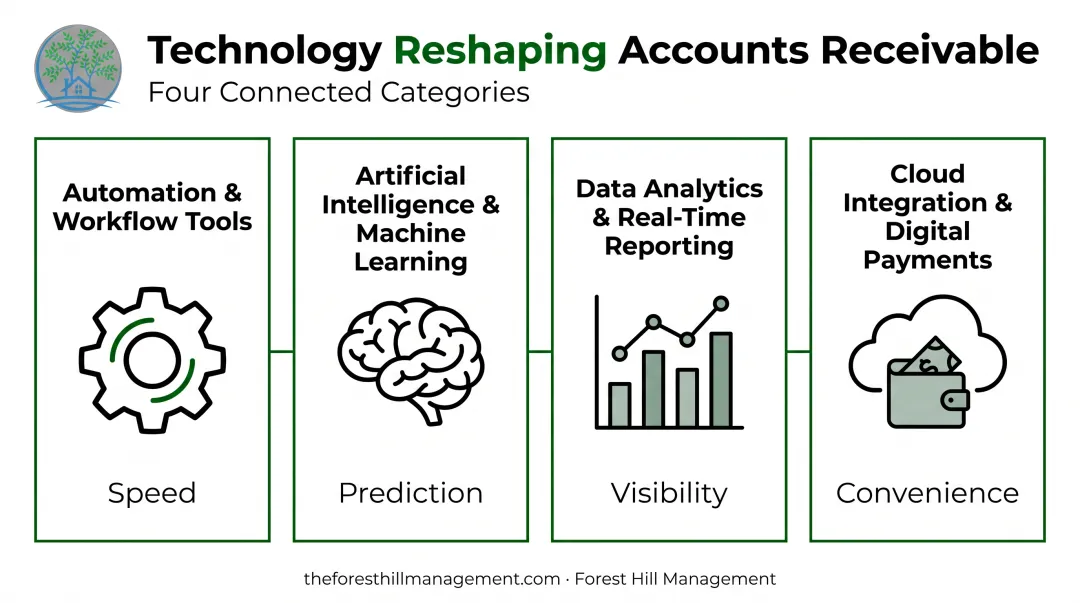
Here's a breakdown of the specific tools reshaping how businesses manage receivables today.
Automation and Workflow Tools
Automated invoicing, payment reminders, and dunning sequences eliminate the repetitive manual tasks that eat up AR staff time. Instead of someone manually emailing every past-due customer, the system triggers reminders on a set schedule based on account status.
The payoff is measurable: 87% of firms using automated AR reported that overall process speed improved, according to AFP's 2024 research. Fewer manual touches mean fewer bottlenecks between invoice and payment.
Artificial Intelligence and Machine Learning
AI has become a working tool inside finance departments. Gartner's 2024 survey of 121 finance leaders found that 58% of finance functions used AI in 2024, up 21 percentage points from the prior year.
In AR specifically, teams use AI to:
- Predict payment timelines based on historical customer behavior
- Flag at-risk accounts before they become seriously delinquent
- Power chatbots and virtual assistants that answer routine billing questions
- Support basic negotiation of payment plans without human intervention
Among finance teams using AI, 44% applied it to intelligent process automation and 39% to anomaly or error detection, both directly relevant to catching AR issues before they snowball.
Data Analytics and Real-Time Reporting
AR aging reports and DSO dashboards give finance teams instant visibility into which accounts need attention right now, not at month-end close.
A PYMNTS survey of 100 U.S. CFOs at firms with $250M+ revenue found that organizations automating more than half of AR saw a 32% DSO reduction (roughly 19 days). 60% of CFOs at highly automated firms pointed to real-time updates as crucial to that improvement.
Predictive analytics takes this further by helping teams prioritize collection efforts on accounts most likely to pay with the right nudge, rather than spreading effort evenly across every past-due balance.
Cloud Integration and Digital Payment Portals
Cloud-based AR platforms integrate directly with ERP and CRM systems, eliminating the duplicate data entry that plagues siloed setups.
On the payment side, customer behavior has shifted hard toward digital channels. Federal Reserve research found digital wallet use among U.S. businesses grew 31% year over year to 62% in 2023, and a separate PYMNTS study found 58% of customers now pay bills online, with 42% using autopay.
Self-service payment portals with flexible options (ACH, card, digital wallets) meet customers where they already are, which shortens the gap between invoice and payment.
Key Benefits of Adopting AR Technology
The technologies above translate into concrete operational gains:
- Shortens payment cycles with automated reminders and real-time tracking, easing working-capital gaps
- Cuts duplicate payments, miscalculations, and lost invoices (63% of CFOs surveyed by PYMNTS tied automation to fewer invoicing errors)
- Creates built-in audit trails that make consumer-protection and data-privacy compliance easier to prove
- Reduces disputes through clear, consistent, multi-channel billing that builds trust
- Handles rising invoice volume without a matching increase in headcount
One healthcare provider case referenced by AFP makes the impact concrete: automation cut the 4.5 hours per day staff spent on remittance matching by 75%. That capacity goes back to exceptions, outreach, and portfolio work—not chasing paperwork.
Choosing the Right AR Technology and the Role of AI in Your Team
What Should Businesses Look for in AR Software?
Not all AR platforms solve the same problems. Evaluate options based on:
- Integration capability: Does it connect cleanly with your existing ERP and CRM systems?
- Scalability: Can it handle your invoice volume in two years, not just today?
- Compliance features: Does it support audit trails and evolving e-invoicing requirements?
- Ease of use: Will your staff and your customers actually adopt it without friction?
The "best" software depends heavily on business size. Smaller businesses often prioritize affordability and simplicity, while larger portfolio holders need deeper analytics and multi-system integration. There's no universal answer, only the right fit for your volume and complexity.
Will AI Replace Accounts Receivable Roles?
Short answer: no. AI works best as a tool that augments AR staff rather than replacing them.
McKinsey's 2025 survey of 102 CFOs found finance professionals in functions with strong AI adoption spent 20-30% less time crunching data, redirecting that time toward strategic work instead. Those hours go back into higher-value work across the team.
AI handles the repetitive stuff well: data entry, reminder sequences, basic remittance matching. It doesn't handle:
- Complex payment disputes requiring judgment
- Sensitive customer conversations that need empathy
- Compliance decisions with legal consequences
Human oversight remains essential in these areas. No algorithm can fully replace a person navigating a difficult conversation with a customer facing financial hardship.
.webp)
When to Partner with a Professional Receivables Management Company
Strong internal AR technology solves a lot of problems. It doesn't solve all of them.
Accounts that drift significantly past due often need dedicated, specialized follow-up that internal teams simply aren't built to sustain. Aged accounts demand different persistence, expertise, and regulatory care than day-to-day collections.
This is where a firm like Forest Hill Management fits in. As a receivables management organization, Forest Hill Management combines technology-driven account tracking with a personalized, compliant approach to resolving past-due balances. Its capabilities include:
- A secure online payment portal for consumers to manage balances directly
- Flexible, customized payment plans designed to fit individual financial circumstances
- Documented dispute resolution and debt verification processes
- Operational adherence to FDCPA and CFPB regulatory frameworks
Partnering with an experienced receivables firm lets internal AR teams stay focused on current billing and active cash flow, while aged accounts get handled by specialists who work these cases every day. That support sits alongside internal AR technology and takes over where automation's return on effort starts to taper off.
Frequently Asked Questions
Who owns accounts receivable?
AR is generally owned jointly by finance/accounting and credit management teams, though execution often involves sales and billing staff. Outsourced partners frequently manage aged or delinquent accounts once internal follow-up reaches its limits.
What is the best accounts receivable software?
There's no single best option. It depends on business size, integration needs, and budget. Categories include automation platforms, ERP-integrated tools, and cloud AR suites, each suited to different operational scales.
Will AI replace accounts receivable roles?
No. AI automates repetitive tasks like data entry and reminders, but human oversight remains critical for negotiation, complex disputes, and compliance decisions.
How does automation reduce Days Sales Outstanding (DSO)?
Automated reminders, real-time account tracking, and faster invoice delivery all shorten the payment cycle. Firms using automation average 40 days DSO versus 47 days for those without it.
Is accounts receivable technology suitable for small businesses?
Yes. Scalable, affordable AR tools exist specifically for smaller operations and often deliver a strong return by cutting manual workload without requiring a large budget.
What is the difference between AR automation and outsourcing to a collections partner?
Automation streamlines internal processes like invoicing and reminders. Outsourcing hands off aged or complex accounts entirely to a dedicated receivables management firm, freeing internal teams to focus on current billing.