-p-500%20(1).png)
California Debt Collection Statute of Limitations: Complete Guide
Need Help Reviewing Your Account?
Contact UsA collector calls about a credit card you stopped paying four years ago. Is it too late for them to sue? Maybe — but the answer depends on more than the calendar.
California's statute of limitations sets a deadline for filing a lawsuit on a debt. That deadline shifts based on the type of account, when it accrued, whether a payment or written promise reset the clock, and whether a court already entered judgment.
Many people assume one four-year rule covers every debt, then assume an old account is worthless to collect or safe to ignore. Neither assumption holds up. A debt can be too old to sue over yet still show up on a credit report, still generate collection calls, or still turn into a judgment if a summons goes unanswered.
This guide covers how to identify the relevant date for your account, avoid an unnecessary default judgment, request documentation, and weigh your options — without assuming every old California debt works the same way.
Key Takeaways
- California generally allows four years to sue on written contracts and open accounts; oral debts, notes, and judgments differ.
- The limitations clock turns on accrual, default, last payment, or a written promise—not the first collector call.
- Time-barred debt can still be reported and collected outside court.
- Confirm legal status before you pay, sign, or respond to a summons on old debt.
What Is the California Debt Collection Statute of Limitations?
A statute of limitations is a deadline for filing a lawsuit. Nothing more. It doesn't determine whether you legally owe money, and it's a separate concept from how long an account can appear on your credit report.
Three Different Clocks, Three Different Purposes
- Lawsuit deadline — the window a creditor or collector has to sue you in court.
- Debt validity — whether the obligation still exists (it usually does, even after the lawsuit deadline passes).
- Credit reporting period — a federal timeline, generally seven years, governing when the account can appear on your report.
Under California Code of Civil Procedure Section 337, most actions on a written contract face a four-year limit. That section also covers certain book accounts and accounts stated in writing. Obligations without a written contract typically fall under a two-year deadline instead.
Common Debt Types and Their Deadlines
Treat this table as a starting point, not a substitute for reviewing your actual documents.
A court judgment is legally distinct from the original account. Once entered, a California judgment generally stays enforceable for 10 years, with renewal options available to the creditor.
A judgment's age doesn't map onto the original debt's four-year (or two-year) deadline. They're calculated separately.
Why "Last Payment Date" Isn't the Whole Story
Two accounts, each with an identical last payment three years ago, can sit in completely different legal positions:
- Account A: no lawsuit, no written agreement since — likely still within the four-year window.
- Account B: same last payment, but the creditor already sued and won a judgment — now governed by the 10-year judgment clock instead.
Only a California attorney reviewing your specific account history and documents can determine whether a claim against you is actually time-barred. This framework helps you ask the right questions, not substitute for that review.
When Does the Clock Start, Pause, or Restart?
"Accrual" simply means the date the clock starts ticking. For many contract debts, that's the date of breach: often a missed payment, a default, or an acceleration clause taking effect.
For certain accounts stated or book accounts, it may instead run from the last item on the account. Don't assume a collector's first phone call is the accrual date. It usually isn't.
Build a Timeline Before You Assume Anything
Gather these before drawing conclusions about your deadline:
- Account statements showing the last activity
- Payment confirmations or bank records
- Collection letters and account-transfer notices
- Any settlement offers you received or signed
- Court records, if a lawsuit was ever filed
These documents establish actual dates, not memory, and not what a caller claims.
Tolling Pauses the Clock; Revival Can Restart It
Collectors sometimes blur these two ideas:
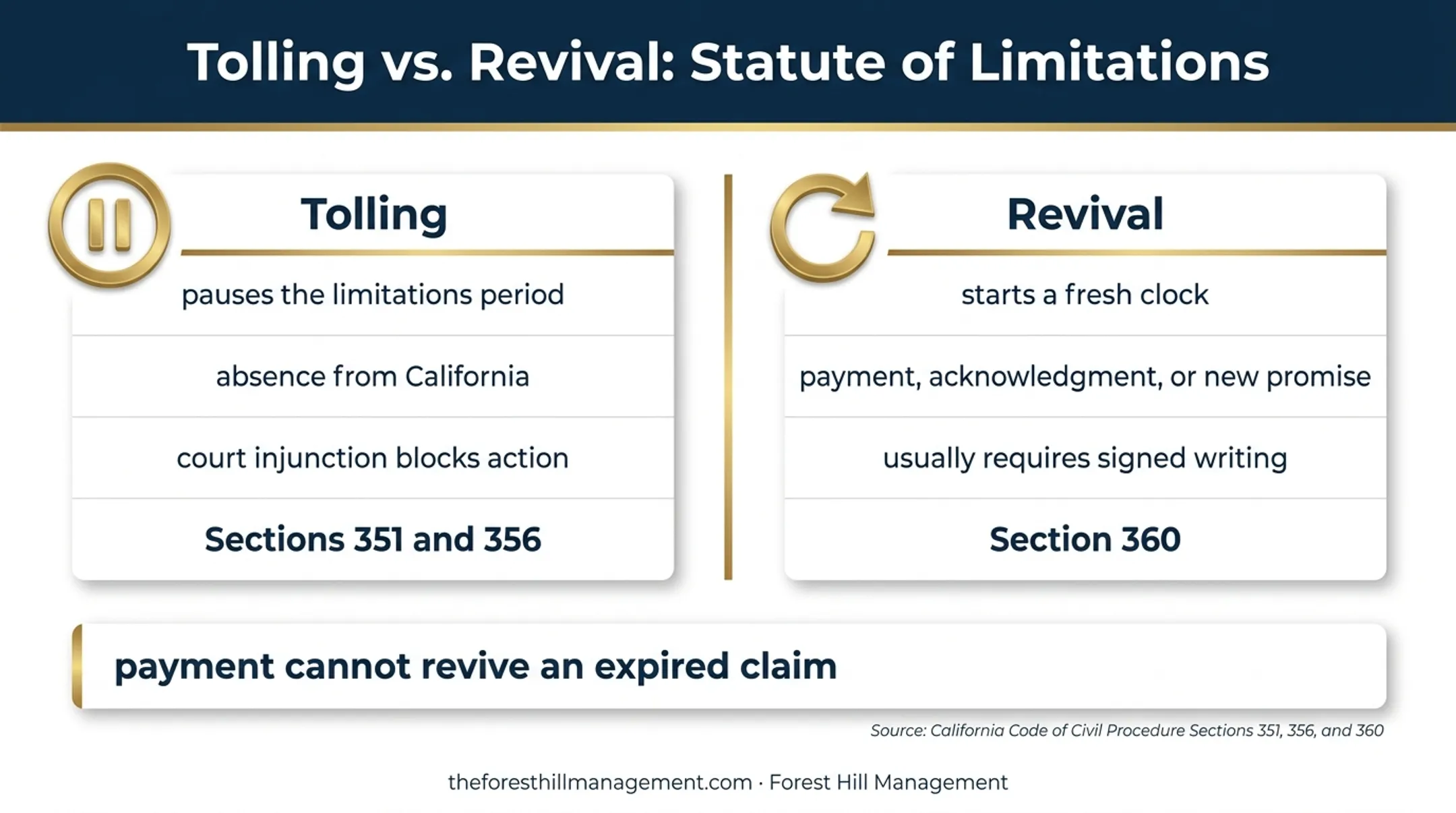
- Tolling pauses the limitations period under specific legal circumstances
- Revival or restarting starts a fresh clock after a later qualifying event
Tolling can apply under California Code of Civil Procedure Section 351 when a debtor is absent from California, or under Section 356 when a court injunction blocks the action. Revival falls under Section 360 and usually follows a payment, written acknowledgment, or new promise.
Section 360 generally requires a signed writing to create a new or continuing promise. One notable exception: a payment on a promissory note can restart an unexpired period without a separate signed writing. Payment alone cannot revive a claim that's already expired, so whether the period has run out controls the outcome.
A common myth claims any payment automatically resets every California debt's clock. That's not accurate. The real effect depends on the debt type, whether the period already ran out, and what documentation exists.
Situations That Require Document Review, Not Guesswork
- Written repayment plans or settlement agreements
- Signed promises to pay
- Bankruptcy filings (may pause creditor action)
- Extended absence from California
- Prior lawsuits or account transfers
If a collector says the statute is about to expire so you should pay now, don't take that at face value. Request written account information first, and talk to a legal professional if the stakes justify it. Signing something or paying before you understand the consequences can permanently change your legal position.
What Happens When a Debt Becomes Time-Barred?
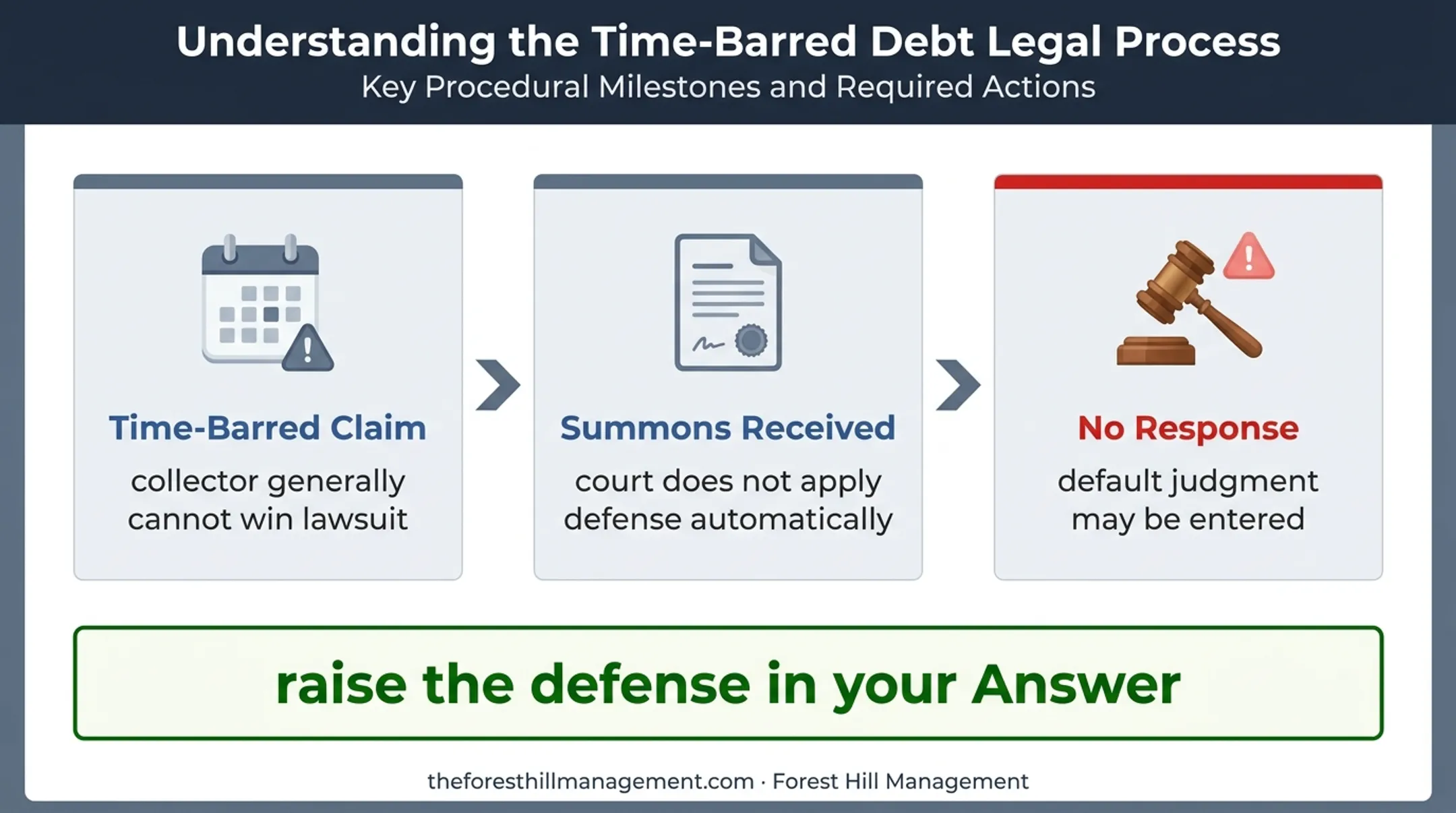
A time-barred debt means a collector generally can't win a lawsuit over it. The debt does not disappear, and collection contact does not have to stop. CFPB guidance confirms collectors may still seek payment on an old debt through calls and letters, as long as they don't misrepresent whether it's legally enforceable.
If You're Sued, You Must Respond — Every Time
Here's where people get tripped up: courts don't automatically apply the statute of limitations for you. If a collector sues on a time-barred debt and you don't respond, the court can still enter a default judgment against you. The defense has to be raised, typically in your Answer, or you risk losing regardless of how old the debt is.
If you receive a summons:
- Read it carefully to find the response deadline (often 30 calendar days from service in California).
- Note the plaintiff and case number to confirm which account it concerns.
- Contact a California legal professional promptly if you're unsure how to answer or whether a defense applies.
- File your response before the deadline. Missing it hands the collector an easy win.
A Practical Response Sequence for Any Old-Debt Contact
- Preserve the letter or message exactly as received
- Request validation or written account information
- Compare the claimed balance and dates against your own records
- Avoid confirming details or making admissions you can't verify
Watch for Prohibited Collector Conduct
Both the federal Fair Debt Collection Practices Act and California's Rosenthal Fair Debt Collection Practices Act restrict certain behavior, including:
- Misleading statements about a debt's legal enforceability
- Threatening a lawsuit the collector doesn't intend to (or legally can't) file
- Harassment or unreasonably frequent contact
- Attempting to collect amounts not authorized by the original agreement or law
Those limits also shape how you should handle a real account contact. If you receive a legitimate communication from Forest Hill Management, verify the message first, then use the company's official channels to request account details or discuss resolution options: (888) 471-0109 or info@foresthillmanagement.com.
Credit Reporting and Other Collection Rules
The California lawsuit deadline and the federal credit-reporting period are separate clocks. Mixing them up leads to bad decisions.
Under the Fair Credit Reporting Act, most collection or charge-off accounts drop off your credit report seven years after the delinquency that led to collection. That clock does not start from a collector's first call or from any lawsuit filing.
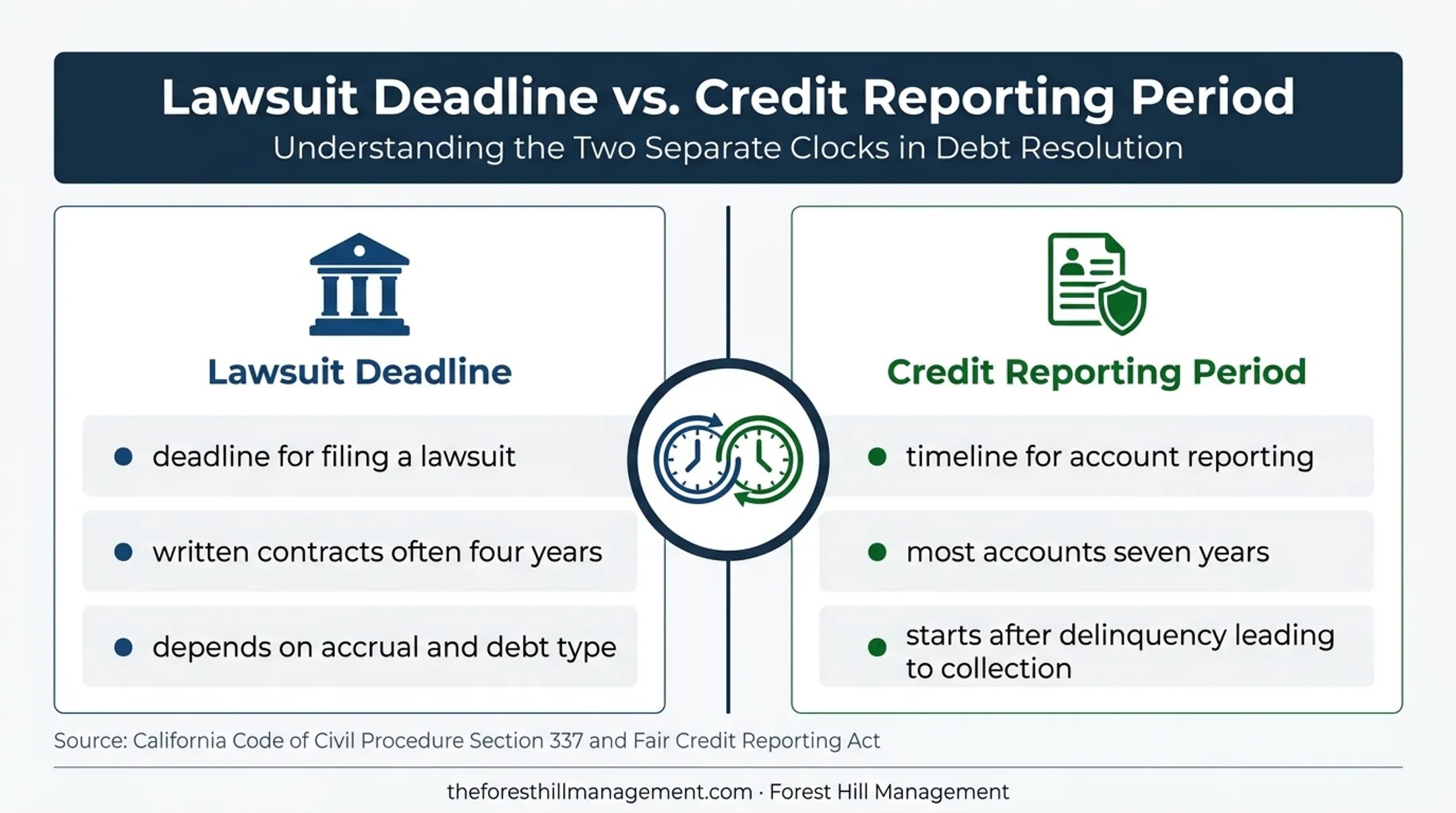
The seven-year figure is about reporting eligibility, not enforceability. A debt can fall off your report and remain legally collectible, or stay reportable after its lawsuit deadline has passed.
California's Required Time-Barred Notices
California law requires collectors to include specific written disclosures in their first communication after a debt becomes time-barred. The exact language depends on whether the debt can still be reported to credit bureaus.
A letter stating the collector won't sue you because of the debt's age is a strong signal the account is time-barred. Confirm that claim against your own timeline before you rely on it.
Collection Contact vs. Legal Remedies
Don't confuse a collection call with a legal action. Tools such as the ones below generally require a valid court judgment or other legal authority already in hand:
- Wage garnishment
- Bank levies
- Property liens
- Repossession
A collector who threatens these steps without a judgment is getting ahead of what the law allows.
Disputes Fix Errors — Not Legal Status
You can dispute inaccurate information on your credit report or in a collector's records. But a dispute isn't a tool for erasing a valid debt or determining whether it's time-barred. Those are separate questions.
How Should You Respond to a California Collection Notice or Lawsuit?
Whether you received a collection letter or a California court summons, a clear step-by-step response protects you better than guessing.
Step-by-Step Checklist
- Confirm the creditor and account — match names, account numbers, and balances against your own records.
- Request written verification where applicable, especially if the account changed hands between collectors.
- Review last payment and default records to establish your own accrual timeline.
- Preserve every communication — letters, emails, voicemail details, call logs.
- Compare the claim against your credit reports and any court records tied to the account.
Choosing Your Next Move
Your best option depends on accuracy, affordability, limitations status, and litigation risk:
- Dispute the debt if details don't match your records
- Negotiate a settlement if it's valid and you can afford a lump sum
- Request a payment plan if you'd rather pay over time
- Consult counsel if the amount or stakes justify it
- Hold off on payment while you verify the debt, if details look wrong or incomplete
Never assume a collector won't sue simply because the account feels old. Filing suit on a time-barred claim does happen, and raising that defense becomes your job, not the court's.
Red Flags That Need Legal Help Fast
- An actual court summons or complaint — California typically allows 30 days after service to respond
- Threatened garnishment or bank levy
- Signs of identity theft on the account
- A debt previously discharged in bankruptcy
- A collector refusing to provide basic account information
- A debt that appears to be past its limitations period
Whatever path you choose, track every contact in writing: dates, names, phone numbers, letters, emails, payment proposals, and account numbers.
Avoid sharing sensitive financial information with unsolicited messages or unverified callers. Legitimate collectors can confirm account details without demanding sensitive data upfront.
Frequently Asked Questions
What is the California debt collection statute of limitations?
California generally gives creditors four years to sue on written contracts and certain accounts, though oral debts typically carry a two-year deadline. Confirm current law with a California attorney before relying on any single number for your account.
Should I pay a debt that's past the California statute of limitations?
That's a personal financial decision with real legal consequences. Confirm whether the debt is actually time-barred first, since a payment or new written agreement can sometimes affect its legal status going forward.
How likely is a collection agency to sue to collect a debt in California?
Lawsuit risk depends on the balance, available documentation, the account's age, its limitations status, and the creditor's practices. No matter how unlikely a suit seems, always respond to any summons you receive.
What happens if you don't pay debt collections in California?
Expect continued collection attempts and possible credit-report effects, plus lawsuit risk if the debt is still within its limitations period. Garnishment or other enforcement generally requires a valid court judgment first. It isn't automatic.
Can I dispute a debt that was sold to a collection agency in California?
Yes. You can dispute inaccurate or unverified information and request validation from the account's current owner. Selling a debt to a new collector doesn't by itself determine whether the balance is valid or time-barred.
What happens to unpaid credit card debt after 7 years in California?
Seven years typically refers to the credit-reporting period, not California's lawsuit deadline. They're separate clocks. The debt doesn't automatically disappear or become legally unenforceable just because seven years have passed.