-p-500%20(1).png)
CFPB Credit Reporting Data Disclosure: What You Need to Know
Need Help Reviewing Your Account?
Contact UsMost people never look at their credit file until something goes wrong. Maybe a loan application gets denied, or a debt collector calls about an account you don't recognize. That's usually the moment consumers realize they have almost no idea what's actually sitting inside their credit reports.
CFPB credit reporting data disclosure refers to your ability, under the Fair Credit Reporting Act (FCRA), to find out what a consumer reporting agency knows about you, where that information came from, and how it might be shared. This matters because the stakes are real. An FTC study found that 1 in 5 consumers had an error on at least one of their three major credit reports, and 5% had mistakes serious enough to affect loan or insurance terms.
This article breaks down your current FCRA rights, recent CFPB guidance, and proposed rules that may (or may not) still be active.
Key Takeaways
- Request the information in your file and its sources once you're properly identified.
- Names, addresses, and phone numbers matter: mismatched identifiers cause "mixed file" errors.
- Disputes target inaccurate or incomplete data, not accurate information you simply dislike.
- Some CFPB proposals on data sharing have been withdrawn; always verify current status before relying on them.
What Does CFPB Credit Reporting Data Disclosure Mean?
Your disclosure rights turn on a few terms the CFPB and FCRA use in a precise way.
- Consumer report: Information a consumer reporting agency (CRA) communicates to third parties for eligibility decisions like credit, employment, or insurance.
- Consumer reporting agency: A company that regularly assembles or evaluates consumer information to produce those reports.
- Consumer file: Everything the CRA has recorded about you, regardless of how it's stored.
- Furnisher: The bank, lender, or collector that supplies data to the CRA in the first place.
- Credit score disclosure: A separate request specifically for your numerical score, not your full file.
That last distinction trips a lot of people up. Requesting your file doesn't automatically hand you a credit score — under FCRA Section 609(a), a CRA must tell you that a score is available separately if you didn't ask for one directly.
The Legal Backbone: Section 609(a)
FCRA Section 609(a) requires a CRA to "clearly and accurately disclose" all information in your file at the time of your request, plus the sources of that information, once you've properly identified yourself. The CFPB's point is simple: you can't fix bad data if you can't see it or trace where it came from.
Where the Rulemaking Stands Right Now
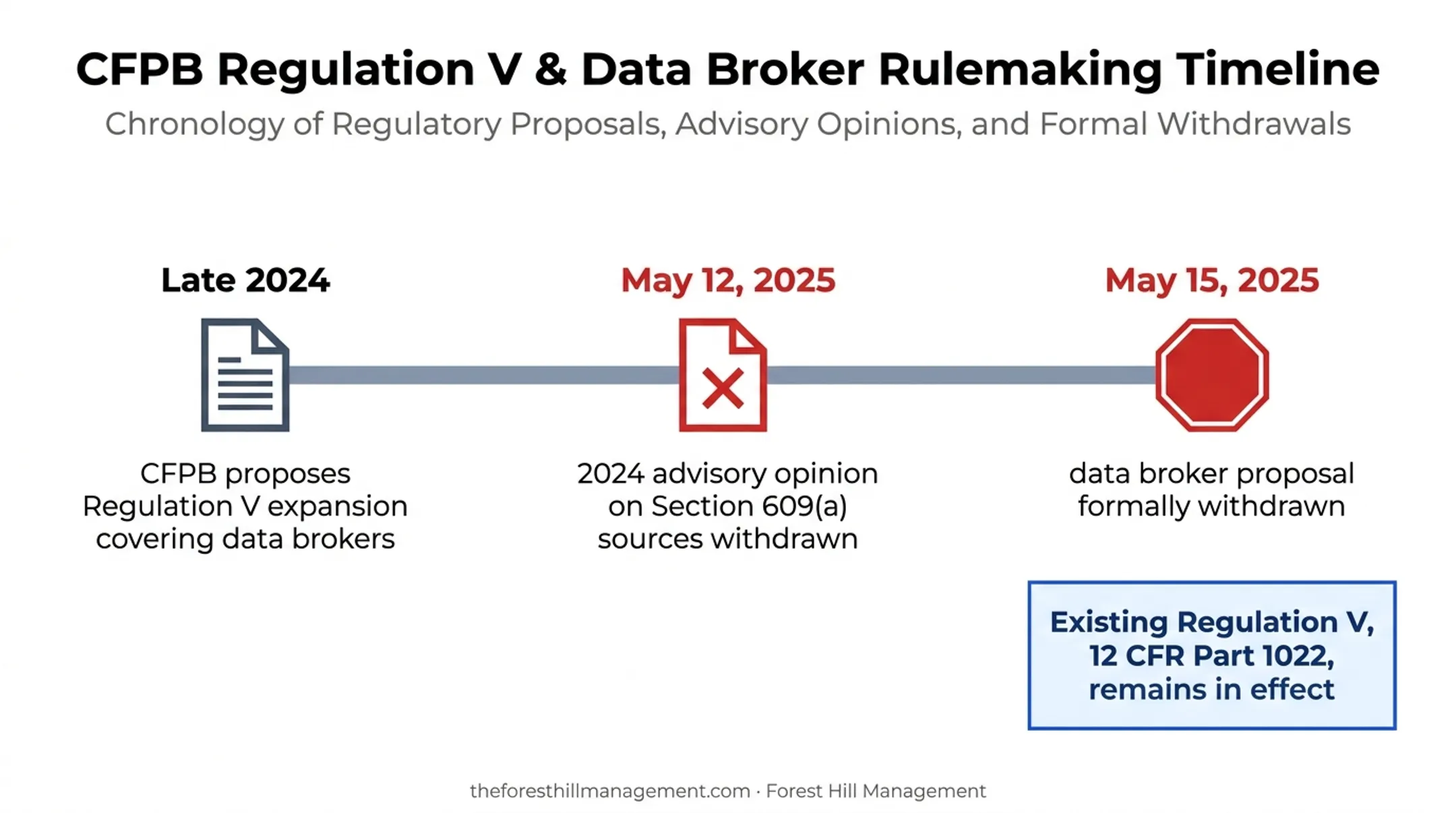
Here's where things get murkier. In late 2024, the CFPB proposed expanding Regulation V to cover data brokers more directly. That proposal was formally withdrawn on May 15, 2025, and the agency said any future rulemaking would need a fresh proposal.
Separately, a 2024 CFPB advisory opinion interpreting "sources" under Section 609(a) was withdrawn on May 12, 2025.
These were withdrawn proposals and guidance documents, not finalized law. Existing Regulation V (12 CFR Part 1022) remains in effect. Check the CFPB's regulation page directly if you're relying on current rulemaking status for anything time-sensitive.
What Information and Sources May Need to Be Disclosed?
A full file disclosure is bigger than the summary report most people see when they pull a free credit report. Section 609(a) covers all information in your file at the time of the request, not just an abbreviated version.
That includes:
- Account information, payment history, and public-record entries
- Collection accounts and their status
- Inquiries from the past year (or two years for employment purposes)
- Recipients who received your report recently
Sources Can Include More Than the Original Creditor
The statute requires disclosure of the "sources of the information," with a narrow exception for sources used only to prepare an investigative consumer report.
A now-withdrawn 2024 CFPB opinion had argued this should include intermediary vendors, not just the original furnisher. Treat that interpretation as historical rather than current binding guidance. The underlying statutory requirement to disclose sources still stands.
Personal Identifiers and Mixed Files
Names, addresses, phone numbers, and identification numbers matter for accuracy. Companies handling consumer accounts, including receivables-management firms, collect this contact and identity data to confirm they have the right person, not someone with a similar name or outdated details.
Mixed files happen when another person's account lands in your file because of overlapping identifiers. It is one of the more common and frustrating errors consumers encounter.
Important caveat: not every identifier gets treated identically across every type of disclosure. Format, timing, and what can be withheld or truncated (like the first five digits of a Social Security number) depend on the specific FCRA provision involved.
What Rights Do Consumers Have When Information Is Wrong?
You have the right to review your file and dispute anything that's inaccurate, incomplete, duplicated, outdated, or simply doesn't belong to you.
A Practical Dispute Sequence
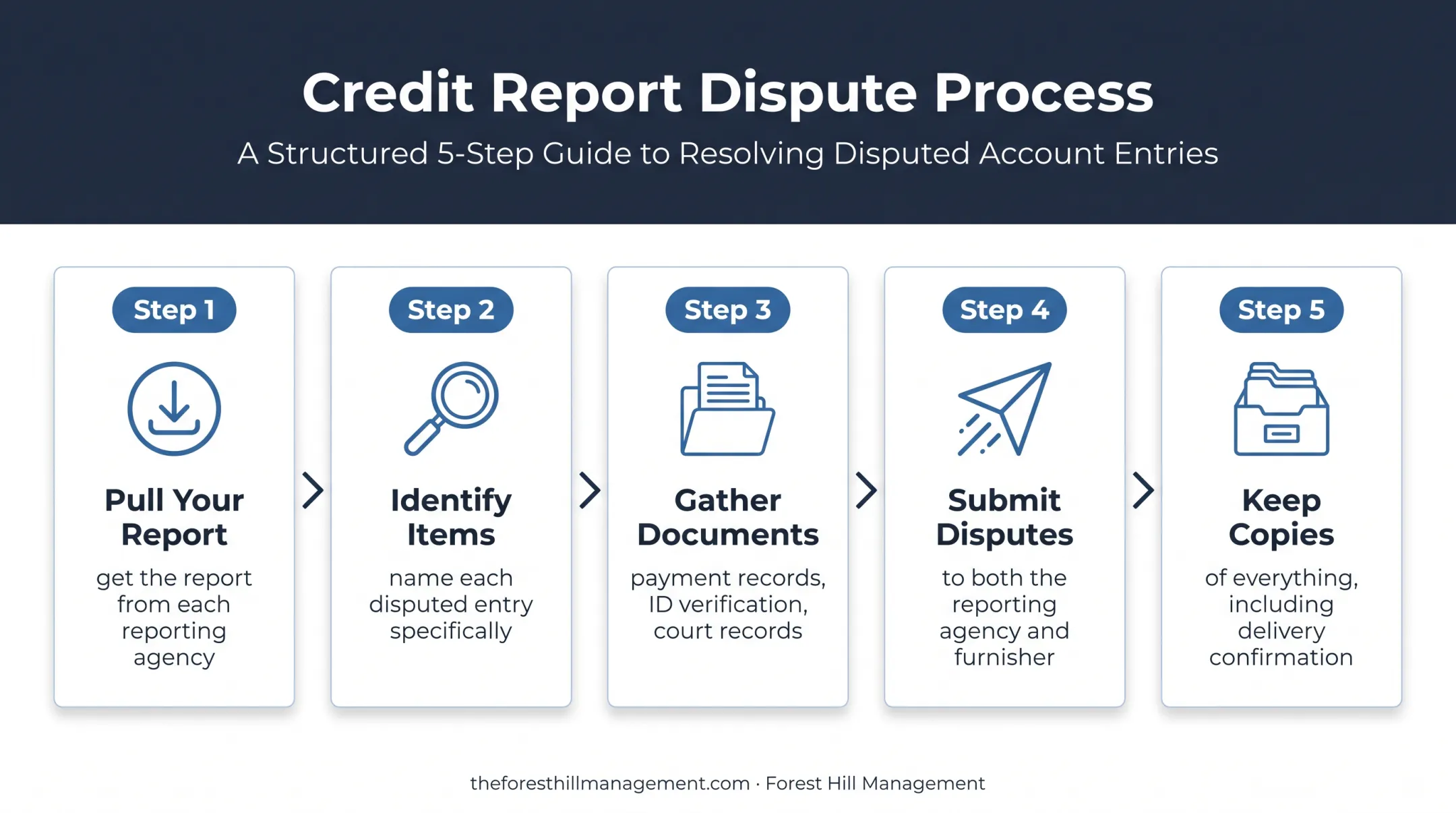
- Pull your report from each reporting agency holding the information.
- Identify each disputed item specifically. Vague disputes get vague investigations.
- Gather supporting documents: payment records, identity verification, court records, whatever proves your point.
- Submit disputes to both the reporting agency and the furnisher of the information.
- Keep copies of everything, including delivery confirmation.
A reasonable investigation means the credit reporting agency (CRA) and furnisher actually evaluate your specific allegation, not just re-check the same data they already had on file. That distinction matters: simply re-confirming existing records isn't the same as investigating a dispute.
What Can't Be Removed
Accurate, timely negative information generally cannot be deleted just because it's unflattering. A missed payment that actually happened stays on your report for the period the law allows. What can require correction or removal:
- Information that's unverifiable
- Data tied to the wrong consumer
- Items that are legally obsolete
- Entries lacking adequate supporting detail
If you're rebuilding after a rough patch, checking for these specific errors is a core early step. It's covered in more depth in our guide on rebuilding credit after collections.
If the Dispute Doesn't Resolve
If the dispute still isn't resolved, you can escalate through several established paths:
- Request the investigation results in writing
- Add a personal statement to your file
- File a complaint with the CFPB
- Consult a qualified attorney
None of these guarantee a specific outcome.
What Should Consumers and Businesses Do Next?
If you get an unexpected letter, call, or credit-report notification, don't panic, but don't ignore it either. For consumers, a quick checklist:
- Verify the sender through official contact channels, not a number or link the message itself provided
- Request account and reporting details in writing
- Review the relevant credit files for anything unfamiliar
- Dispute specific inaccuracies with the reporting agency and furnisher
- Monitor for signs of identity theft or unauthorized inquiries Freezes, fraud alerts, credit report requests, and disputes serve different purposes and aren't interchangeable:
- Permissible purpose documentation and disclosure recordkeeping
- Data minimization, source tracking, and accuracy procedures
- Dispute-handling workflows and access controls When an account is transferred for servicing, consumers may hear from a receivables-management company such as Forest Hill Management. If you get that kind of outreach, use verified contact information to request account details or ask how reporting information can be reviewed. That conversation does not replace a formal credit-bureau dispute, and it is not legal advice. Guides on verifying legitimate communications and what to expect when contacted about a transferred account can help you decide on next steps before you respond. If you ever suspect a communication isn't legitimate, request debt validation and report your concerns to the FTC or CFPB.

Frequently Asked Questions
Which three credit bureaus should I freeze?
Equifax, Experian, and TransUnion. Contact each one separately through its official website or verified phone line; freezing one doesn't automatically freeze the others.
What cannot be removed from your credit report?
Accurate, timely, and verifiable negative information can't be removed just because it's unfavorable. You can dispute errors, mixed-identity items, obsolete entries, and unverifiable data.
Can someone run my credit report without me knowing?
Only for permissible purposes under the FCRA, such as a credit application, account review, or employment screening. Some of these don't require advance notice. If you see an unfamiliar inquiry, dispute it and review your accounts closely.
What information must a credit reporting company disclose to me?
Everything in your file at the time of the request, plus the sources of that information, once you verify your identity. The process can differ based on the type of report or disclosure you request.
How do I dispute inaccurate information in my credit file?
Identify the specific error, gather supporting evidence, and submit disputes to both the credit reporting agency and the furnisher. Keep copies of everything, then review the investigation results when they arrive.