-p-500%20(1).png)
How to Create Effective Company Contingency Plans

Need Help Reviewing Your Account?
Contact UsIntroduction
A ransomware attack locks your systems at 2 a.m. Your biggest client cancels their contract without warning. A hurricane shuts down your only warehouse for three weeks.
None of these scenarios are hypothetical. They happen to well-run companies every day, often with zero warning.
Contingency planning sounds simple: write down what to do when something goes wrong. The gap between a plan that works and one that gathers dust comes down to specifics—how you identify risks, rank them, and turn them into steps a team can run under pressure.
In the U.S., cybercrime losses reported to the FBI’s Internet Crime Complaint Center (IC3) run into the billions each year, and many incidents hit businesses with little or no warning.
This guide covers how to build a contingency plan, what to prepare beforehand, what separates a working plan from a paperweight, common mistakes to avoid, and the plan types your business likely needs.
Key Takeaways
- A contingency plan is a proactive "Plan B" that keeps critical operations running when disruptions strike
- Strong plans start with risk assessment, rank threats by likelihood and severity, and set clear triggers
- Ownership, communication, and regular testing separate plans that work from those that fail under pressure
- Most failures trace back to vague triggers, missing leadership buy-in, or a plan nobody's touched in years
- Use several targeted plans—financial, IT, operational, HR—not one catch-all document
How to Create an Effective Company Contingency Plan
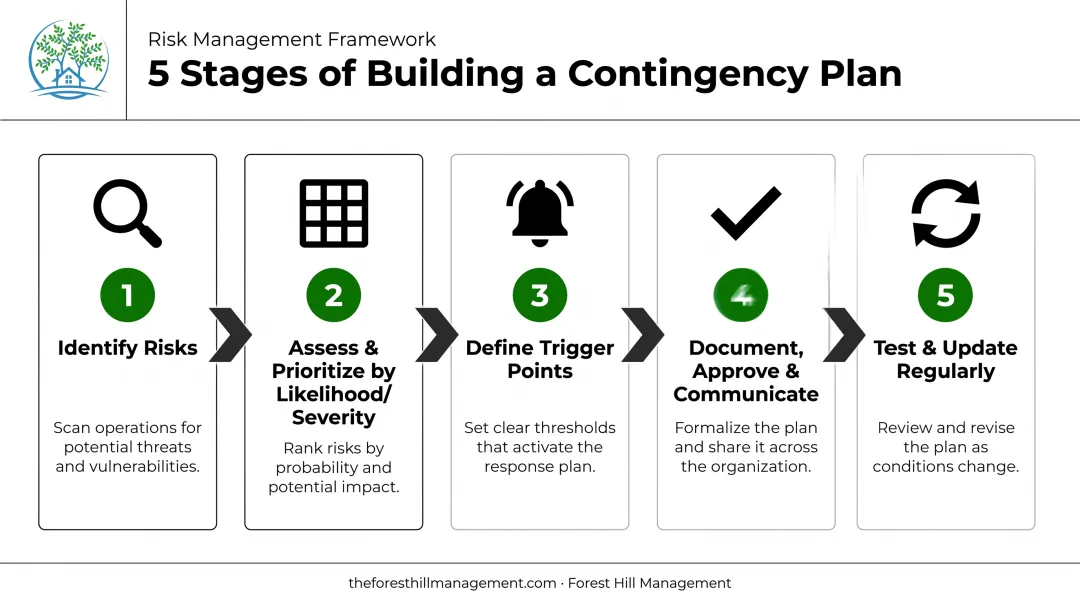
Building a plan that actually holds up during a crisis follows a specific sequence. Skip a step and the whole thing gets shakier.
Step 1: Identify Potential Risks Across the Business
Bring finance, operations, HR, and IT into the same room before writing a single procedure. Each department sees different blind spots: finance spots cash flow gaps, IT flags system vulnerabilities, HR notices succession gaps that nobody else would catch.
Brainstorm risks across categories:
- Natural disasters (fire, flood, severe weather)
- Cyberattacks and data breaches
- Financial shocks (delinquent accounts, sudden revenue loss)
- Supply chain disruptions
- Personnel loss (key employee departure, sudden unavailability)
Track everything in a shared risk register (even a basic spreadsheet works) so nothing falls through the cracks before prioritization.
Step 2: Assess and Prioritize Risks by Likelihood and Severity
Not every risk on your register deserves a full response plan. Score each one on a simple matrix: likelihood (high/medium/low) and potential business impact (high/medium/low). Risks landing in the high-high box get planned for first.
This is where a business impact analysis (BIA) earns its place. A BIA predicts the operational and financial consequences of a disruption and identifies which processes and revenue streams are mission-critical, according to Ready.gov's business impact framework.
It also flags financial exposure like regulatory fines, contractual penalties, or dependency risk tied to a single supplier.
The payoff: instead of guessing which systems matter most, you have data showing what needs protecting first and how much downtime each function can tolerate.
Step 3: Define Trigger Points and Map the Response
A trigger point is the measurable condition that activates your plan, not a gut feeling. Vague language like "if things get bad enough" leads to delayed, emotional decisions right when clarity matters most.
Realistic trigger examples:
- System downtime exceeding 4 hours activates the IT contingency plan
- 20% or more of staff unavailable (illness, weather, travel restrictions) activates the workforce continuity plan
- A key client representing 25%+ of revenue cancels or defaults, activating the financial contingency plan
Once triggers are set, map who does what using a RACI-style chart (Responsible, Accountable, Consulted, Informed) or a basic flowchart. Everyone should know their role before a crisis, not during one.
Step 4: Document, Approve, and Communicate the Plan
Write the plan in plain language. Include defined roles, an updated emergency contact list, and step-by-step recovery procedures anyone on the team could follow under pressure. Avoid burying critical steps in jargon or scattering them across five different documents.
Before finalizing, secure sign-off from leadership or the board. Teams often skip this step, and it's costly. Teams without documented authority hesitate to spend money or redirect staff during an actual emergency, even when the plan calls for it.
Once approved, distribute the plan to everyone with a role in it, not just department heads. A plan sitting in one manager's inbox helps no one when that manager is unreachable.
Step 5: Test, Review, and Update the Plan Regularly
A plan that's never been tested is a guess dressed up as a strategy. Run tabletop exercises or simulated drills at least annually, walking teams through their roles and responses without disrupting live operations.
Beyond the annual check-in, revisit the plan immediately after:
- Major restructuring or leadership turnover
- New office locations or facility changes
- Significant technology or vendor changes
Plans age fast. The contact list from eighteen months ago might still list a manager who left the company last spring.
When Do You Need a Contingency Plan?
Not every risk deserves its own dedicated plan. Overplanning burns time and resources on unlikely scenarios. Underplanning leaves real exposure unaddressed. The goal is matching planning effort to actual risk.
Common triggers for building a dedicated plan include:
- Critical system failure (servers, software, core infrastructure)
- Sudden loss of key personnel
- Supply chain disruption from a vendor or logistics partner
- Natural disasters affecting facilities or staff safety
- Cybersecurity incidents like ransomware or data breaches
- Loss of a major client or revenue source
Some businesses face more urgency than others. Companies with complex operations, tight margins, or heavy reliance on a handful of key clients, suppliers, or systems need plans sooner than smaller, diversified operations.
If one client generates a third of your revenue, you're carrying concentrated risk that deserves a written response.
Supply chain exposure makes the stakes concrete. McKinsey research found that companies face material disruptions lasting a month or longer every 3.7 years on average. A single prolonged shock can erase 30% to 50% of a year's EBITDA in many industries. Over a decade, that frequency is closer to expected than exceptional.
Key Elements Every Contingency Plan Must Include
A plan's effectiveness depends less on which risks it lists and more on whether it includes these five building blocks. Miss one, and the plan tends to break down exactly when it's needed most.
Risk Assessment and Business Impact Analysis
A thorough assessment identifies which operations and revenue streams are mission-critical if disrupted. Without it, teams waste effort protecting low-priority systems while critical ones stay exposed.
Clear Roles, Responsibilities, and Communication Channels
Assign ownership before a crisis, not during one. Every person named in the plan should know exactly what they own and who they report to—before anyone has to ask.
Defined, Measurable Trigger Points
Objective indicators—hours of downtime, percentage of revenue lost, or staff unavailability thresholds—prevent delayed or emotional decision-making. Clear triggers remove the guesswork from "is this bad enough to act?"
Backup Resources and Alternative Procedures
Backup vendors, systems, and funding sources should already be identified and ready to activate, not sourced while the crisis is unfolding. That might mean a secondary supplier contract, a cash reserve line, or a pre-vetted receivables management partner who can step in if collections stall.
Testing and Maintenance Schedule
Untested plans create false confidence. Outdated contact lists, stale vendor agreements, and old recovery steps surface only under pressure. Review the plan at least annually, and again after any significant organizational change.
Build all five into the plan before you need it. Each gap you leave becomes a decision you will have to improvise under pressure.
.webp)
Common Mistakes When Building a Contingency Plan
Even well-intentioned teams fall into the same traps repeatedly. Watch for these four:
- Skipping risk prioritization. Trying to plan for every conceivable scenario spreads resources thin. Focus on high-likelihood, high-severity events first, using the BIA from Step 2 to guide priorities.
- Failing to define clear trigger points. Without measurable activation criteria, teams delay action or react emotionally instead of decisively. "We'll know it when we see it" isn't a plan.
- Writing it once and never touching it again. Staff turnover, systems get upgraded, offices relocate. A plan written two years ago may not reflect who's even on the team today.
- Not securing leadership buy-in. Teams without executive authority hesitate to spend money or redirect resources when a crisis hits, even when the plan explicitly calls for it.
One survey of accounting firms found that among those with a formal continuity plan, nearly half had never tested it. Until a real crisis hit, the plan's viability was pure guesswork.
Types of Contingency Plans Businesses Should Prepare
Most organizations need several targeted plans rather than one broad document. Different risks require different response teams, different backup resources, and different procedures. A single generic plan rarely covers all of it well.
Financial and Receivables Contingency Plan
Cash flow disruptions, whether from delinquent accounts, slow-paying clients, or a broader economic downturn, require a dedicated plan for managing receivables risk. That plan should define:
- Collection timelines for past-due accounts
- Escalation procedures when payments stall
- Alternative funding sources if cash flow tightens faster than expected
Partnering with an experienced receivables management firm like Forest Hill Management gives businesses a resource to activate the moment this plan kicks in. Rather than building an internal collections function mid-crisis, companies can rely on a firm set up to recover past-due accounts, manage payment plans, and stabilize cash flow under FDCPA and CFPB standards.
IT and Cybersecurity Contingency Plan
Data breaches, ransomware, and system outages call for backup systems and incident-response steps that are ready the moment an incident is detected. In Uptime Institute's 2024 survey, 54% of organizations said their most recent significant outage cost over $100,000, and one in five reported losses exceeding $1 million.
A solid IT contingency plan should be in place before an attack, not after:
- Defined recovery time objectives
- Offsite backups that are tested regularly
- A named incident-response lead
Natural Disaster / Facilities Contingency Plan
Fire, flood, and severe weather put staff safety and facility access at risk. A facilities plan should spell out:
- Staff safety protocols and shelter-in-place resources
- Evacuation routes and emergency contact trees
- When remote work replaces in-office operations, plus alternate work locations
Supply Chain Contingency Plan
Backup suppliers and logistics reroutes limit downtime when deliveries stop. Prepare before a disruption hits:
- Identify critical suppliers and flag single points of failure
- Pre-negotiate terms with at least one alternate vendor per critical input
.webp)
Waiting until a shipment fails to start that search costs weeks you don't have.
Frequently Asked Questions
What is a company contingency plan?
A company contingency plan is a proactive strategy outlining the specific steps a business takes to maintain operations during an unexpected disruption. It covers who's responsible and what resources get activated.
What are the 5 steps of contingency planning?
Identify risks. Assess and prioritize them by likelihood and severity. Build a response plan with clear trigger points. Secure leadership buy-in and communicate the plan. Test and update it regularly.
Can you give me an example of a contingency plan?
An IT contingency plan for a data breach might define a 4-hour response trigger, a named incident lead, and backup data systems. A financial contingency plan might outline steps for a sudden spike in delinquent accounts, including when to bring in a receivables management partner.
What is the difference between a contingency plan and a business continuity plan?
A contingency plan addresses a specific incident, like a data breach or supplier failure. A business continuity plan takes a broader approach, covering how the entire organization keeps functioning across many potential disruptions.
How often should a contingency plan be reviewed?
Review contingency plans at least annually, and update them immediately after major changes like restructuring, leadership turnover, or a new facility location.
Who is responsible for creating a contingency plan?
Creating a contingency plan typically involves cross-functional leadership from finance, operations, HR, and IT, with final sign-off from executive leadership or the board.