-p-500%20(1).png)
Credit Card Debt Settlement vs. Bankruptcy: Choose the Best Option
Need Help Reviewing Your Account?
Contact UsMillions of Americans are staring down credit card statements they can't fully pay off, wondering whether to negotiate a settlement or file for bankruptcy. Both paths lead to relief, but they get there in very different ways.
The average U.S. cardholder carried $5,312 in credit card balances at the end of 2023, according to the Consumer Financial Protection Bureau's 2025 market report. For many households, that balance has grown unmanageable alongside rising interest rates and everyday expenses.
This decision affects more than your bank balance. It shapes how fast your credit recovers, whether creditors can sue you tomorrow, and how soon you can qualify for a car loan or mortgage again. Below, we break down both options so you can decide which one actually fits your situation.
Key Takeaways
- Debt settlement can cut what you owe, but creditors are not legally required to accept any offer
- Bankruptcy can discharge or restructure debt under court oversight and stops collections right away
- Credit damage, tax treatment, and timelines differ enough that neither path wins for every situation
- Let total debt, income stability, and how fast you need protection decide which option fits
Credit Card Debt Settlement vs. Bankruptcy: Quick Comparison
Here's how the two options stack up across the factors that matter most:
The biggest difference is certainty. Bankruptcy guarantees a legal outcome. Settlement depends entirely on whether creditors say yes.
What Is Credit Card Debt Settlement?
Debt settlement means negotiating with a creditor to accept less than the full balance you owe, usually through a lump sum or a structured payment plan. It appeals to people who want to avoid court records, public filings, and the long-term stigma some associate with bankruptcy.
Core benefits include:
- A lower total payoff amount than the original balance
- Faster resolution than years of minimum payments that barely touch the principal
- No public court record tied to your name
Settlement can be pursued on your own, directly with each creditor, or through a receivables management firm. Some firms, such as Forest Hill Management, service accounts already placed with them by an original creditor. They offer customized payment plans and settlement options for that specific balance, rather than negotiating every card you hold.
Who Should Consider Debt Settlement
Debt settlement works best for consumers who have:
- Several thousand dollars in unsecured credit card debt
- Steady income, but no realistic path to paying the full balance
- Debt too small to justify the long-term credit hit of bankruptcy
Example scenarios: Someone juggling three maxed-out cards after a rough year, or a household combining medical bills with credit card debt but still bringing home a paycheck every two weeks.
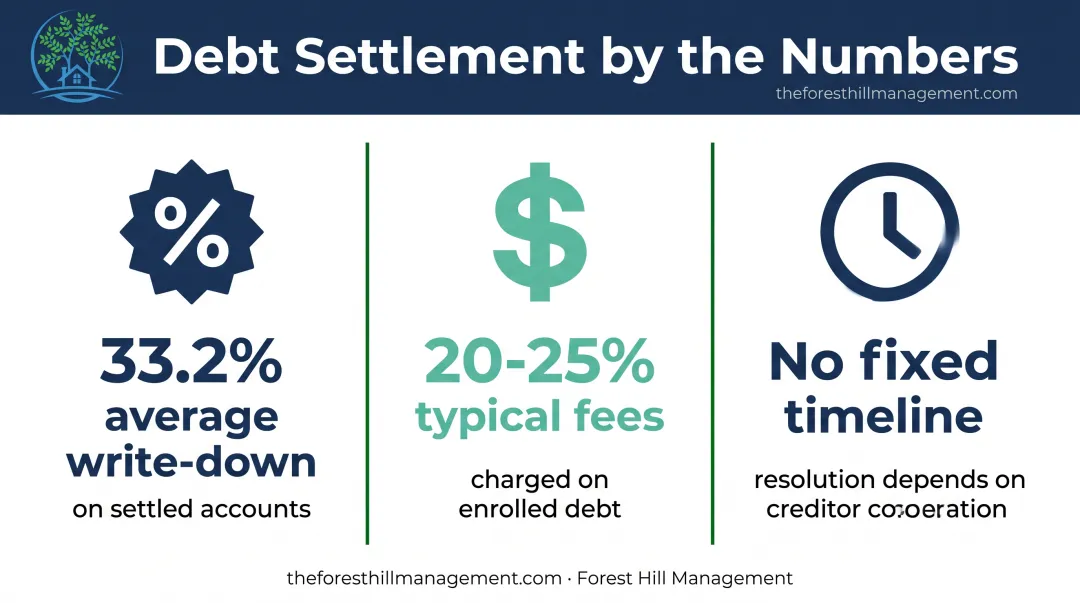
Results vary widely, but a 2020 American Fair Credit Council study found an average 33.2% write-down on accounts that successfully settled, after fees (AFCC, 2020). That figure applies only to settled accounts. Not every enrolled debt gets resolved, since some creditors simply refuse to negotiate.
What Is Bankruptcy?
Bankruptcy is a federal, court-supervised process for discharging or restructuring debt. For individuals, two chapters matter most:
- Chapter 7 (liquidation): Wipes out qualifying unsecured debt, sometimes requiring liquidation of non-exempt assets
- Chapter 13 (repayment plan): Restructures debt into a court-approved plan lasting 3-5 years while protecting assets
Core benefits include:
- An automatic stay that stops collection calls, lawsuits, and garnishments the moment you file
- A legally guaranteed resolution, not dependent on a creditor's willingness to negotiate
- Discharge of qualifying debt in Chapter 7, often within months
Chapter 7 moves fast but may put certain assets at risk. Chapter 13 protects those assets but demands years of committed payments.
Who Should Consider Bankruptcy
Bankruptcy fits best when:
- Unsecured debt is overwhelming relative to income, with no realistic settlement path
- You're already facing lawsuits, wage garnishment, or foreclosure
- A sudden event (job loss or a major medical crisis) pushed debt beyond recovery
Nationally, Chapter 7 accounted for roughly 62% of individual bankruptcy filings and Chapter 13 for about 38% during the 12 months ending December 2025. Total nonbusiness filings reached 549,577 that year, up 11.2% from 2024, according to the U.S. Courts' February 2026 report.
That rise points to more households hitting a point where negotiation alone is no longer enough.
Credit Card Debt Settlement vs. Bankruptcy: Which Is Better?
There's no universal winner here. The right choice depends on five factors:
- Total debt amount — manageable versus overwhelming relative to income
- Income stability — can you sustain payments over months or years?
- Assets you want to protect — a home, car, or savings account
- Urgency of creditor protection — are you already being sued or garnished?
- Long-term credit goals — buying a home or car in the next few years
Choose debt settlement if:
- Your debt is significant but still manageable relative to income
- Your income is steady enough to fund a settlement plan
- You want to avoid a public court record
- You're comfortable negotiating or working with a settlement firm
Choose bankruptcy if:
- Your debt is unmanageable even with reduced payoffs
- You're already facing lawsuits or wage garnishment
- You need immediate, court-enforced protection from creditors
Real-World Scenario: Choosing Debt Settlement Over Bankruptcy
A consumer has significant but manageable credit card debt and steady income. They initially lean toward Chapter 7, then pause over asset-liquidation risk and the long mark bankruptcy leaves on a credit report.
They pursue a structured settlement instead. At a common benchmark of roughly a 33% reduction on settled balances, a $20,000 balance can fall to about $13,400 before fees. That path can resolve the debt without a public bankruptcy filing or the asset exposure that may come with Chapter 7.
.webp)
Settlement fits best when the balance is heavy but not insurmountable and you can stick to a payment plan. Skilled negotiation often improves the final number.
If you already have an account placed with Forest Hill Management, call (888) 471-0109 for a free consultation. You can review a payment plan that fits your situation before you decide whether bankruptcy is necessary.
Conclusion
Neither debt settlement nor bankruptcy is the "better" option in every case. The right path depends on how much you owe, how stable your income is, and how urgently you need legal protection versus a private, negotiated resolution.
Settlement often means lower total costs and faster credit recovery for manageable debt loads. Bankruptcy offers guaranteed protection from lawsuits and garnishment when debt has outgrown any realistic settlement.
Before you commit to either path, review your numbers with a nonprofit credit counselor or a bankruptcy attorney who can map the tradeoffs to your situation.
Frequently Asked Questions
Is debt settlement always better than bankruptcy?
No. It depends on your debt amount and income. Settlement suits moderate, manageable debt, while bankruptcy suits overwhelming debt that needs legal protection.
Will debt settlement hurt my credit score as much as bankruptcy?
Both hurt your score, but bankruptcy typically causes a sharper drop and stays on your report longer than a settled account.
Can creditors sue me while I'm negotiating a settlement?
Yes. Debt settlement offers no automatic legal protection, so creditors can still sue or pursue collections during negotiations.
Do I have to pay taxes on debt that's forgiven?
Forgiven debt of $600 or more is generally taxable as income in a settlement. Debt discharged through bankruptcy is not taxed.
How long does each option typically take to complete?
Settlement generally takes months to years depending on creditor cooperation. Chapter 7 bankruptcy resolves in a few months; Chapter 13 spans 3-5 years.
Can I try debt settlement first and file for bankruptcy later if it doesn't work?
Yes, but time and money spent on failed negotiations can be lost. It helps to evaluate eligibility for both options early on.