-p-500%20(1).png)
Medical Bill Sent to Collections: What You Need to Know
Need Help Reviewing Your Account?
Contact UsA collections notice for a medical bill can feel like an emergency. It isn't proof that you owe what the letter says, and it doesn't erase your options.
Before you pay anything, there's a process worth following: verify the account, check your insurance paperwork, dispute what's wrong, and understand how credit reporting actually works for medical debt. This article walks through each step.
A quick note on scope: Collection rules, credit-reporting protections, and lawsuit deadlines vary by state and change over time. Treat this as a starting point, not legal advice, and confirm current rules with the CFPB, your state attorney general, or a consumer-law attorney before making major decisions.
Key Takeaways
- A collection notice means "verify this," not "pay this immediately"
- Cross-check the collector's claim against your provider bill, insurance EOB, and payment history
- Put every dispute, payment plan, and settlement offer in writing
- Medical debt gets different credit-reporting treatment, but rules shift, so check current bureau policy
- Never ignore a court summons, even if you believe the debt is wrong
What Happens After a Medical Bill Is Sent to Collections?
Not every "collector" is the same entity, and the distinction matters for your rights.
Accounts typically land in collections for reasons such as:
- Missed payments or high deductibles
- Insurance denials or incorrect coordination of benefits
- Claims that were never filed correctly
- Plain billing errors, which are more common than most people assume
What a Proper Notice Should Include
Under Regulation F, a collector generally must send validation information in the first communication or within five days after it. That notice should identify:
- The collector's name and contact information
- The original creditor and current owner of the debt
- An account number or truncated version
- The balance at itemization, plus interest, fees, and any payments or credits since then
- Your right to dispute the debt in writing within 30 days
The amount a collector claims may not match what you actually owe. Insurance adjustments, provider corrections, financial assistance, or payments you already made can all change the real balance.
From there, a collector may send letters, call you, report the account to credit bureaus, offer a settlement, or in some cases file a lawsuit.
Federal rules still set hard limits. Collectors cannot:
- Threaten arrest
- Use obscene language
- Harass you with repeated calls
- Misrepresent legal consequences
Your first 24 hours checklist:
- Save the notice and the envelope it arrived in
- Wait to share bank details until you've verified the collector
- Log every call with the date and the person's name
- Pull together your original bills, EOBs, and payment receipts
What to Do When a Medical Bill Is in Collections
Verify Before You Do Anything Else
Compare the collector's notice line by line against your own records. Match these details:
- Patient name and date of service
- Itemized charges versus what insurance processed
- Payments already made
- The balance the collector is now claiming If anything doesn't line up, treat it as a dispute:
- Send a written request for information within 30 days
- Note exactly what you believe is wrong
- Ask for supporting documentation
- Use a trackable method (certified mail or delivery confirmation) and keep copies
Check Insurance Before Negotiating Anything
Before you discuss payment, confirm:
- Whether the claim was even filed
- Whether the correct insurer was billed
- Whether an appeal window is still open
- Whether the Explanation of Benefits actually explains the patient responsibility amount Many "patient balances" shrink or disappear once a billing error gets corrected.
Don't Skip Financial Assistance
You can often still apply for charity care or financial assistance after an account goes to collections—or even after a lawsuit is filed—according to the Consumer Financial Protection Bureau. Nonprofit hospitals in particular often must offer these programs. Contact the provider's billing office and ask how to apply, even at this stage.
Communicating Without Digging a Deeper Hole
Keep phone conversations factual and brief. Follow up every call with a short written summary of what was discussed. Avoid casually admitting the full balance is correct if you haven't confirmed that yet. If Forest Hill Management contacts you about a transferred medical account, use the verified contact details on the notice, reference your account number, and request documentation before treating the balance as accurate. You can also use the complaint and dispute process to:
- Dispute the debt
- Request manager assistance
- Ask for communication to stop This is not legal advice. Do not assume any reduction or outcome until the account has been reviewed.
Medical Collections, Credit Reports, and Your Legal Rights
Whether a medical collection shows up on your credit report depends on current bureau policy, the account details, and applicable law, which means this is an area to double-check rather than assume.
What the Three Bureaus Currently Do
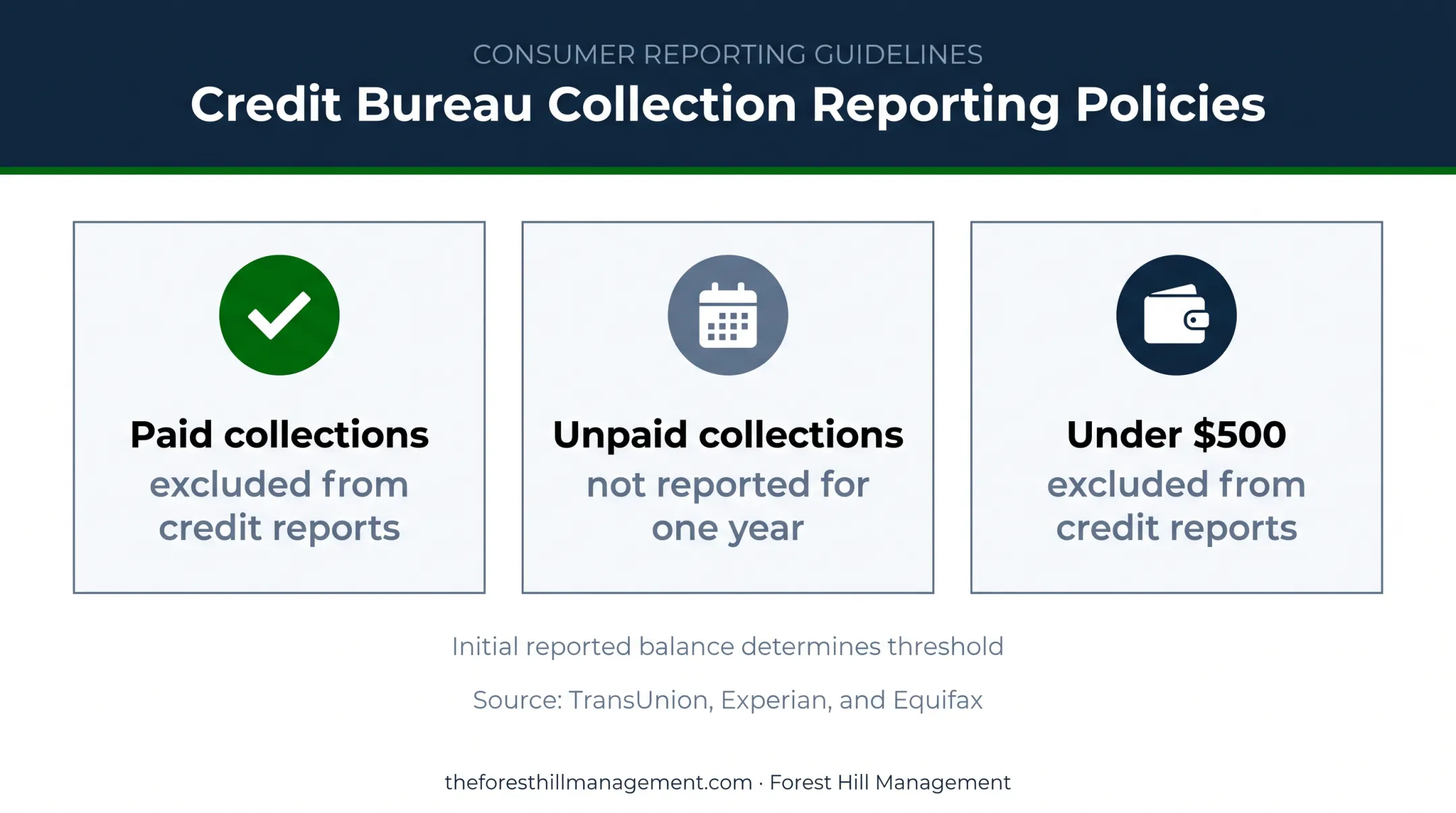
Experian, Equifax, and TransUnion each adopted policy changes announced in 2022 and 2023:
- Paid medical collections are excluded from credit reports
- Unpaid medical collections aren't reported until one year after the account entered collections (up from six months)
- Medical collections with an initial reported balance under $500 are excluded
That $500 threshold applies to the initial reported balance, according to a joint announcement from TransUnion, Experian, and Equifax. Paying down a larger balance later doesn't retroactively qualify it. These are voluntary bureau policies, not a blanket federal ban, and rules can shift, so verify current status before assuming an account qualifies for exclusion.
Listed vs. Scored vs. Underwritten
Three different things can happen with the same account:
- It appears on your credit report
- It affects your credit score (or doesn't, depending on the scoring model)
- A lender's own underwriting policy treats it a certain way, separate from the score itself
Those outcomes do not always move together. An account can show on your report, leave some scoring models untouched, and still matter under a lender's own guidelines—so check the report, the score model, and the underwriting rules separately.
How to Check and Dispute
Pull your reports at AnnualCreditReport.com and review each collection entry for:
- The creditor name
- Balance and date information
- Status (paid, disputed, duplicated)
- Whether it's actually yours
If something's wrong, dispute it with both the credit bureau and the company that reported it. Attach your supporting records and track the investigation response.
Your Basic FDCPA Protections
Under the FDCPA, collectors generally cannot:
- Use deception, harassment, or prohibited threats
- Ignore written requests that limit how they contact you
- Treat time-barred debt as if those extra limits do not apply
For current guidance, rely on the CFPB, the FTC, and your state regulator.
Why state law matters here: Statutes of limitation, wage-garnishment rules, and medical-debt-specific protections vary widely. New York, for instance, gives certain hospital and health care provider plaintiffs three years to sue on medical debt, while Texas generally allows four years for debt lawsuits and shields current wages from garnishment on ordinary debts.
If you're facing a lawsuit or worried about a debt that might be past its deadline, get legal advice before responding. Never assume a payment on an old debt won't restart the clock in some states.
Payment, Assistance, and Settlement Options
You have several paths forward. Choose based on what is actually wrong with the account.
Compare these options:
- Fix the billing or insurance error first — often the fastest way to lower or wipe out the balance
- Apply for charity care or hardship assistance — still worth trying after collections
- Set up a written payment plan — terms in writing, never verbal only
- Pay the verified balance — once you're confident it's accurate
- Negotiate a settlement — only when it fits your situation, and only in writing
Payment Plans Still Need to Be Documented
A payment plan can still land in collections. That happens when terms were never written down, a payment was late, the current owner ignored the arrangement, or the account changed hands.
Get written terms before you rely on any plan. Cover at least:
- Payment amount and due dates
- Plan length and any fees
- Who owns the account now
- How the plan affects collection status
Negotiating a Settlement
Before agreeing to anything:
- Decide what you can realistically afford
- Ask whether the offer resolves the account in full, not partially
- Confirm who currently owns the debt
- Get the settlement in writing before you pay a cent
There is no standard discount. The number depends on the account, who holds it, and your circumstances.
Think Twice Before Moving Medical Debt to a Credit Card
Putting a medical bill on a regular credit card or medical financing product is a tradeoff, not a fix. Compare interest rates, fees, and deferred-interest traps before you move the balance.
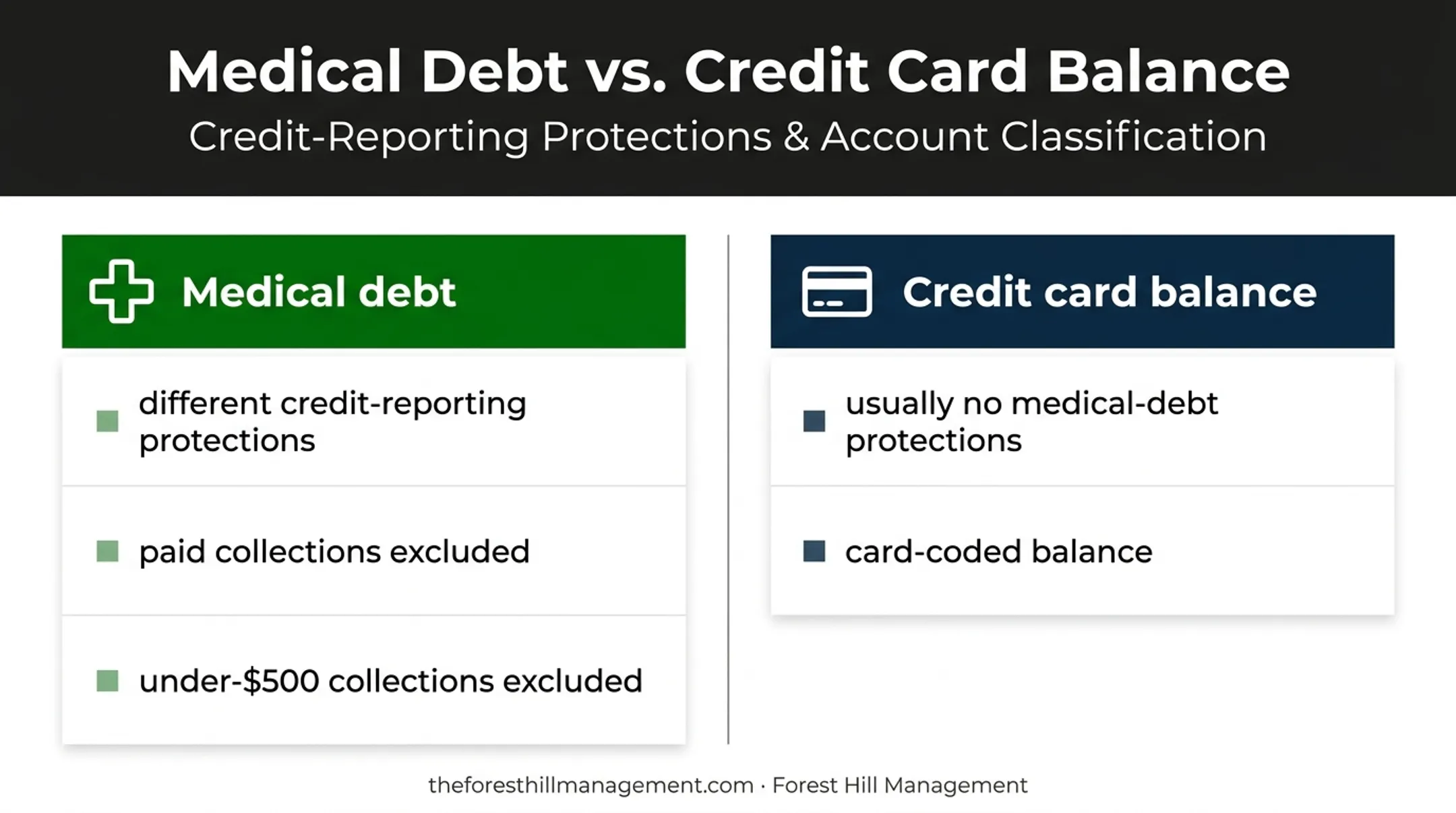
You also give up medical-debt credit reporting protections. Card-coded balances usually do not receive the same treatment as medical collections.
Spotting a Bad Debt-Relief Offer
Red flags include:
- Guaranteed results
- Upfront fees before any resolution
- Pressure to act immediately
- Vague explanations of risk
Under the FTC's Telemarketing Sales Rule, legitimate debt-relief companies generally can't collect a fee until a debt is actually settled and you've made a payment under the new agreement.
Mistakes to Avoid and When to Get Help
A few habits turn a manageable situation into a bigger problem.
Don't:
- Ignore letters or notices, hoping they'll stop
- Rely on a verbal promise instead of getting it in writing
- Send payment before verifying who you're paying
- Hand over unrestricted bank account access
- Throw away medical bills, EOBs, or payment receipts
Paying an account does not automatically remove it from your credit report. Accurate information can often remain under current bureau and state rules, even after you've paid.
When to Escalate
Get help immediately if you're facing:
- A lawsuit or court summons
- A wage-garnishment threat
- Suspected identity theft
- Repeated collection on an account you already paid or disputed
- A possible surprise-billing violation
- Harassment or an account you genuinely can't understand
Who to Contact
SituationResourceBilling questionProvider's patient advocate or billing officeInsurance disputeInsurer's appeal departmentCan't afford the billNonprofit financial counselorFacing a lawsuitConsumer-law attorneySuspected FDCPA violationCFPB or FTCState-specific questionState attorney general or insurance regulator
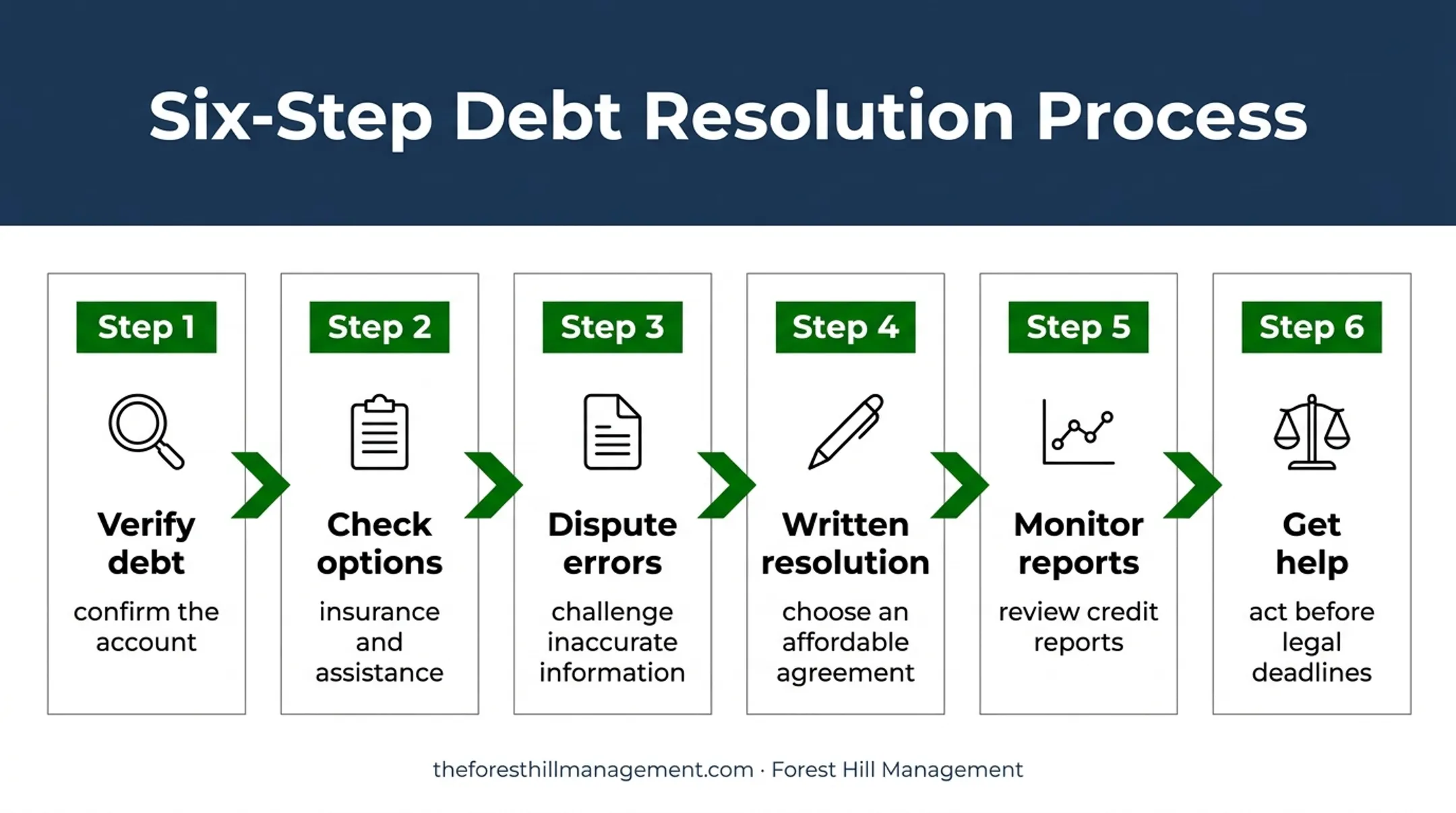
The sequence that actually works:
- Verify the debt
- Check insurance and assistance options
- Dispute what's inaccurate
- Choose an affordable written resolution
- Monitor your credit reports
- Get professional help quickly when a legal deadline is involved
Frequently Asked Questions
Should I pay a bill that went to collections?
Verify the debt first against your provider bill and insurance records before paying anything. Once you've confirmed it's accurate, get any payment or settlement terms in writing.
Will a medical collection appear on my credit report?
It depends on current bureau policy, the account's balance and age, and applicable law. Check all three credit reports at AnnualCreditReport.com and dispute anything inaccurate.
How can I remove medical debt from my credit report?
Inaccurate, duplicated, or prohibited entries can be disputed with the bureau and the creditor or collector that reported it. Accurate information that meets current reporting criteria may legitimately remain, so check current bureau procedures first.
What happens if I don't pay medical debt in the US?
Expect continued collection attempts, possible credit reporting where permitted, and potentially a lawsuit. Ignoring notices rarely helps; seeking assistance or disputing errors early is the better move.
Can I be sent to collections if I am making monthly payments?
Yes, if the arrangement isn't in writing, a payment is late, or the account gets transferred to a new owner. Always confirm your payment plan terms in writing with the current account holder.
Can I ignore a debt collection agency?
Ignoring contact doesn't stop collection activity or prevent a lawsuit from being filed. You can request information, dispute errors, and set communication preferences, but a court summons always needs a timely response.