-p-500%20(1).png)
Missouri Statute of Limitations on Debt Collection: Complete Guide
Need Help Reviewing Your Account?
Contact UsWhen an old account suddenly reappears in a collection letter, phone call, or lawsuit, Missouri consumers often ask the same practical question: how long does a creditor have to sue me for this? The answer isn't a single, simple deadline. Missouri’s statute of limitations—the legal time limit for filing a lawsuit—depends on the type of debt, the language in your original agreement, and your account history.
This guide will walk you through how to identify the likely time limit for different debts, what factors can change the calculation, and what it means for a debt to be "time-barred." We'll cover what to do if you're contacted about an old debt and explain why you should never ignore a lawsuit.
Disclaimer: This article provides general information for educational purposes and is not a substitute for legal advice. Laws can change, and your situation is unique. You should always verify the current Missouri Revised Statutes and consult with a qualified attorney for advice on your specific circumstances.
Key Takeaways
- Missouri's time limits to sue on a debt vary significantly by debt type, typically ranging from five to ten years. Always check the specific Missouri statutes and your account documents.
- The statute of limitations primarily restricts a creditor's ability to file a lawsuit. It may not erase the debt itself or prevent all lawful collection communications.
- Never ignore a lawsuit. You must respond by the court's deadline, and you may need to formally raise the statute of limitations as a defense for the court to consider it.
- Making a payment or a written promise to pay on an old debt can sometimes affect the statute of limitations calculation, so it's wise to understand the potential consequences before you act.
Missouri Statute of Limitations on Debt Collection by Debt Type
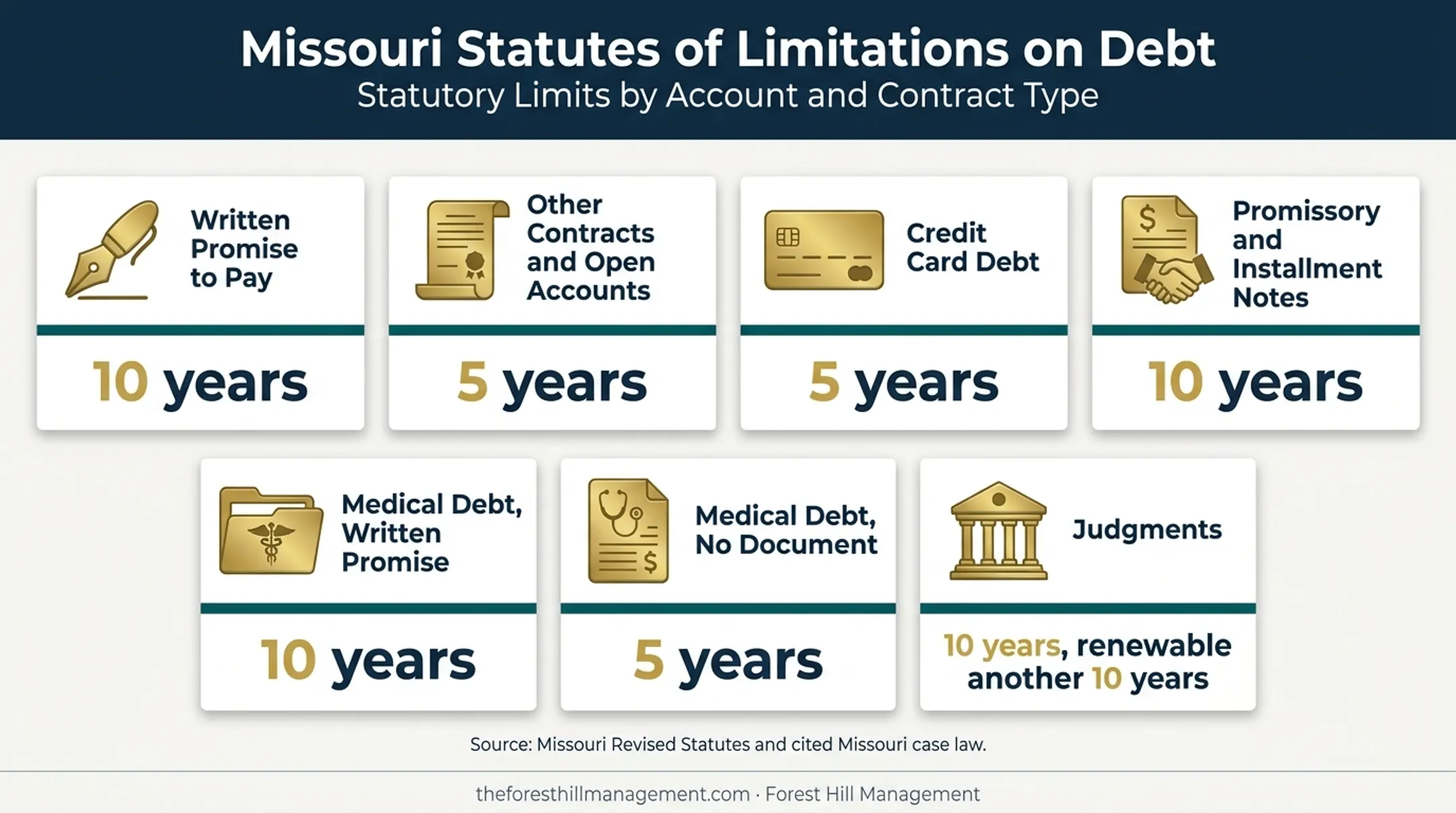
In Missouri, start by identifying the legal category of your debt. The two statutes that most often govern consumer debts are Missouri Revised Statutes § 516.120 (five-year limit) and § 516.110 (ten-year limit), but they don't cover every situation. The specific contract you signed is critical.
Here’s a breakdown of common debt types and the periods that often apply.
Written Contracts, Oral Agreements, and Open Accounts
- Written Promise to Pay: A "writing for the payment of money or property" has a 10-year limit under § 516.110(1). The writing itself must show an explicit promise to pay, without outside evidence.
- Other Contracts and Open Accounts: Oral agreements, open accounts, and other general obligations generally fall under the 5-year limit in § 516.120(1).
Credit Card Debt
Credit card debt is a frequent point of confusion. Even with a written cardholder agreement, Missouri courts often apply the 5-year statute of limitations.
In Capital One Bank v. Creed, the court used the 5-year limit because the creditor never produced a specific writing where the consumer promised to pay a set amount. A generic cardholder agreement alone may not unlock the 10-year period. Collectors usually must prove a true "written promise to pay" to avoid the shorter deadline.
Promissory and Installment Notes
For promissory notes payable at a definite time, such as many auto loans or personal installment loans, Missouri law (§ 400.3-118) sets a different rule. An action to enforce the note must usually start within 10 years after the due date.
If the loan was accelerated (the full balance demanded early after default), the clock starts from that accelerated due date.
Medical Bills
Medical debt has no separate statute of limitations. Classification depends on the paperwork:
- Clear written promise to pay: A creditor may argue the 10-year period applies
- No such document: The debt likely falls under the 5-year general contract period
Judgments
Once a creditor sues you and wins, the original debt becomes a court judgment. In Missouri, a judgment is presumed paid and satisfied after 10 years from the date it was entered (§ 516.350).
A creditor can "revive" the judgment for another 10 years, but only if they act within that initial 10-year window.
How Missouri’s Debt-Collection Clock Is Calculated
The deadline depends on when the clock started. That triggering event is the date the cause of action “accrued.” In most debt cases, accrual is the first uncured missed payment or default.
Reconstructing Your Account Timeline
To get a clear picture, you need to organize your documents and identify key dates. Look for:
- The original contract or agreement
- Account statements showing your payment history
- Any formal notice of default or acceleration from the creditor
- The charge-off date (when the creditor wrote the debt off as a loss)
- Records of your last payment
The most important date for calculation purposes is typically the date of default. This is usually the day after the first payment you missed and never made up. While dates like "last activity" or "charge-off" appear on credit reports, Missouri law generally ties the statute of limitations to the date the contract was breached.
Can the Clock Be Reset or Paused?
Certain actions can affect the statute of limitations deadline. These are complex legal concepts—do not assume they apply without consulting an attorney.
- Acknowledgment or new promise: Under § 516.320, a signed written promise to pay can restart the clock if it clearly admits the debt still exists.
- Partial payment: A payment of principal or interest may be used by a creditor to argue the limitations period restarted.
- Tolling: In rare cases the clock pauses—for example, if the debtor leaves Missouri or conceals themselves.
Before you pay anything on an old debt, confirm how that payment could change your legal position.
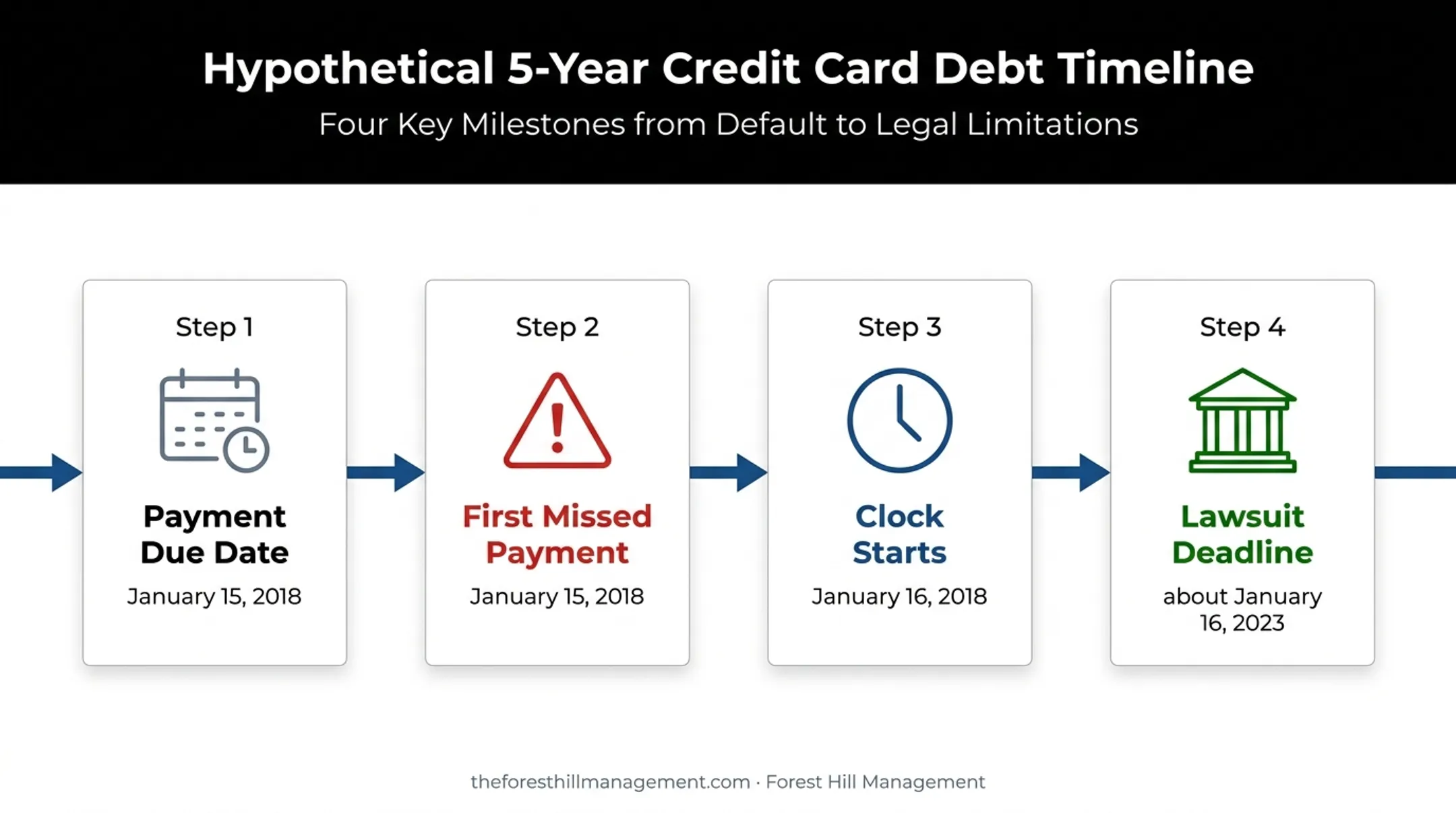
Hypothetical Example: Imagine a credit card debt subject to a 5-year statute of limitations.
- Payment due date: January 15, 2018
- First missed payment: The consumer does not pay on January 15, 2018
- Clock starts: The claim accrues on January 16, 2018, the date the contract was breached
- Lawsuit deadline: The creditor would have until about January 16, 2023, to file
Use your contract, statements, and default notices to map these same milestones on your account before you respond to any collection effort.
What “Time-Barred Debt” Means in Missouri
A debt is "time-barred" when the statute of limitations for filing a lawsuit has expired. That label limits how collectors can use the courts—it does not wipe the balance clean on its own.
What being time-barred does
- Affirmative defense: If you are sued, you can raise the expired limitation period in court. When proven, the case should be dismissed.
- Lawsuit ban: Under federal Regulation F, a collector may not sue—or threaten to sue—on time-barred debt.
What being time-barred does not do
- Cancel the balance: The debt is not automatically forgiven. A collector may still contact you to ask for voluntary payment.
- Clear your credit file: Lawsuit deadlines differ from credit-reporting limits. Most negative items, including a delinquency, can stay for up to seven years from the date of initial delinquency.
- Dismiss a case for you: Courts do not apply the defense on their own. You or your attorney must raise it in a timely response, or the creditor can still win a default judgment.
What to Do If a Missouri Debt Collector Contacts You
Receiving a call or letter about an old debt can be stressful, but a calm, organized approach is best.
- Stay Calm and Gather Information: Don't ignore the communication. Note the date, the collection agency's name, and the amount claimed. Avoid sharing your Social Security number or bank account details until you've verified the debt.
- Request Written Verification: You have the right to demand written debt verification, including the original creditor and amount owed. Send that request in writing and keep a copy.
- Review the Details: Compare the collector’s details with your records—original creditor name, account number, and last payment date. If the account is with Forest Hill Management, our correspondence already includes those details; contact us through our website for account information only—we do not give legal advice.
- Communicate in Writing: After initial contact, handle further communications in writing so you have a clear record. Log phone calls, save letters and emails, and never send money without written settlement or payment plan terms.
What to Do If You Are Sued for an Old Debt in Missouri
Getting sued for an old debt is a high-stakes moment. Ignoring the court papers is the worst move you can make.
Do Not Ignore a Summons
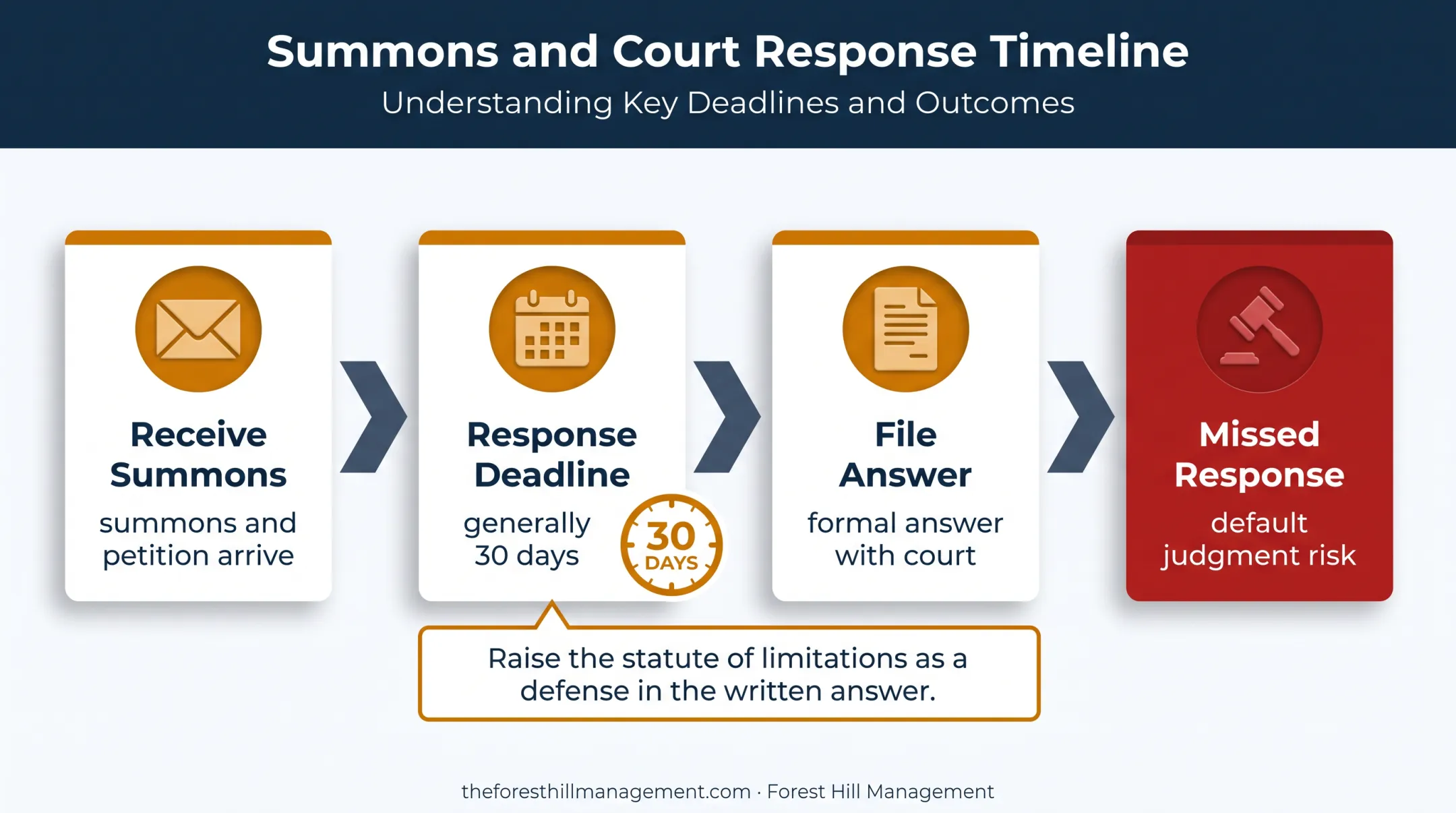
When you receive a summons and petition, the clock is ticking. In Missouri, you generally have 30 days to file a formal answer with the court.
If you fail to respond, the collector can ask the court for a default judgment. That judgment can open the door to wage or bank account garnishment.
Review Your Defenses
A lawsuit doesn't automatically mean the collector's claims are valid. Carefully review the paperwork with an attorney to identify potential defenses, such as:
- Expired statute of limitations: Was the suit filed after the legal deadline?
- Incorrect identity: Are you the right person, or is this mistaken identity or identity theft?
- Inaccurate amount: Is the balance wrong, or padded with unauthorized fees?
- Lack of standing: Can the plaintiff prove it has the right to sue on this account?
- Prior payment or discharge: Did you already pay the debt or discharge it in bankruptcy?
The statute of limitations is an affirmative defense. You must raise it in your written answer; a judge is not required to raise it for you.
Consider Your Options
Faced with a lawsuit, you still have a few clear paths:
- Seek legal help: A Missouri consumer rights attorney can evaluate defenses and represent you in court.
- Negotiate a settlement: You or your attorney may still resolve the balance for less than the full amount. Get every term in writing before you pay.
- File an answer: Put valid defenses in a formal answer so you avoid a default judgment and can contest the case.
Practical Checklist for Evaluating an Old Missouri Debt
Use this checklist to organize your information when an old debt resurfaces.
- Identify the Debt Type: Is it a credit card, installment loan, medical bill, or something else?
- Locate the Original Agreement: Find any written contract, promissory note, or cardholder agreement you signed.
- Record Key Dates:
- Date of the original agreement
- Date of your last payment
- Date of the first missed payment (the likely default date)
- Check for Payments or Promises: Have you made any payments or written promises to pay since the default? Note the dates and amounts.
- Determine if a Judgment Exists: Check Missouri's online court records (Case.net) to see if the creditor already sued you and obtained a judgment.
- Compare Your Timeline to the Law: Use the information above to estimate whether the statute of limitations may have passed.
Create an evidence file with copies of statements, canceled checks, collection letters, and court papers. That file helps if you dispute the debt or talk with an attorney.
Seek legal advice right away if you:
- Receive court papers
- Are considering a payment on a potentially time-barred debt
- Find the facts of your case unclear
Frequently Asked Questions
How long can a debt collector legally pursue old debt in Missouri?
Lawsuit deadlines depend on debt type: often 5 years for credit cards and open accounts, and 10 years for written promises to pay and judgments. Collectors may still ask for voluntary payment after that deadline.
What happens if I don't pay collections after 7 years?
The 7-year mark mainly covers credit reporting under the Fair Credit Reporting Act, not Missouri lawsuit deadlines. Depending on the debt type, a creditor may still sue you after 7 years.
Do I have to pay my debt if it was sold to a debt collector?
The sale of a debt from an original creditor to a collector generally does not erase the obligation. However, the new owner must be able to prove it has the legal authority to collect on that specific account. You have the right to request this verification.
Can making a payment restart the statute of limitations on a debt in Missouri?
It can. In some circumstances, a payment on a past-due debt may be interpreted by a creditor as renewing the statute of limitations clock. Seek legal guidance before making any payment on an old account.
Does the statute of limitations erase my debt in Missouri?
No. An expired statute of limitations is an affirmative defense that can bar a successful lawsuit. It does not erase the debt, stop voluntary payment requests, or remove accurate negative credit history.
What should I do if I receive a lawsuit for an old debt in Missouri?
Do not ignore it. Immediately note the deadline to respond, which is typically 30 days. Gather all your account records and contact a qualified Missouri attorney to discuss your rights and potential defenses, including the statute of limitations.