-p-500%20(1).png)
Statute of Limitations on Debt Collection by State
Need Help Reviewing Your Account?
Contact UsMany people assume an old debt just vanishes after a few years. It doesn't work that way.
The deadline for a creditor or collector to sue you over a debt depends on your state, the type of account, and specific dates in your payment history. Get any of those wrong, and you could misjudge your legal risk entirely.
This guide breaks down state statutes of limitations, time-barred debt, credit-reporting timelines, and your rights when a collector contacts you or files a lawsuit. We'll also cover what happens after you receive a validation notice or court summons.
Before you make a payment, sign a settlement, or acknowledge an old debt in writing, confirm which state's law applies and when the clock actually started running. That single step can change the outcome of your entire situation.
Key Takeaways
- Each state sets its own lawsuit deadline, and that period often differs by debt type (credit card, written contract, promissory note)
- A statute of limitations bars a lawsuit; it does not erase the debt or stop all collector contact
- Payments, written acknowledgments, and settlement offers can restart the clock in some states
- Credit reporting timelines and lawsuit deadlines are separate clocks under different laws
- Always request debt verification, keep records, and respond to any court summons by its deadline
What Is the Statute of Limitations on Debt Collection?
A statute of limitations is the legally defined window during which a creditor or debt collector can file a lawsuit to collect a debt. Once that window closes, the debt is considered time-barred: creditors can no longer sue to collect it.
A time-barred debt is not the same as a debt that's been paid, settled, discharged, or forgiven. The obligation may still exist. What changes is whether a court can enforce it.
Expiration Is a Defense, Not an Automatic Dismissal
This is a critical distinction. If a lawsuit deadline has passed and someone still sues you, the case doesn't automatically get thrown out.
According to the Consumer Financial Protection Bureau, the person being sued generally must raise the statute-of-limitations expiration as a defense in court. If you ignore the summons, a judge can still enter a default judgment against you — even on a debt that's well past its legal deadline.
Why the Deadline Is Hard to Pin Down
Calculating the correct deadline isn't always straightforward. Several variables affect the answer:
- State law: each state sets its own periods, and they're not interchangeable
- Debt classification: written contracts, oral agreements, promissory notes, and credit cards can each carry different periods
- Last payment or default date: the specific trigger date varies by state
- Account agreement terms: some contracts specify a governing state or venue
- Prior judgments: a lawsuit filed before expiration creates a new enforcement period with its own rules
This article is educational, not legal advice. Debt situations are fact-specific—consult a qualified consumer attorney about your circumstances.
Statute of Limitations on Debt Collection by State
State law controls how long a creditor has to sue on unpaid debt, and the numbers genuinely differ from state to state. Below is a reference table built from official state statutes and court sources, current as of September 2026.
Important: Laws change, and some states don't clearly separate every debt category (written contract, oral contract, promissory note, credit card) the way this table does. Where a state hasn't published a distinct period for a category, that cell is left blank rather than guessed at.
Contract terms or an existing judgment can also change your specific outcome.
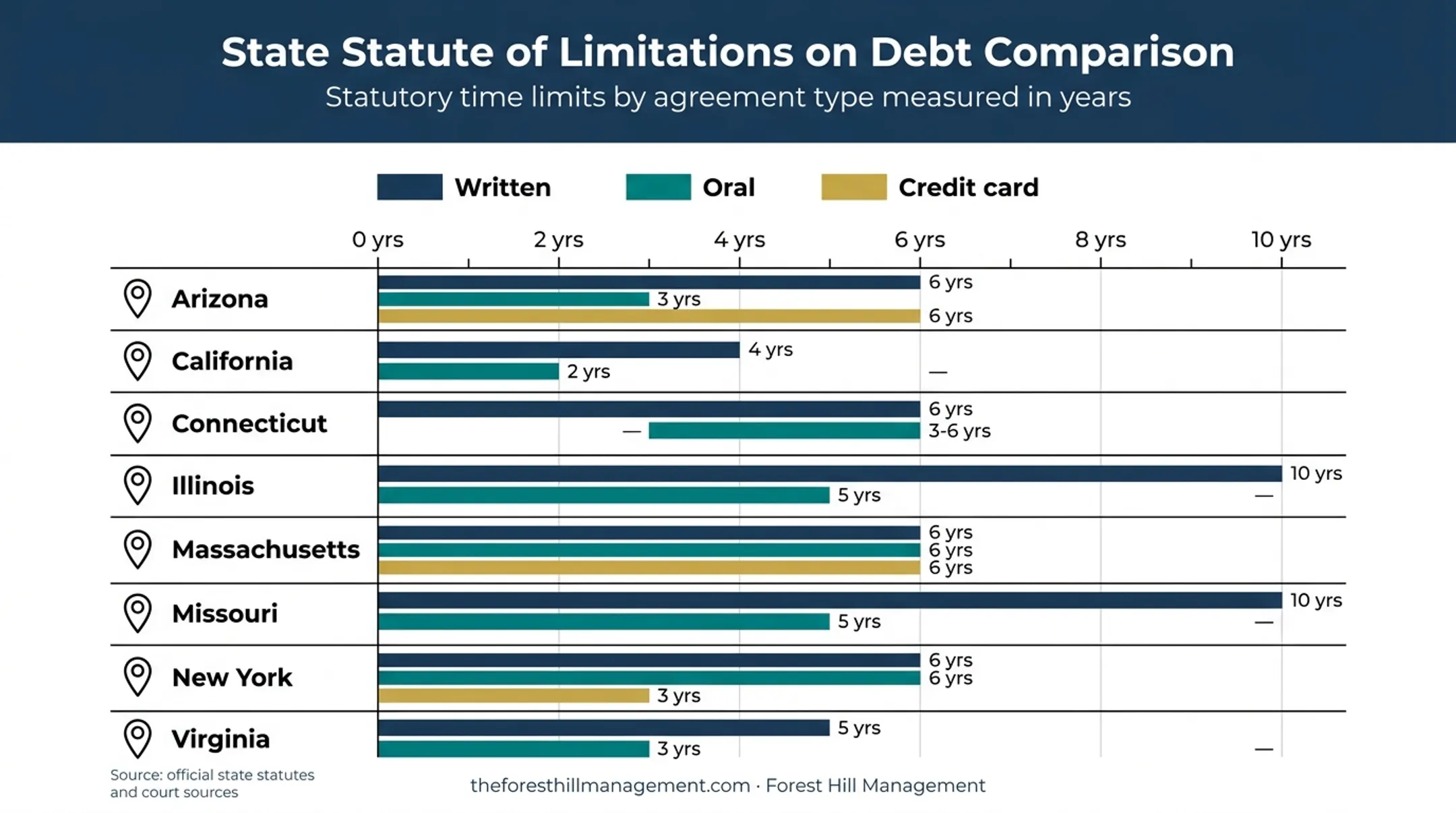
This table isn't exhaustive. Every state has its own statutes, and many aren't reflected here because a distinct category period couldn't be confirmed from an official source. Check your state legislature's website or a local court's self-help resources for the precise language that applies to you.
How to Use This Table
Follow these steps before assuming anything about your account:
- Identify the debt type. Is it a credit card, signed loan agreement, or informal arrangement?
- Confirm the governing state. Usually where you live, but some contracts specify a different state.
- Locate the trigger date. Often the last payment or default date, but this varies.
- Check for payments or acknowledgments. These can restart the clock in some states.
- Look for an existing judgment. Judgments carry their own separate enforcement period.
Example: Say a credit card account went unpaid in a state with a 4-year credit card limitations period, and the last payment was made on March 1, 2020. The lawsuit deadline would generally fall around March 1, 2024, assuming no payment, acknowledgment, or other event restarted the clock. This is illustrative only, not legal advice for any specific account.
One more thing: moving to a different state doesn't automatically change which state's law applies. Review your original agreement's governing-law clause, and when multiple states are involved, get advice from a qualified attorney.
What Types of Debt Are Covered?
Not all debt is treated the same way under state limitations laws. The classification matters because it often determines which column in a table like the one above actually applies to you.
Common categories include:
- Written contracts: signed personal loans, installment agreements, and credit contracts where the terms are documented
- Oral contracts: informal agreements without signed documentation
- Promissory notes: negotiable instruments with their own due-date and acceleration rules
- Open-ended accounts: credit cards and revolving lines of credit, which some states classify separately
State terminology isn't uniform. A state might fold credit cards into its general written-contract category, while another state, like Arizona, names credit cards explicitly.
Debts With Their Own Rules
Several debt types don't fit neatly into the standard framework above and deserve separate research before you assign a deadline:
- Medical bills: treatment depends on documentation and state classification
- Auto loans and mortgages: secured debts governed by collateral and repossession or foreclosure rules
- Federal student loans: generally follow federal enforcement rules, not state statutes of limitations
- Tax obligations: government claims with separate assessment and collection windows
- Court judgments: start a new enforcement period that can often be renewed
Federal student loans, secured debts, and government claims often follow different enforcement rules entirely. Once a debt becomes a judgment, that judgment usually starts its own limitations clock, with renewal options in many states. Do not assume it follows the original debt's deadline.
How Does the Statute of Limitations Clock Work?
The clock doesn't start on the same event in every state. Depending on jurisdiction, the trigger date might be:
- The date of default
- The date the account became due
- The date of the last payment
- The date of the last charge
- Another event defined by that state's law
Getting this starting point wrong throws off every calculation that follows.
What Can Restart or Pause the Clock
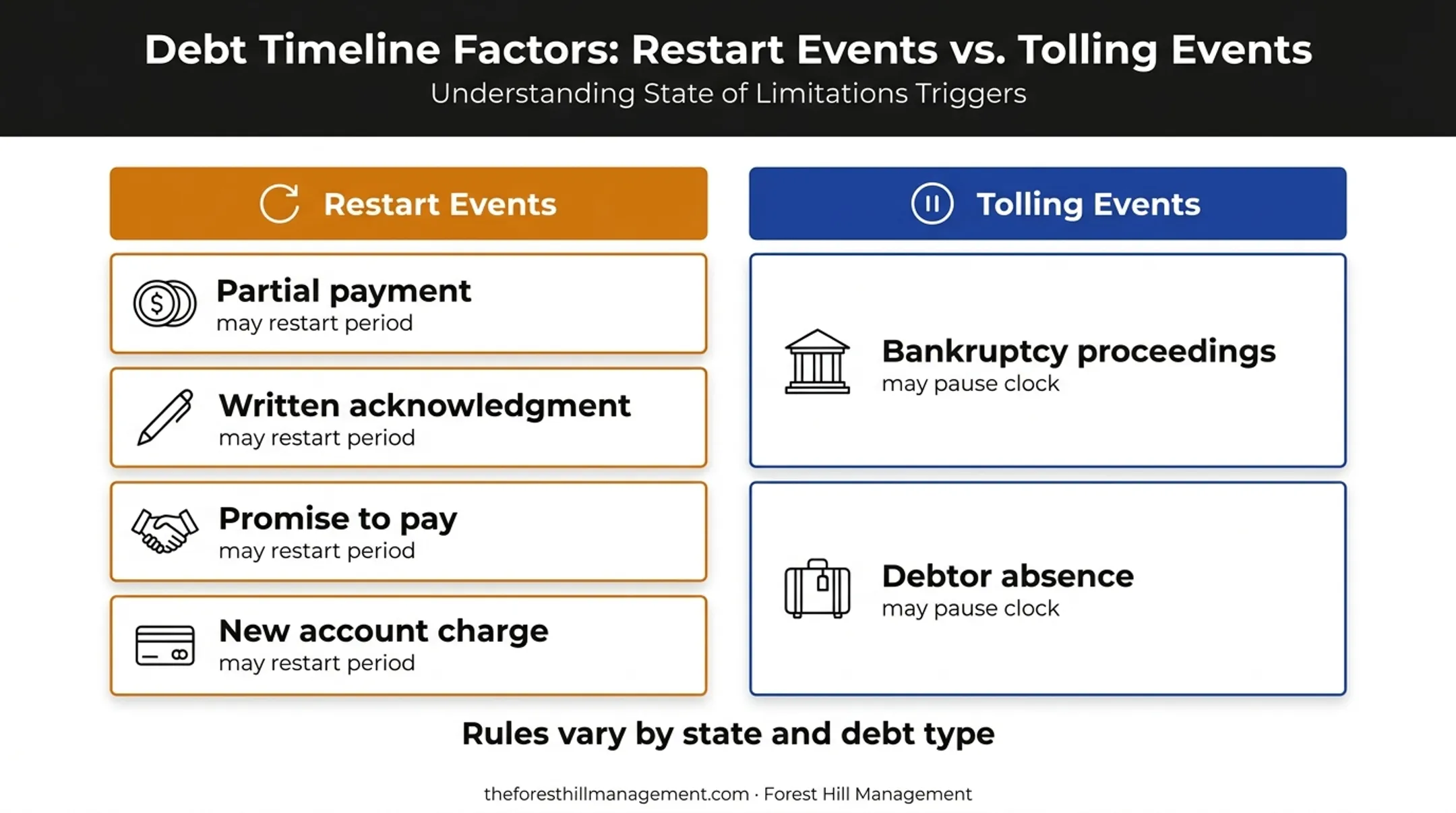
This is where mistakes happen most often. In some states, any of the following can restart the limitations period:
- A partial payment
- A written acknowledgment of the debt
- A promise to pay
- A new charge on the account
In other states, the same actions have no effect. The rule depends entirely on the jurisdiction and debt type.
Some events toll (pause) the clock instead of restarting it, such as bankruptcy proceedings or a debtor's absence from the state for certain periods. Tolling rules are state-specific, so confirm them for your jurisdiction rather than assuming a national standard.
Disputing a debt or requesting validation is not an acknowledgment that you owe it. Don't let a collector—or your own assumptions—treat them as the same.
When a Lawsuit Is Filed Before the Deadline
If a creditor sues and wins before the limitations period expires, the resulting judgment creates a separate enforcement period, with its own renewal rules and often its own interest calculations. That judgment clock is separate from the original debt's statute of limitations.
Recordkeeping Checklist
Because start dates, restarts, and lawsuit timing all turn on proof, keep these documents on hand for any old or disputed debt:
- Account statements and payment history
- Copies of every collection letter received
- Settlement offers, in writing
- Validation notices and your responses
- Credit reports showing the account
- Court documents, if any exist
- Dates of every phone call or written communication
Credit Reporting and Federal Collection Rules
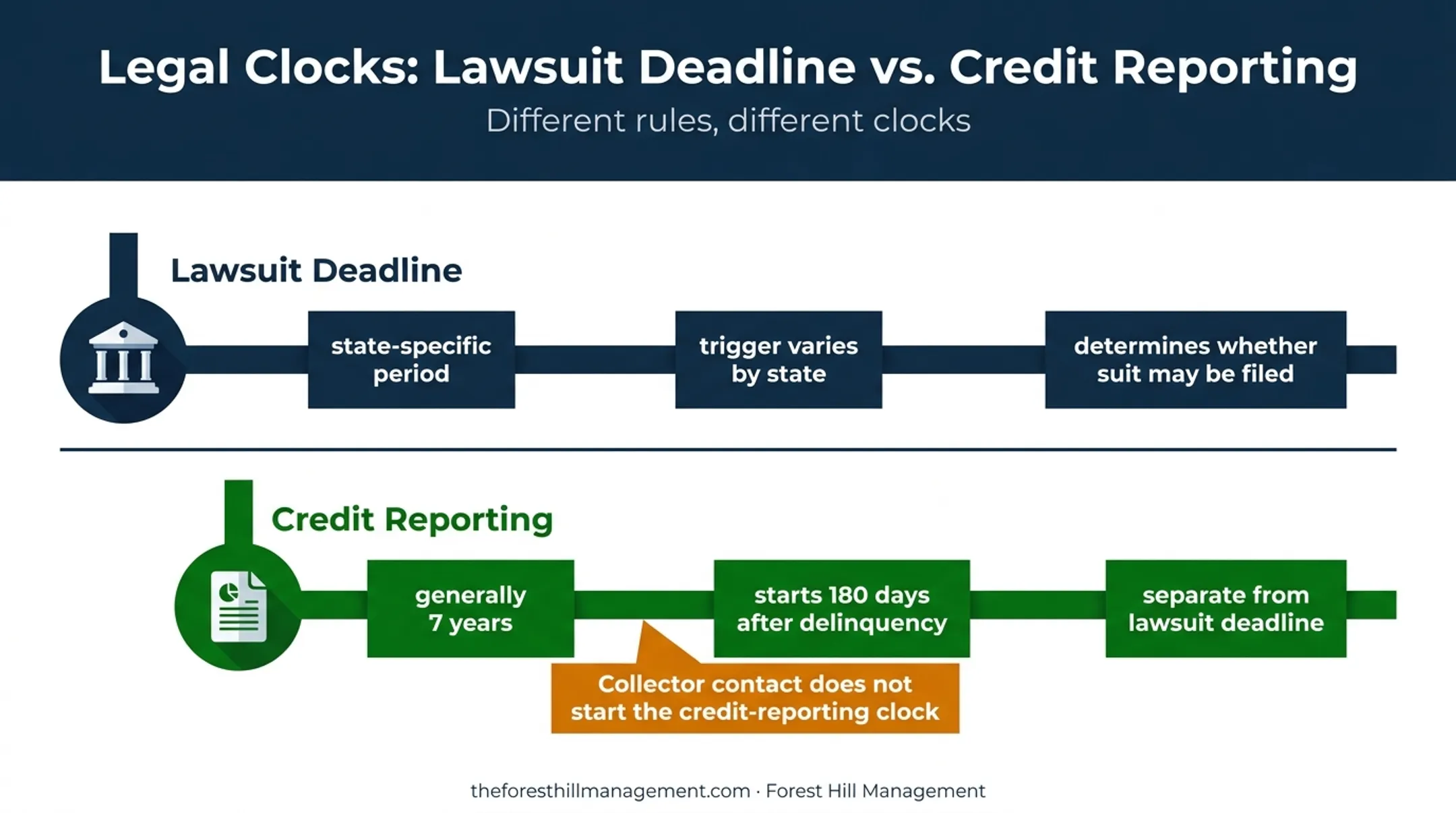
Here's a distinction that trips up a lot of consumers: the lawsuit deadline and the credit-reporting timeline are not the same rule, and they don't run on the same clock.
Under the Fair Credit Reporting Act, negative information about a collection or charge-off account is generally limited to seven years. That clock usually starts 180 days after the delinquency that led to the collection or charge-off, not the date a collector first called you and not your state's lawsuit deadline.
What Collectors Can and Can't Do
A collector may still contact you about a debt after the state lawsuit deadline has passed, asking for voluntary payment. What they cannot do is:
- Threaten a lawsuit that can't lawfully be filed
- Misrepresent the debt's legal status
- Use harassment, deception, or false threats of any kind
The Fair Debt Collection Practices Act (FDCPA) and CFPB Regulation F specifically prohibit a covered debt collector from suing, or threatening to sue, on a debt that's known to be time-barred. Regulation F makes this a binding conduct rule for covered collectors.
Your Right to Written Validation
When a third-party collector first contacts you, ask for written validation information. If you dispute the debt in writing within 30 days of receiving that notice, the collector must pause collection activity until it mails you verification.
Original creditors and third-party debt collectors aren't always held to the same federal requirements. Don't assume every communication you receive follows identical rules.
What Should You Do About Old or Time-Barred Debt?
If an old debt lands back on your radar through a letter, phone call, or court summons, work through this process methodically rather than reacting immediately.
- Identify the collector: confirm who's contacting you and whether they're licensed to collect in your state
- Confirm the creditor and balance: request documentation showing the original debt and current amount owed
- Request validation information: do this in writing, and keep a copy
- Compare records: check your own account history and credit reports against what the collector claims
- Document everything: dates, names, and content of every communication
Before You Pay or Sign Anything
Don't make a payment, sign a settlement agreement, or admit anything about an old debt before checking whether that action could revive or extend the limitations period under your state's law. A small goodwill payment on a debt that's already time-barred can, in some states, restart the entire clock.
If You're Served With a Lawsuit
A court summons should never be ignored, even on debt that looks ancient. Check the filing date, respond by the deadline stated in the paperwork, and raise a statute-of-limitations defense if it applies. Silence can still produce a default judgment against you.
Forest Hill Management services portfolios of past-due consumer accounts and offers account documentation, payment plans, and dispute resolution support for verified obligations. If you've confirmed an account belongs to you and want to discuss resolution options, you can reach the team at (888) 471-0109 or info@foresthillmanagement.com.
Questions about whether a specific debt is legally time-barred are a different matter. Those call for a qualified consumer attorney who can review your state's law and your account's exact history.
Final Checklist Before Taking Action
Answer these questions before you respond to any collector or lawsuit:
- Which state's law applies to this debt?
- What type of debt is it (written contract, oral, note, credit card)?
- When did the relevant trigger date occur?
- Was there a payment or written acknowledgment after that date?
- Has a judgment already been entered on this account?
- Has the debt been properly validated?
Frequently Asked Questions
What is the statute of limitations on debt collection?
It's the state-law deadline for filing a lawsuit to collect a debt. The exact period varies by state, debt type, account history, and whether a judgment already exists.
Can a debt from 10 or 20 years ago still be collected or lead to a lawsuit?
A collector can still contact you and ask for voluntary payment on very old debt. Whether a lawsuit would still be timely depends on your state's deadline and any payments or judgments on the account.
Can you be sued for credit card debt after 7 years?
Seven years is generally tied to credit reporting, not a universal lawsuit deadline. Your state's specific credit-card limitations period and your account's payment history determine whether a suit is still legally viable.
Does unpaid credit card debt go away after 7 years?
No. Credit reporting and legal enforceability are separate issues. The underlying debt isn't automatically erased just because seven years have passed.
How long does a collection account stay on my credit report?
Generally seven years, measured from 180 days after the original delinquency that led to collection or charge-off. Credit reporting is separate from your state's lawsuit deadline. Check your report if the timing looks off.
What should I do if I never received a debt validation letter?
Request validation information from the collector in writing and keep a copy along with proof of delivery. If they don't comply within the applicable timeframe, consider seeking help from a qualified consumer attorney.