-p-500%20(1).png)
Statute of Limitations for Debt Collection in Georgia
Need Help Reviewing Your Account?
Contact UsGeorgia's statute of limitations sets a legal deadline for filing a lawsuit over unpaid debt. It does not erase what you owe.
Many consumers assume an old account simply vanishes once enough time passes. Georgia's Consumer Protection Division confirms that isn't the case: an expired lawsuit deadline doesn't automatically stop collection efforts, and creditors can still contact you about the balance.
This article covers how Georgia calculates these deadlines, what triggers the clock, whether a payment can restart it, and what to do if you're served with a lawsuit. This is general information, not legal advice for your specific account.
Key Takeaways
- Your Georgia lawsuit deadline depends on debt type (written contract, open account, note, or judgment)—confirm current law.
- A lawsuit deadline and a credit-reporting timeframe are two separate clocks that rarely align.
- A payment or new agreement on old debt can change your legal position—investigate before you act.
- Never ignore a summons because the debt seems too old; courts don't raise that defense for you.
What the Statute of Limitations Represents in Georgia Debt Collection
A statute of limitations is a deadline for filing a specific type of lawsuit. It doesn't stop a creditor from calling you, sending letters, or reporting the account. Calls and letters can continue; the deadline mainly limits when a collector may sue.
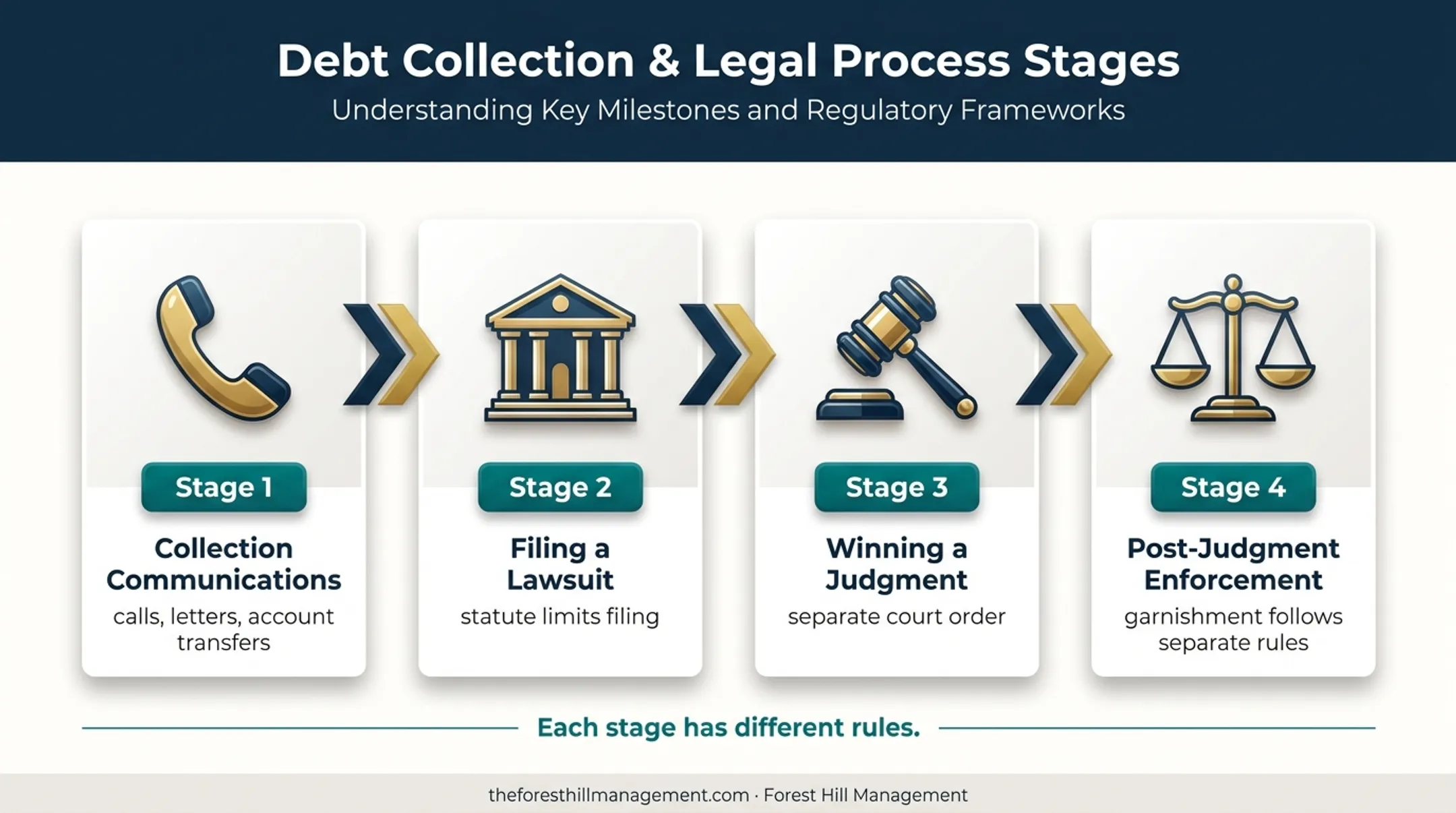
Four things happen at different stages:
- Collection communications — calls, letters, and account transfers can continue indefinitely, subject to federal and state limits.
- Filing a lawsuit — this is what the statute of limitations restricts.
- Winning a judgment — this creates a separate court order with its own enforcement power.
- Post-judgment enforcement (like garnishment) — follows separate rules after the court enters a judgment.
A time-barred debt can still show up in your mailbox or on a phone call. What changes is whether a collector can sue you over it, and whether threatening to sue on a stale claim creates compliance problems for the collector.
Debt Validation Is a Different Process
Don't confuse the statute of limitations with your right to dispute a debt under the Fair Debt Collection Practices Act. Validation lets you challenge whether an account is accurate or belongs to you. The limitations period is about whether a court case can still be filed. They run on separate tracks.
Why Classification Matters
Georgia treats written contracts, oral agreements, open accounts, promissory notes, and judgments differently, each with distinct rules. A credit card balance, for example, isn't automatically an "open account" just because charges accrued over time. Georgia courts have applied written-contract rules to credit-card debt in certain cases. Always verify classification against current statutory text rather than assuming a category based on how the account looks.
What Actually Moves the Deadline
Several events can affect when the clock starts or whether it resets:
- Default or breach — often the trigger for contract claims
- Maturity date or acceleration — relevant for notes and installment agreements
- Written acknowledgment or new promise to pay — Georgia law requires this to be documented in writing to count
- Account sales or transfers to debt buyers — generally do not create a new obligation or reset the clock by themselves
Account sales and servicer changes are a common point of confusion. When a creditor sells a delinquent account to a debt buyer, the buyer typically steps into the same legal position the original creditor held. The sale itself isn't a new legally significant event. Still review the facts of each transfer.
Before accepting any single date, review the underlying contract, payment history, correspondence, and any court filings together. A credit report entry showing "date of first delinquency" is useful evidence, but it isn't automatically the controlling date for every claim.
Georgia Debt Collection Time Limits and How to Calculate Them
Georgia doesn't use one blanket deadline for every type of debt. The period depends on how the obligation is classified.
Statutory Time Periods by Debt Type
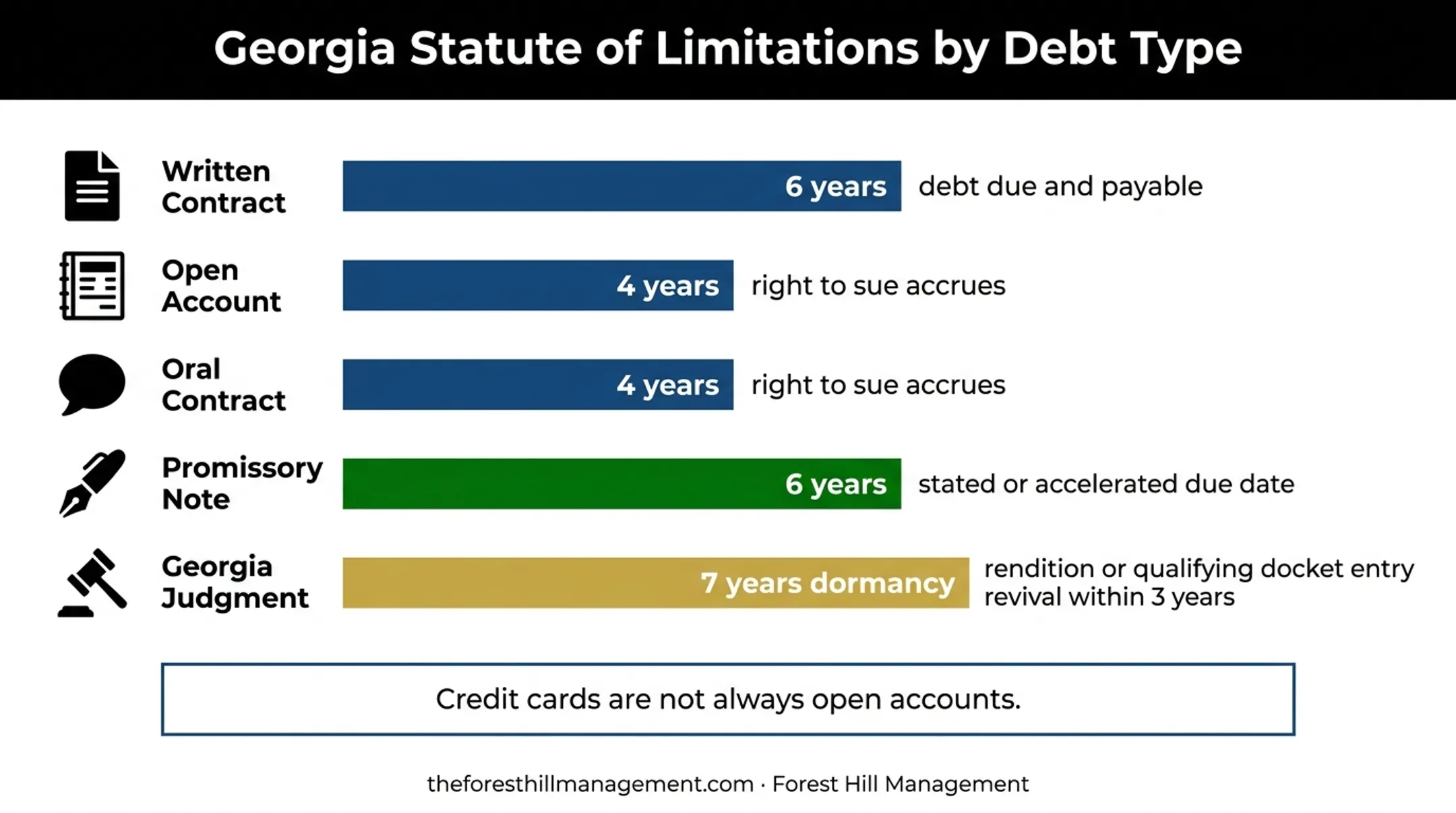
Credit cards deserve a specific note. Georgia's Consumer Protection Division generally treats credit-card debt as subject to the six-year period. At least one Georgia Court of Appeals decision applied the written-contract standard to a credit-card balance rather than the shorter open-account period.
Don't assume every revolving account defaults to four years.
Calculating the Possible Expiration Date
Use this simplified walk-through:
- Identify the alleged default date. Note when payments stopped or the account became due.
- Determine the claim type. Decide whether it is a written contract, open account, or note.
- Apply the relevant period. Use 6 years, 4 years, or the other statutory timeframe that fits.
- Check for altering events. A written new promise, acceleration clause, or documented payment can change the calculation.
Example: Say a credit card account went unpaid starting January 2021 and is treated as a written contract with a six-year period. The rough expiration lands around January 2027, unless a written acknowledgment or new promise reset the clock.
Cross-check this math against actual account statements, collection letters, and any court filings. A single date on a credit report shouldn't be your only source.
Time-Barred Debt Versus Unpaid Debt
"Time-barred" means the lawsuit deadline has passed. It doesn't mean the balance is canceled.
- You may still owe the money.
- Collectors may still contact you through non-litigation means.
- The debt may still be reportable to credit bureaus for a separate period.
That reporting period comes from federal law, not Georgia's contract statutes. Under the Fair Credit Reporting Act, collection accounts generally can't stay on a credit report for more than seven years after a specific delinquency-based starting point.
That is a different calculation from the state lawsuit deadline, and the two rarely expire on the same date.
If a creditor already won a judgment, that judgment is now its own legal instrument with its own dormancy and revival rules, separate from whatever limitations period applied to the original account.
How to Determine, Document, and Validate the Deadline
Figuring out whether an account is time-barred is a documentation exercise, not a quick calculation based on how old a collection letter looks.
Reviewing Account and Court Records
Gather these before drawing any conclusions:
- Original agreement or cardholder terms
- Itemized balance and payment history
- Documented date of default
- Correspondence from the creditor or collector
- Validation notice
- Assignment or sale records (if the account changed hands)
- Credit reports showing the account
- Summons, complaint, and proof of service (if a lawsuit exists)
Watch for inconsistencies before you pay anything:
- Different balances across documents
- Mismatched account numbers
- Conflicting default dates
Confirming Debt-Validation and Dispute Rights
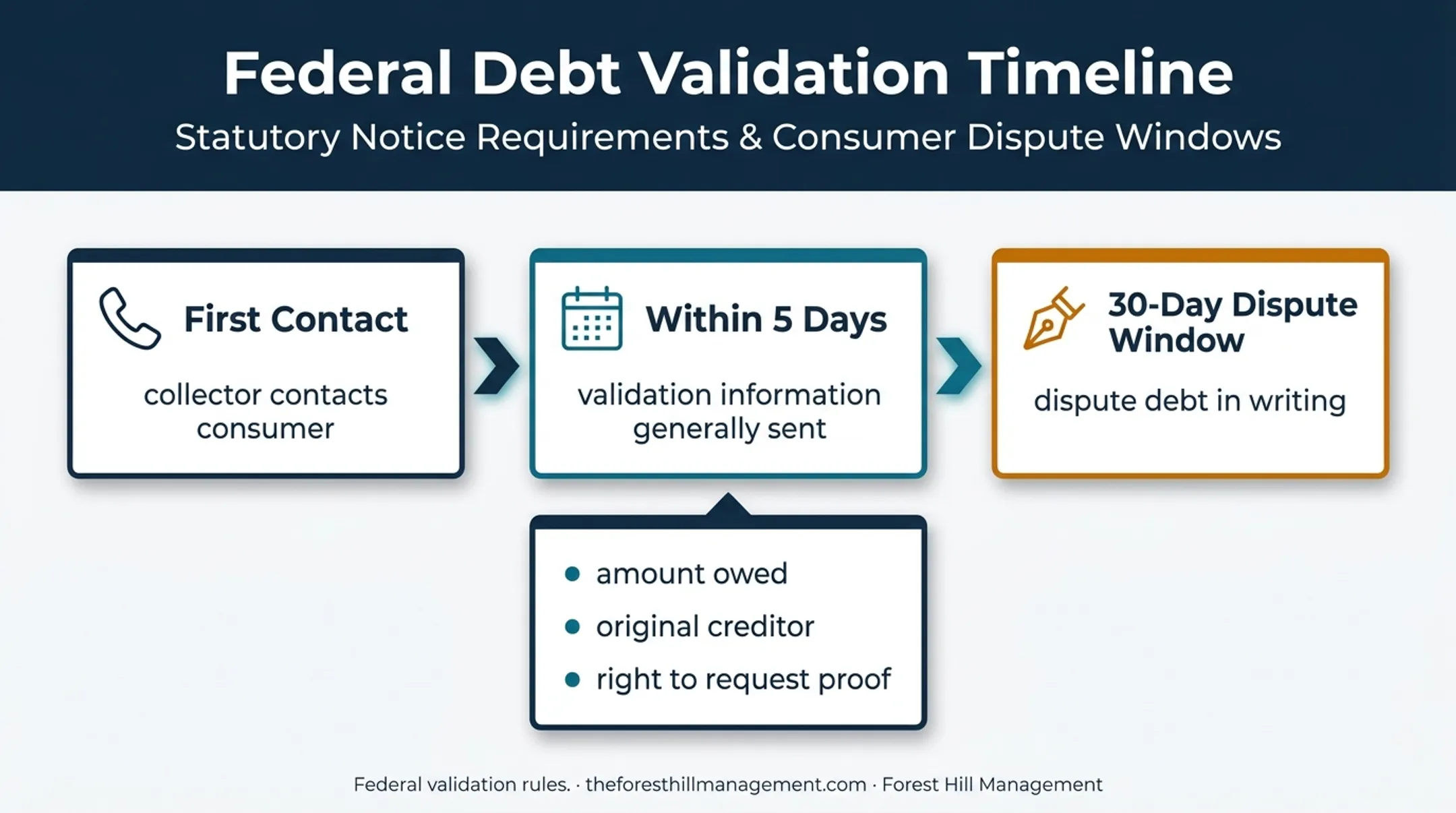
Under federal law, a debt collector generally must send validation information within five days of first contacting you. You then have 30 days to dispute the debt in writing. Under CFPB validation rules, that notice should state the amount owed, identify the original creditor, and explain your right to request more proof.
A few clarifications:
- Disputing a debt and raising a statute-of-limitations defense are not the same action. They have different timing and different legal effects.
- Send disputes in writing, and keep delivery confirmation.
- Retain copies of everything: letters, call logs, and any payment agreements discussed.
Responding to a Lawsuit
If you're served with a summons or complaint, don't ignore it just because the account feels old. Georgia treats the statute of limitations as an affirmative defense: meaning you generally need to raise it yourself within your answer deadline, rather than assume the court will apply it automatically.
Answer deadlines vary by court. Magistrate court typically allows 30 days after service to respond.
Missing that window can lead to a default judgment against you, even if the underlying debt was time-barred. A Georgia-licensed attorney can review your specific summons and advise on the applicable defenses.
What Happens When Deadlines Are Misunderstood or Missed
Getting the timeline wrong creates risk on both sides of a collection account.
For consumers, common mistakes include:
- Making a payment on an old account without knowing it could reset the limitations clock
- Signing a new payment agreement without understanding how it changes your legal position
- Ignoring a lawsuit summons, which can lead to a default judgment and later enforcement action
For collectors, pursuing or threatening a lawsuit on a genuinely time-barred debt raises compliance concerns. Federal rules under Regulation F prohibit debt collectors from suing or threatening suit on time-barred debt, and violations can trigger regulatory scrutiny under both federal and Georgia consumer-protection law.
One common misconception: people often assume a collector's most recent letter, or the sale of an account to a new owner, automatically restarts the limitations period. That's generally not accurate. Georgia law requires a written new promise or acknowledgment to count. A letter alone typically doesn't qualify, and neither does a simple account transfer.
This is where documentation practices matter for anyone managing receivables. Account age, debt classification, dispute status, and litigation history should all be tracked and reviewed before any account moves toward legal escalation.
Forest Hill Management works with consumers on personalized payment arrangements for past-due accounts and encourages reviewing account records directly rather than acting on assumptions. This is account guidance, not legal advice; Forest Hill Management is not a law firm.
A Short Action Checklist
- Pause before paying or promising payment on an old account
- Request documentation showing the debt's history and current owner
- Preserve all records and correspondence
- Dispute inaccurate information in writing within your window
- Calendar any court response deadlines immediately
- Consult a licensed attorney if you're served with a lawsuit
Georgia debt law changes over time, and this article can't determine whether your particular account is time-barred. Verify current statutes or speak with a Georgia-licensed attorney before making decisions based on a deadline calculation.
Conclusion
Georgia's debt-collection deadline depends on what type of claim is involved, when it legally accrued, and whether any documented event changed that calculation. A time-barred claim isn't the same as a canceled debt, and a lawsuit should never be ignored just because the account looks old.
Before you act:
- Pull your account records and payment history
- Protect dispute and court-response deadlines
- Get legal advice if you receive a summons
Frequently Asked Questions
How long does a debt collector have to sue you in Georgia?
It depends on the debt type. Written contracts generally get six years; open accounts and oral agreements generally get four. Confirm the classification and triggering date before relying on either number.
What is a statute of limitations?
It's the legal deadline for filing a specific type of lawsuit. It doesn't cancel a debt, and it's separate from how long an account can appear on your credit report.
Should I pay a debt that is past the statute of limitations?
Verify the debt's accuracy, ownership, and legal status first. Making a payment or promise without understanding the consequences could affect your position, so get legal advice if you're unsure.
What happens if a debt collector sues you and you have no money?
You still need to respond to the lawsuit. Lack of funds doesn't eliminate that requirement, though available defenses and payment options depend on your specific facts.
Can you dispute a debt if it was sold to a collection agency?
Yes. You can generally request verification and dispute the account after receiving the required notice. Send your dispute in writing and keep proof of delivery.
What happens to unpaid collections after 7 years?
Seven years typically refers to the credit-reporting timeline, not Georgia's lawsuit deadline. Whether the debt is still legally enforceable depends on the debt type, payment history, and any judgment involved.