-p-500%20(1).png)
How to Make a Budget and Get Out of Debt

Need Help Reviewing Your Account?
Contact UsA budget sounds simple on paper. You write down your income, list your expenses, and try to make the numbers work. But when debt is involved, it rarely feels that straightforward. Payments overlap, balances don’t move as quickly as you expect, and it becomes harder to tell if you’re actually making progress.
That pressure is happening against a large debt backdrop. The Federal Reserve reported that household debt in the U.S. reached $20.7 trillion in the third quarter of 2025, while consumer credit grew at an annual rate of 2.3%. That kind of environment makes a budget more of a practical tool for staying ahead of what you owe.
The reality is, getting out of debt is not about cutting everything out or following a perfect method.
In this blog, you’ll learn how to build a budget that works in real life, how to align it with your debt obligations, and how to use the 5 best strategies to move toward resolution in a clear and manageable way.
Key Takeaways
- A budget becomes effective only when it reflects your actual income, expenses, and debt obligations, not an ideal or estimated version of them.
- Getting out of debt depends more on consistency than on aggressive repayment, as steady, realistic contributions lead to better long-term progress.
- Organising your debts clearly, including past-due and collection accounts, helps you prioritize actions and avoid confusion.
- Budgeting strategies work differently for different situations, and the most effective one is the one you can follow consistently.
- Taking early and informed action on past-due accounts helps maintain control and makes resolution more structured and manageable.
What Is Budgeting?
Budgeting is the process of understanding how your money comes in and where it goes, so you can make intentional decisions about it. It is not just about limiting spending. It is about creating a clear structure that helps you manage your financial responsibilities without uncertainty.
Budgeting allows you to see your actual financial position, not what you assume it to be, and helps you organize your income in a way that supports consistent payments and fewer disruptions.
How Does Budgeting Help When You Are in Debt?
When debt is involved, a budget becomes a practical tool for financial stability. It helps you move from reacting to expenses to managing them with clarity and intent.
- Gives you a clear view of your financial reality: Budgeting helps you see your exact income, expenses, and obligations in one place, which removes guesswork and makes decision-making more grounded.
- Helps you prioritize essential payments and obligations: By organising your expenses, you can ensure that necessary costs and debt payments are accounted for before discretionary spending.
- Reduces the chances of missed or delayed payments: When payments are planned in advance, you are less likely to overlook due dates or fall behind unintentionally.
- Supports consistent progress toward reducing debt: Even small, regular payments become more effective when they are part of a structured plan rather than occasional efforts.
- Prevents further financial strain or additional debt: A clear budget helps you avoid overspending and reduces the need to rely on additional credit while you are already managing existing obligations.
Budgeting, when used properly, is not restrictive. It is what allows you to move forward with more control and fewer surprises while dealing with debt.
How to Make a Budget To Get Out of Debt?
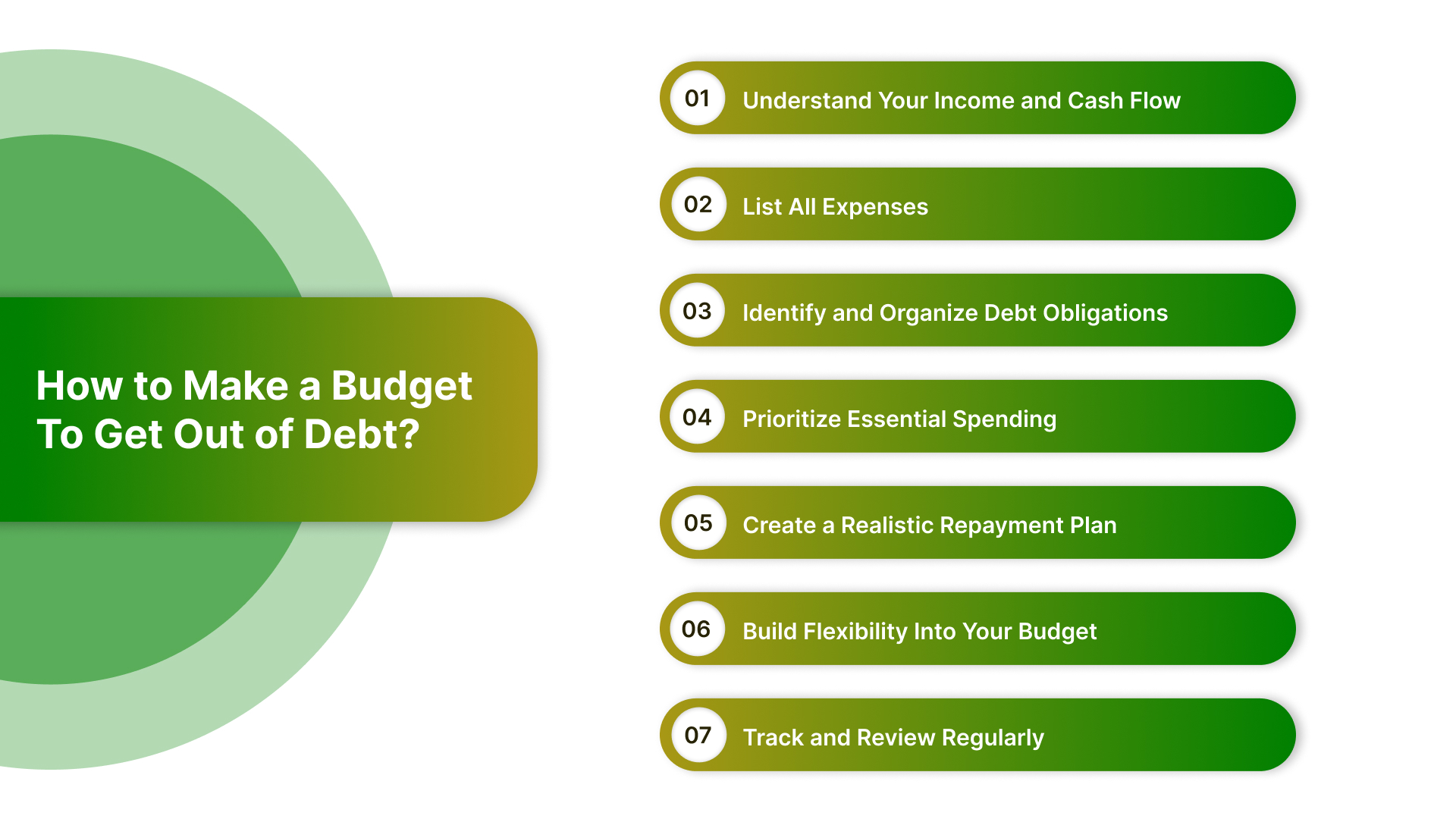
A budget only works when it reflects your real financial situation, not an ideal version of it. When you are trying to get out of debt, the goal is not to create a perfect plan, but to build a system you can follow consistently.
The steps below are designed to help you build a budget that you can actually follow through on:
Step 1: Understand Your Actual Income and Cash Flow
Before planning expenses or payments, you need a clear picture of what you actually have available each month. This step sets the foundation for everything that follows.
- Calculate your net income: Focus on the amount you receive after taxes and deductions, as this is what you can realistically allocate toward expenses and debt. Overestimating income often leads to budgets that fail quickly.
- Account for irregular or variable income: If your income changes month to month, base your budget on a conservative average rather than your highest earning periods. This helps maintain stability even during lower-income cycles.
Step 2: List All Expenses Without Filtering or Adjusting
To build a workable budget, you need to understand your current spending before trying to optimize it. This step is about visibility, not correction.
- Identify fixed and variable expenses: Fixed costs include rent, utilities, and subscriptions, while variable expenses include groceries, transportation, and daily spending. Separating them helps you see where adjustments are possible.
- Include smaller and less obvious expenses: Frequent small transactions, such as subscriptions or daily purchases, can add up significantly. Capturing these ensures your budget reflects your actual financial behavior.
Step 3: Identify and Organize All Debt Obligations
A debt-focused budget needs a clear understanding of what you owe and how each account is structured. This helps you prioritize effectively.
- List all debts with their current status: Include credit cards, loans, and any past-due or collection accounts. Understanding which accounts are active and which require immediate attention is essential.
- Note minimum payments and any overdue amounts: This allows you to distinguish between ongoing obligations and accounts that need resolution, helping you plan more accurately.
- Build an Emergency Fund: Before structuring how to pay debt, set aside a small emergency fund (e.g., $500 to $1500 ) to avoid using credit cards for unexpected expenses.
Step 4: Prioritize Spending Based on What Is Essential
Once your income and expenses are clear, the next step is to allocate funds in a way that supports stability and repayment.
- Cover essential living expenses first: Housing, utilities, food, and transportation should be secured before allocating money elsewhere. This ensures your basic needs are not disrupted.
- Allocate funds toward debt obligations next: Once essentials are covered, assign a consistent portion of your income toward debt repayment. This creates a structured approach instead of irregular payments.
Step 5: Create a Realistic and Sustainable Repayment Plan
A budget only works if the repayment structure within it is achievable over time. This step is about balancing progress with consistency.
- Set a fixed amount for debt repayment each month: Even if the amount is modest, consistently paying a minimum amount matters more than aggressive targets that are difficult to maintain.
- Align repayment with your financial capacity: Avoid committing to amounts that leave no room for other expenses, as this often leads to missed payments and disruption.
Step 6: Build Flexibility Into Your Budget
Unexpected expenses are a part of real life, and a rigid budget can fail quickly if it does not account for them.
- Leave room for unplanned costs or variations: Setting aside a small buffer helps you handle sudden expenses without affecting your debt repayment plan.
- Adjust allocations as your situation changes: Income changes, new expenses, or shifts in priorities should be reflected in your budget to keep it relevant.
Step 7: Track and Review Your Budget Regularly
A budget is not a one-time exercise. It needs to be reviewed and adjusted to stay effective over time.
- Monitor your spending and payments consistently: Regular tracking helps you stay aware of where your money is going and whether you are following your plan.
- Make small adjustments instead of major changes: Gradual improvements keep the system stable and prevent the need to restart the process entirely.
A budget is about creating a system that reflects your real situation, supports steady progress, and helps you move forward without unnecessary setbacks.
5 Budgeting Strategies to Help with Debt

Once you have clarity on your income, expenses, and debt obligations, the next step is choosing a budgeting approach that actually supports repayment. What matters is choosing a structure that is realistic, repeatable, and allows you to stay consistent over time.
These strategies are frameworks you can adapt based on your financial position and the level of control you need.
Zero-Based Budgeting for Complete Visibility
Zero-based budgeting is one of the most structured approaches. It works by assigning every dollar of your income to a specific category, so nothing is left unaccounted for by the end of the month.
This method is particularly useful when you are trying to regain control. Instead of wondering where your money is going, you decide that in advance. It forces you to look closely at each expense and make deliberate choices about what stays and what needs to be reduced.
- Every expense, including debt repayment, is planned before the month begins
- It reduces the chances of overspending or relying on credit to fill gaps
- It ensures that debt payments are treated as a fixed priority, not something optional
This approach works best if your income is stable and predictable, as it requires consistent planning each month.
50/30/20 Rule for Balanced Structure
The 50/30/20 method offers a simpler way to organize your finances into 50% for needs, 30% for wants, and 20% for savings and debt repayment. It divides your income into three broad categories: needs, wants, and debt or savings.
- A portion of your income is consistently directed toward debt repayment
- You maintain space for essential and discretionary expenses without losing structure
- The percentages can be adjusted if your situation requires more focus on debt
If your expenses are already high, this method can be modified to prioritize repayment more heavily.
Envelope System for Spending Control
The envelope system is designed to limit spending by setting clear boundaries for each category. Whether you use physical cash or a digital version, the principle remains the same: once a category is used up, spending in that area stops.
- Each category has a fixed allocation that cannot be exceeded
- It creates discipline without requiring complex tracking systems
- Any unused amount can be redirected toward debt repayment
Over time, this approach builds stronger spending habits and reduces unnecessary expenses.
Debt Avalanche Method for Long-Term Efficiency
The debt avalanche method focuses on reducing the cost of debt by targeting high-interest balances first. You continue making minimum payments on all accounts, while directing any extra funds toward the debt with the highest interest rate.
- High-interest debts are cleared first, reducing the overall financial burden
- You save money in the long run by lowering interest accumulation
- Progress may feel slower initially, but it becomes more efficient over time
This method works best if you are comfortable with a longer-term approach and can stay consistent without immediate results.
Debt Snowball Method for Building Momentum
The snowball method takes a different approach by focusing on smaller balances first. Instead of prioritising interest rates, you eliminate the smallest debts quickly to create a sense of progress.
- Smaller debts are cleared faster, giving you visible progress early on
- Each completed payment builds momentum and confidence
- It can help maintain consistency, especially if motivation has been a challenge
While it may not always be the most cost-efficient method, it is often the easiest to stick with over time.
Each of these strategies serves a different purpose. The key is not choosing the “best” method, but choosing the one you can follow consistently while continuing to meet your obligations and reduce your debt in a steady, manageable way.
What to Do If Your Debt Is Already Past Due or in Collections?
When debt becomes past due or is placed in collections, the situation shifts from planning to action.
At this stage, the goal is not to find the perfect strategy, but to take clear, informed steps that help you move toward resolution.
- Confirm the accuracy of the account before proceeding: Take time to review the balance, original creditor, and any prior payments or adjustments. This ensures you are working with the correct information and not acting on incomplete or outdated details.
- Identify who is currently managing the debt: Determine whether the account is still with the original provider or has been assigned to a collection agency. This helps you understand the process you need to follow and who you should communicate with.
- Use your budget to define a realistic repayment amount: Look at your income and essential expenses to decide what you can consistently afford. This prevents overcommitting and helps you maintain steady progress over time.
- Keep track of all communication and payment activity: Maintain records of conversations, agreements, and transactions. This creates a clear reference point and helps avoid confusion later in the process.
- Stay consistent once a plan is in place: Following through on agreed payments and timelines ensures that the account moves steadily toward resolution without setbacks.
Approaching past-due or collection accounts in this way keeps the process structured, clear, and within your control.
Conclusion
A budget on its own does not solve debt. What it does is give you a clear way to understand your situation and take control of it. Once you know where your money is going and what you can realistically commit to, debt stops feeling uncertain and starts becoming something you can work through step by step.
You do not need a perfect plan. You need a plan that you can follow. One that accounts for your income, your obligations, and your limits without pushing you into something you cannot maintain.
If your debt is already past due or being managed by The Forest Hill Management, the next step is to act on that plan. With clear account details, structured repayment options, and support available when you need it, you can move forward without added confusion.
Take the next step toward financial clarity by reviewing your account or contacting our team for support today.
FAQs
1. How long does it usually take to see progress after starting a budget for debt?
Progress depends on your income, total debt, and consistency, but most people begin to notice better control over their finances within the first few weeks of following a structured budget.
2. Should I include irregular or seasonal expenses in my budget?
Yes, including irregular expenses such as annual bills or occasional costs helps prevent disruptions and ensures your budget remains accurate throughout the year.
3. Can I adjust my budget if my financial situation changes suddenly?
A budget should be flexible, so it can and should be updated whenever your income, expenses, or priorities change to remain effective.
4. Is it better to use digital tools or manual tracking for budgeting?
Both can work effectively. The best option is the one you are most likely to use consistently, whether it is an app, spreadsheet, or simple written plan.
5. What should I focus on first if I feel overwhelmed by multiple debts?
Start by organising all your debts clearly and understanding their status, as this provides a foundation for prioritising and creating a manageable repayment plan.