-p-500%20(1).png)
How to Manage Student Debt Strategically in 2026

Need Help Reviewing Your Account?
Contact UsStudent loans have a way of following you into real life long after school ends. The payment may be manageable at first, but once rent, bills, and everyday expenses start competing for the same paycheck, the loan can begin to feel less like a number and more like a monthly decision you have to keep making.
Student loan balances rose to $1.65 trillion at the end of 2025, and the New York Fed also reported that 9.4% of aggregate student debt was 90+ days delinquent or in default in Q3 2025, which shows how quickly repayment can become stressful once payments fall behind.
That is why strategy matters. The right repayment plan, a realistic budget, and timely action can keep a difficult situation from turning into a bigger one.
In this blog, we’ll break down how to manage student loan debt in a practical way, what repayment options exist, and what to do if payments start getting harder to keep up with.
Key Takeaways
- Student loan debt is a long-term commitment that includes interest, repayment terms, and loan type, all of which directly affect how you manage it over time.
- Choosing the right repayment plan depends on your income stability and financial capacity, not just on paying the loan off quickly.
- Consistently making minimum payments on time is essential to avoid penalties and keep your account in good standing.
- Acting early when payments become difficult gives you more options, such as deferment, rehabilitation, or structured repayment.
- Small strategic actions, like directing extra payments or aligning due dates with income, can reduce interest and improve long-term repayment outcomes.
What Is Student Loan Debt?
Student loan debt is not just the amount you borrow for education; it is a long-term financial commitment that continues well beyond graduation. It includes the original loan amount, the interest that builds over time, and the repayment terms that determine how and when you pay it back.
What makes student debt different from other types of debt is how structured it is. The type of loan you have, who issued it, and the terms attached to it all influence your repayment options, flexibility, and overall cost. Understanding these details early is what allows you to manage the debt strategically instead of reacting to it later.
Key Terms You Need to Understand in Your Student Loan
When you review your loan documents, three details matter most: whether the loan is subsidized or unsubsidized, who issued it, and what interest rate applies.
Federal student loans are offered by the U.S. Department of Education and usually come with structured repayment options and borrower protections, while private loans are separate products that generally offer fewer built-in protections.
- Subsidized loans: These are federal Direct Subsidized Loans, and they are available only to eligible undergraduate students. The government pays the interest while you are in school at least half-time, during the grace period, and during approved deferment periods, which can make them less expensive over time. For undergraduate borrowers, the current fixed interest rate is 6.39%.
- Unsubsidized loans: These are also federal Direct Loans, not private loans. Interest starts accruing as soon as the loan is disbursed, and that interest can add to your total cost over time if it is not paid while you are in school or during deferment. For graduate or professional borrowers it is 7.94%.
- Interest rate: This is the cost of borrowing, shown as a percentage of your loan balance. A lower rate usually means less interest paid over the life of the loan, while a higher rate means more of your payment can go toward interest instead of reducing the principal. For federal student loans, rates are fixed by the government and depend on the loan type and when it was first disbursed.
Also read: Understanding the Importance of Financial Stability
What Are Your Student Loan Repayment Options?
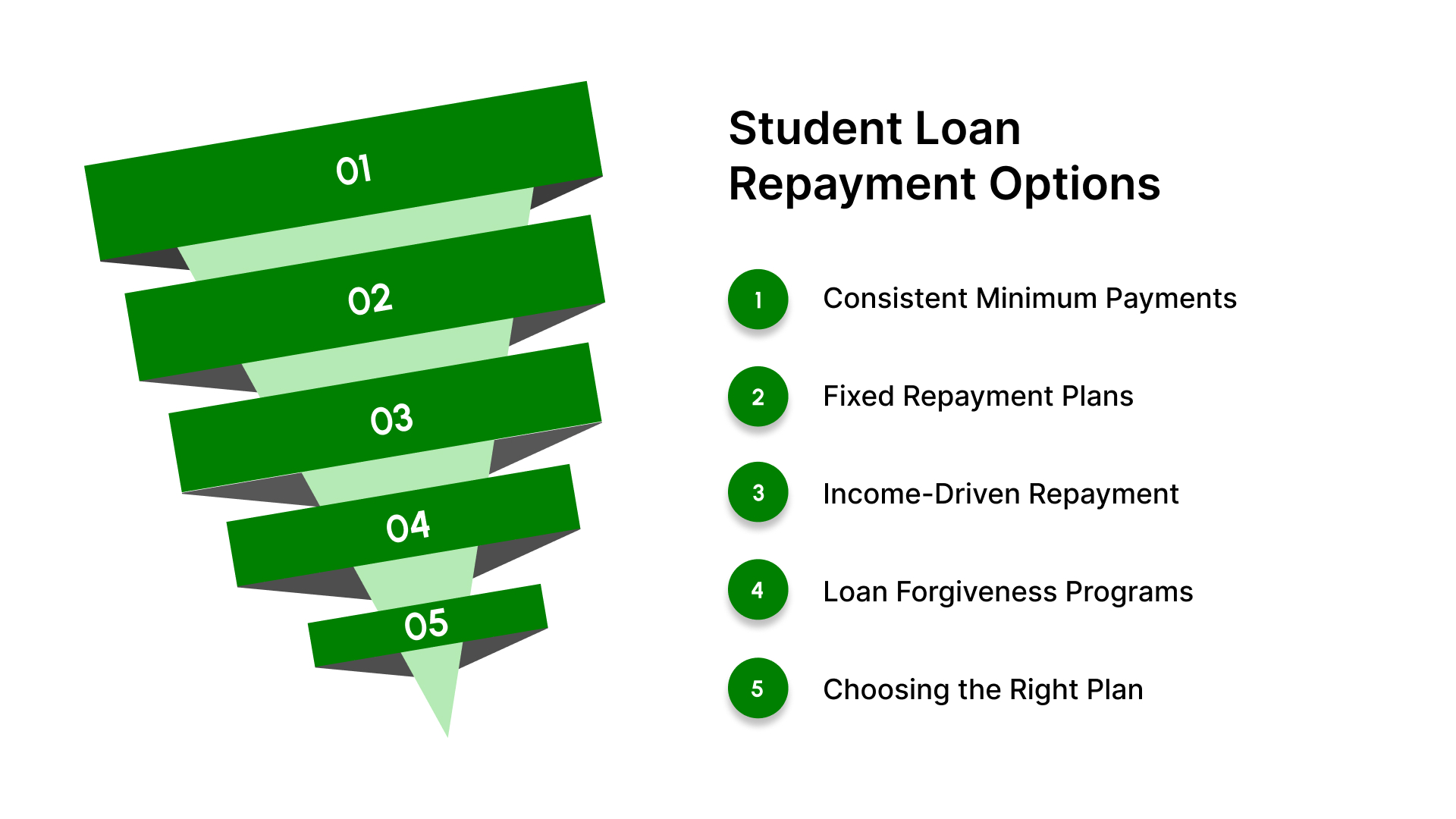
Student loan repayment is not limited to a single path. The option you choose depends on your income, loan type, and how manageable your current payments feel. The key is to understand what is available and choose an approach that keeps your payments consistent without creating additional financial strain.
Rather than focusing only on paying the debt quickly, the goal should be to stay on track and avoid falling behind, while making progress at a pace you can maintain.
Make Your Minimum Payments Consistently
Every repayment plan starts with meeting your minimum monthly obligation. This is the baseline that keeps your account in good standing and prevents additional complications.
- Paying on time helps you avoid late fees and negative credit impact, which can make future financial decisions more difficult
- Consistency matters more than occasional large payments, as missed payments can reset progress
- If your situation allows, adding extra payments toward the principal can reduce the total interest paid over time
Even small additional contributions can make a noticeable difference when applied regularly.
Fixed Repayment Plans for Predictable Payments
Fixed repayment plans follow a set schedule where your monthly payment is calculated upfront and remains the same throughout the repayment period. This means your payment does not change based on your income, giving you a clear timeline for when your loan will be fully paid off.
- Standard repayment plan: This is the default plan for most federal loans. Your total loan amount is divided into equal monthly payments, usually over 10 years. Each payment includes both the original loan amount (principal) and interest, which is the cost of borrowing. Because the timeline is shorter, this plan typically results in less total interest paid.
- Graduated repayment plan: In this plan, payments start lower and increase gradually, usually every two years. It is designed for borrowers who expect their income to grow over time. While it can make early payments more manageable, the increasing structure often leads to higher overall interest costs.
- Extended repayment plan: This option stretches your repayment period up to 25 years, which reduces your monthly payment amount. However, because you are paying over a longer period, more interest builds up, increasing the total amount you repay over time.
- Revised standard plans (from 2026 onward): Newer versions of standard repayment plans may adjust the repayment period based on your loan size. Larger balances may come with longer timelines, offering lower monthly payments while still keeping a fixed structure.
These plans work best if your income is stable and you prefer a clear, predictable path to becoming debt-free.
Income-Driven Repayment Options for Flexibility
Income-driven repayment plans are designed to make payments more manageable by linking them to your income instead of your total loan balance. This means your monthly payment adjusts based on what you earn and, in some cases, your household size.
- How income-based payments work: Instead of paying a fixed amount, your payment is calculated as a percentage of your discretionary income. This allows payments to stay affordable, especially during periods of lower earnings.
- Existing plans and gradual phase-out: Plans such as Income-Based Repayment (IBR), Pay As You Earn (PAYE), and similar options are still available for existing borrowers. However, these are being phased out over time, meaning new borrowers may not have access to all of them in the future.
- New repayment structures from 2026: A Repayment Assistance Plan (RAP) is expected to become a primary option for many borrowers. This type of plan adjusts payments dynamically as income changes, making it more responsive to real-life financial situations.
- Eligibility differences across loan types: Not all borrowers qualify for income-driven plans. For example, certain loan types, such as Parent PLUS loans, may have limited access unless specific conditions are met.
These plans are useful if your income is inconsistent or if fixed payments feel too restrictive.
Loan Forgiveness and Assistance Programs
Some repayment paths include the possibility of having a portion of your loan forgiven, meaning you are no longer required to repay that remaining balance after meeting certain conditions.
- Public Service Loan Forgiveness (PSLF): This program applies to borrowers working full-time in qualifying public service roles, such as government or nonprofit organizations. After making a required number of qualifying payments, the remaining balance may be forgiven.
- Teacher Loan Forgiveness: Teachers who work in eligible schools for a specific number of years may qualify to have a portion of their loans forgiven. The amount depends on the subject taught and other criteria.
- Employer repayment assistance: Some employers offer financial support toward student loans as part of their benefits. This can reduce your balance faster without increasing your own monthly payments.
It is important to understand that these programs have strict eligibility rules and documentation requirements, so they should be approached with clarity and careful tracking.
Choosing the Right Option for Your Situation?
The right repayment plan depends on how stable your income is, how quickly you want to repay the loan, and how much flexibility you need along the way.
- Fixed plans offer clarity and faster payoff, but require consistent income
- Income-driven plans provide flexibility but may extend repayment timelines
- Assistance programs can help, but they depend on eligibility and long-term commitments
The key is to choose a plan you can realistically maintain. A structured, consistent approach is far more effective than switching between options or delaying payments when things become uncertain.
What to Do If You Can’t Pay Your Student Loans?
If keeping up with your student loan payments becomes difficult, the most important thing is not to ignore the situation.
There are structured options available that can help you pause, adjust, or resolve your payments depending on where your loan stands:
- Request temporary relief through deferment or forbearance: These options allow you to pause or reduce your payments for a limited time if you are facing financial difficulty. Deferment may pause interest in certain cases, while forbearance usually allows interest to continue building, which can increase your total balance over time.
- Consider loan rehabilitation if your loan is in default: If your loan has already defaulted, rehabilitation allows you to bring it back into good standing by making a series of consistent, agreed-upon payments. This process helps reset your loan status and can reopen access to structured repayment options.
- Explore settlement if the loan has progressed further: In some situations, particularly when loans are significantly overdue or in collections, it may be possible to resolve the balance for less than the full amount. This depends on the type of loan and its current status, and it typically requires a clear agreement before proceeding.
- Avoid taking on additional debt while managing existing loans: Using credit cards or new loans to manage current obligations can increase financial pressure and make repayment more difficult. It is more effective to financially stabilize your current situation and focus on structured repayment.
- Take action early instead of delaying decisions: Addressing the issue as soon as payments become difficult gives you more flexibility and access to options. Waiting too long can limit your choices and make the process more restrictive.
Also read: What to Do If Sued for Debt in California
Approaching the situation this way helps you stay in control, even when payments feel difficult, and allows you to move toward a more structured and manageable resolution.
6 Best Tips on Paying Student Loans

Paying student loans well is more about doing the right things in the right order. The most effective moves are the ones that lower your total interest, protect you from missed payments, and keep your repayment plan workable as life changes.
Here are our best tips:
- Compare repayment plans before you commit to one: If you have federal loans, use the Loan Simulator to compare monthly payments, total interest, and eligibility before choosing a plan. That gives you a clearer picture of what you are signing up for, instead of locking into a repayment structure that looks manageable now but becomes difficult later.
- Move your due date to match your pay cycle: If your loan payment falls before payday, ask your servicer to adjust the due date so it fits your income schedule. This is a practical fix, but it can make a major difference by reducing the risk of accidental late payments and cash-flow stress.
- Use autopay only when it actually works for your budget: Direct debit can lower your interest rate by 0.25% on many federal loans, and it also removes the chance of forgetting a payment. It is especially useful if your income is stable enough that the automatic withdrawal will not disrupt your regular expenses.
- Tell your servicer exactly how to apply extra payments: If you pay more than the minimum, ask for that extra amount to go toward principal or toward your highest-interest loan first. That way, the payment reduces the balance faster and saves more interest over time instead of just sitting on the account.
- Pay early when interest is still growing behind the scenes: Interest can build while you are in school, during grace periods, and during deferment or forbearance, especially on unsubsidized loans. Even modest payments during those periods can help reduce capitalization, which is when unpaid interest gets added to the principal and starts earning interest itself.
- Use one-off money to make a real dent in the balance: If you receive a tax refund or another unexpected lump sum, consider putting it toward your student loans instead of letting it get absorbed into regular spending. Federal guidance notes that this kind of extra payment can help reduce both the time it takes to pay off the loan and the interest you pay along the way.
These are the kinds of moves that make repayment feel less random and more deliberate.
Conclusion
Managing student loan debt is not about having a perfect plan from day one. It is about knowing your loan type, choosing a repayment path that fits your income, and adjusting early when things change.
When you stay proactive, the loan becomes easier to manage and less likely to create avoidable pressure later. And if your account has already become past due or you are being contacted about it, the next step is to deal with it clearly instead of putting it off.
If your student debt is being handled by The Forest Hill Management, log in to review your account, understand your balance, and explore your repayment options. Taking that step now can make the process feel far more manageable.
FAQs
1. Can I switch my loan servicer if I am not satisfied with how my loan is managed?
In most cases, you cannot choose your servicer directly, but your loan may be transferred between servicers. You will be notified if this happens and should review the new details carefully.
2. Do student loan payments always stay the same throughout repayment?
Not necessarily. Payments can change depending on the repayment plan you choose, especially if you are on an income-driven plan or if your loan terms are updated.
3. What happens if I make a payment after the due date?
Late payments may result in additional fees and can impact your credit profile if delays continue. It is important to check how your servicer handles late payments.
4. Can I repay my student loan early without penalties?
Most federal student loans do not have prepayment penalties, which means you can pay more than required or close the loan early without extra charges.
5. How do I keep track of multiple student loans at once?
You can organize them by listing each loan with its balance, interest rate, and servicer details, which helps you manage payments and prioritize effectively.