-p-500%20(1).png)
How to Create an Effective Debt Repayment Plan
Need Help Reviewing Your Account?
Contact UsIf you’ve ever tried to pay off debt without a clear plan, you may have noticed how easy it is to stay busy without actually feeling progress. One payment gets made, another gets delayed, and over time, it becomes harder to tell whether your efforts are really moving things forward.
This is a situation many people are facing today. In the United States, credit card balances reached $1.28 trillion in Q4 2025, according to the Federal Reserve Bank of New York. At the same time, interest rates on accounts assessed interest have remained high, with averages around 22.30% in late 2025 based on Federal Reserve data.
Without a structured approach, high balances and interest can make repayment feel slow and unpredictable.
In this blog, you will learn how to create a debt repayment plan step by step, how to choose an approach that fits your situation, what challenges to expect, and how to stay on track while working toward a resolution.
Key Takeaways
- A debt repayment plan gives structure to your payments by organizing balances, timelines, and priorities into a clear and manageable system.
- Without a plan, payments can become inconsistent, progress is harder to track, and the overall process may feel more stressful and unstructured.
- Creating a plan step by step—by listing debts, setting a realistic budget, and choosing a strategy—makes repayment more predictable and easier to follow.
- Challenges such as unclear information, multiple accounts, or changing financial situations are common and can be managed with a flexible and practical approach.
- Consistency, clear records, and regular adjustments help keep your repayment plan effective over time, even when circumstances change.
What Does a Debt Repayment Plan Actually Mean?

A debt repayment plan is a structured way for you to pay off what you owe over time. It is more than simply making payments when you can. It gives your debt a clear order by organizing your balances, payment schedule, and priorities, making the process feel more manageable.
A repayment plan helps you understand three things: how much you owe, when payments are due, and how your balance will be reduced over time. That clarity matters because it turns an overwhelming situation into a plan you can follow step by step.
A well-structured repayment plan typically includes:
- Your total amount owed: This gives you a complete picture of your financial obligations, so you are not working with partial or unclear information. Knowing the full amount helps you plan your next steps more confidently.
- Your monthly payment commitments: A repayment plan outlines what you can realistically pay each month based on your financial situation. This helps ensure that payments remain consistent without creating additional strain.
- A defined repayment timeline: Understanding how long it may take to resolve your balances helps set expectations and gives you a clearer sense of progress over time.
- A structured approach to reducing your balances: Instead of making uncoordinated payments, a plan ensures your payments are applied in a way that steadily reduces what you owe.
Also read: 11 Best Tips to Pay Off Debt Fast
A debt repayment plan is about clarity and predictability, not pressure. When your payments are organized in a structured way, it becomes easier to understand your options and move forward with confidence.
Why Creating a Debt Repayment Plan Matters
Without a structured plan, debt tends to feel more chaotic than it needs to be. Over time, that lack of structure can make the situation feel heavier, even when the debt itself has not changed.
A repayment plan gives you a way to stop reacting and start organizing. It helps you decide what needs attention first, how much you can realistically commit each month, and how to keep your payments moving in a steady direction.
Here is what often happens when there is no clear repayment plan in place:
- Payments become inconsistent: You may pay one account while unintentionally falling behind on another. That uneven approach can make it harder to reduce balances in a meaningful way.
- Balances feel harder to track: Without a clear plan, it is easy to lose sight of due dates, payment amounts, and account status. That can lead to confusion and missed opportunities to stay current.
- Stress increases with every notice: When there is no structure, each new reminder or statement can feel like a separate problem. Instead of one plan, you are left managing a series of urgent decisions.
- Progress becomes difficult to measure: If you are not following a clear repayment path, it is hard to know whether your efforts are actually helping. Small payments may feel like they disappear into the background without visible movement.
- You may spend more over time: When balances are left unstructured for too long, fees, interest, or repeated missed payments can make the situation more difficult to resolve later.
A repayment plan changes that experience. It gives you a clearer order of operations, makes your next step easier to identify, and helps turn a stressful financial issue into something more manageable.
Step-by-Step: How to Create a Debt Repayment Plan
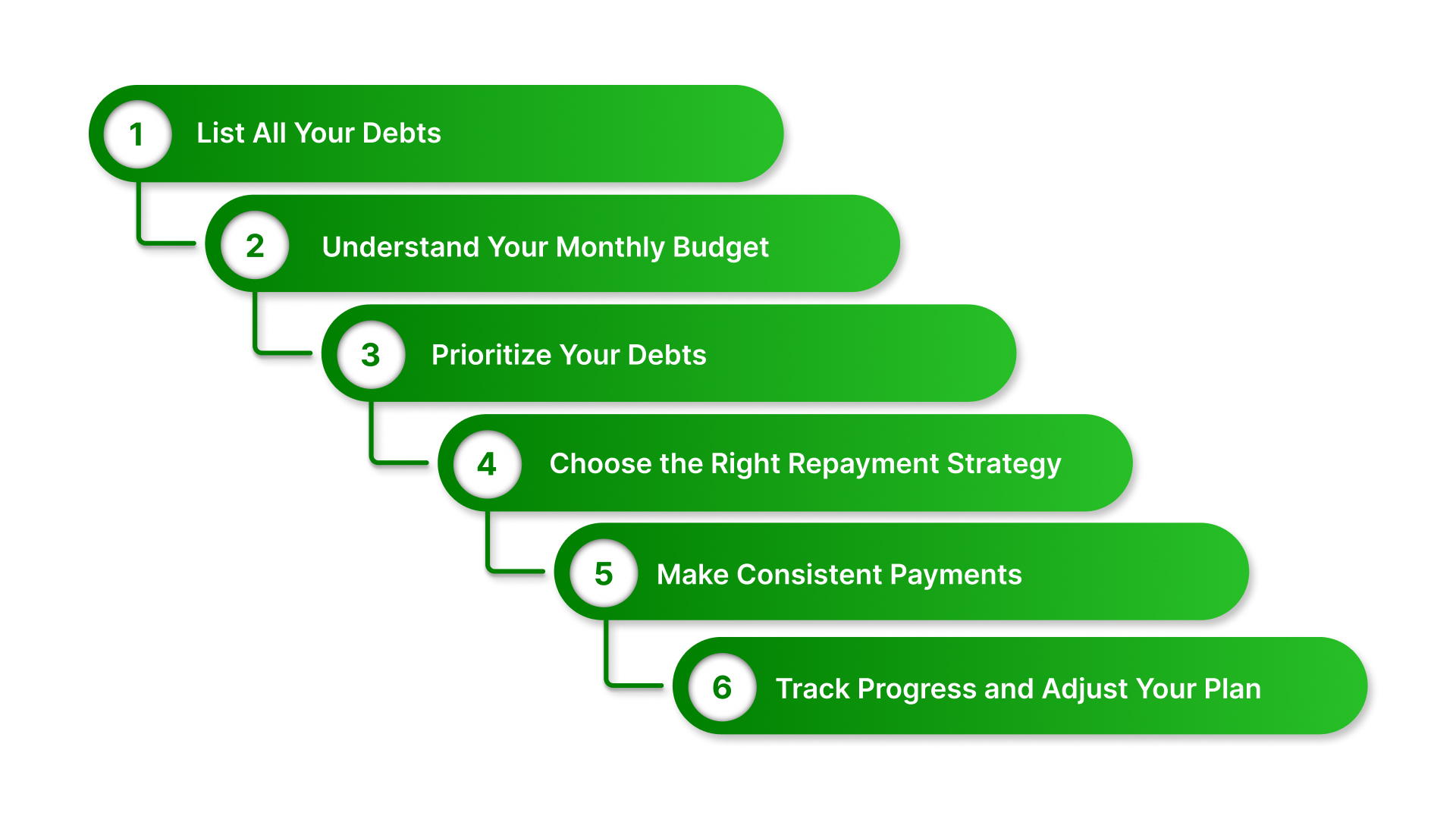
Creating a debt repayment plan works best when you approach it in order, rather than trying to fix everything at once.
Here is a practical step-by-step process you can follow:
Step 1: List All Your Debts
Start by writing down every account you need to manage. This gives you a complete picture instead of forcing you to rely on memory or scattered statements.
Include:
- Balances so you know the total amount tied to each account
- Interest rates so you can see which balances may grow faster over time
- Minimum payments so you understand the least amount due each month
- Account status so you know whether each balance is current, overdue, or in collections
This step matters because it replaces uncertainty with a clear starting point. Once everything is in one place, it becomes easier to decide what needs attention first.
Step 2: Understand What You Can Afford Monthly
A repayment plan only works if it fits your real budget. Before deciding what to pay, compare your monthly income with your essential expenses so you can see what is actually left over.
Focus on:
- Income versus expenses to determine your available monthly amount
- Realistic repayment capacity so you do not commit to more than you can sustain
- Avoiding overcommitment so your plan remains manageable over time
A plan that is too aggressive may fall apart quickly. A realistic one gives you a better chance of staying consistent.
Step 3: Prioritize Your Debts
Once you know what you owe and what you can afford, decide which balances need the most attention. There are two common ways to do this.
- Snowball method: You focus on the smallest balance first. This can create quick wins and help you stay motivated as you eliminate individual accounts one by one.
- Avalanche method: You focus on the highest interest rate first. This may save more money over time because you reduce the most expensive debt sooner.
- Keep minimum payments current on all accounts: Even if you decide to focus extra money on one balance first, continue making at least the minimum payment on every other account. This helps reduce the risk of additional late fees, credit damage, or further account escalation while you work through your plan.
Neither method is right for everyone. The better choice is the one that matches your financial situation and helps you stay on track.
Step 4: Choose a Repayment Strategy That Fits You
A repayment plan should be based on your actual circumstances, not a one-size-fits-all formula. What works well for one person may not be realistic for another.
Think about:
- Your income, especially how stable it is from month to month
- The number of accounts you are managing
- Your overall financial stability, including whether your situation is likely to improve or stay tight for a while
The goal is not to create the perfect plan on paper. The goal is to create one you can actually follow.
Step 5: Make Consistent Payments, Even If They Are Small
Progress matters more than perfection. Even modest payments can help reduce balances when they are made regularly and on time.
Keep in mind:
- More than the minimum, when possible, helps reduce principal faster
- Consistency matters more than intensity
- Regular payments build momentum and reduce the chance of falling behind again
A smaller payment that happens every month is more useful than a larger payment that cannot be sustained. Stability is what makes the plan work.
Step 6: Track Progress and Adjust When Needed
A debt repayment plan should not stay frozen if your situation changes. Review your balances regularly so you can see what is improving and what may need to be adjusted.
Make sure to:
- Review balances regularly, so you know where you stand
- Adjust the plan if your situation changes, such as a shift in income or new expenses
- Keep records of payments, so you have proof of what has been paid and when
Tracking your progress helps you stay in control. It also makes it easier to spot issues early instead of waiting until they become harder to manage.
A repayment plan works best when it stays clear, realistic, and flexible. Once you know what you owe, what you can afford, and how you want to prioritize your accounts, the process becomes far more manageable.
What If You Can’t Afford Your Debt Repayment Plan?
Sometimes, even after creating a plan, the numbers simply do not work. Your income may not leave enough room for meaningful payments, or unexpected expenses may make consistency difficult.
If that happens, it does not mean you have failed. It means your plan needs to adapt to your current reality.
Here are practical ways to handle this situation:
- Revisit your budget and trim non-essential expenses: Start by reviewing where your money is going each month. Even small adjustments, such as reducing discretionary spending, can create some breathing room for payments.
- Focus on staying current rather than aggressive repayment: If paying extra is not possible, aim to keep minimum payments consistent. This helps you maintain stability while avoiding additional penalties or account escalation.
- Consider debt consolidation if it fits your situation: Combining multiple balances into one payment may make your obligations easier to manage. It can also help you keep track of fewer due dates and payment amounts.
- Use tools or apps to track and organize payments: Digital tools can help you visualize your balances, due dates, and progress. This can make the process feel less overwhelming and easier to follow.
- Build a small emergency buffer when possible: Even a modest reserve can help you handle unexpected costs without interrupting your repayment plan. This reduces the risk of falling behind again.
- Seek accountability or support if needed: Talking to a financial advisor, credit counselor, or even a trusted individual can help you stay consistent and make more informed decisions.
- Adjust the plan instead of abandoning it: If your situation changes, update your repayment approach. A slower plan that you can follow is more effective than an aggressive one that breaks down quickly.
When a repayment plan feels out of reach, the solution is not to stop. It is to simplify, adjust, and continue at a pace that works for you.
Common Challenges When Building a Debt Repayment Plan
Creating a repayment plan sounds straightforward, but in practice, it can come with a few challenges. These challenges do not mean you are doing something wrong. They are a normal part of trying to organize multiple accounts, balances, and financial priorities at the same time.
Understanding these difficulties in advance can help you approach the process with more clarity and make adjustments where needed.
- Unclear or incomplete account information: It can be difficult to build a plan if you are not fully sure about your balances, payment history, or account status. Missing details or outdated information can make it harder to decide how much to pay or which account to prioritize.
- Difficulty estimating what you can afford: Monthly income and expenses are not always predictable. You may find it challenging to determine a repayment amount that is realistic without affecting essential expenses like rent, utilities, or groceries.
- Managing multiple accounts at once: When you have more than one account, keeping track of due dates, payment amounts, and priorities can feel overwhelming. Without structure, it becomes harder to stay consistent across all accounts.
- Choosing the right repayment approach: With different strategies available, such as focusing on smaller balances first or higher interest accounts, it can be confusing to decide which method fits your situation best.
- Staying consistent over time: Even a well-planned repayment strategy requires consistency. Changes in income, unexpected expenses, or life events can interrupt your progress and make it difficult to stay on track.
- Emotional stress and uncertainty: Financial situations often carry stress, which can affect decision-making. Feeling overwhelmed may lead to delaying actions or avoiding communication, which can make the process feel more complicated.
- Lack of structured support or guidance: Trying to manage everything on your own can make the process feel isolating. Without clear communication or access to accurate account information, it becomes harder to move forward confidently.
These challenges are common, and they do not prevent you from creating a repayment plan. In many cases, having access to clear account information, structured communication, and manageable repayment options can make the process much easier to navigate.
Tips for Keeping a Debt Repayment Plan on Track

A repayment plan only helps if it remains usable in real life. The goal is not to build something perfect on paper, but to keep the process steady enough that you can follow it even when your circumstances change.
- Build in a small buffer: A plan becomes harder to follow when it leaves no room for unexpected costs. Leaving a little flexibility in your budget can make it easier to stay consistent if something unplanned comes up.
- Keep your records in one place: When payment confirmations, account notices, and written agreements are scattered, it becomes easier to lose track of what has already been done. Keeping everything together gives you a clearer reference point when you need it.
- Pay attention to changes in your situation: A repayment plan should reflect your current reality, not just the situation you had when you first created it. If your income, expenses, or obligations change, reviewing the plan can help it stay realistic.
- Use written confirmation whenever possible: Clear written records help reduce confusion later. If a payment arrangement changes or a question comes up about your balance, written documentation gives you something reliable to refer back to.
- Avoid treating missed progress as failure: A setback does not mean the plan is useless. The important part is adjusting quickly and continuing with a structure that still makes sense for your situation.
- Stay in communication if something shifts: If a payment becomes difficult or your circumstances change, staying silent usually makes the situation more stressful. Reaching out early can help keep the process more manageable and prevent avoidable confusion.
Also read: How to Get Ahead Financially: Tips for U.S. Borrowers
A repayment plan works best when it is treated as a living process rather than a fixed rule. Small adjustments, clear records, and steady communication can make it much easier to follow over time.
Conclusion
Creating a debt repayment plan is not about fixing everything at once. It is about bringing structure to a situation that may currently feel uncertain. When you understand your balances, know what you can realistically afford, and follow a consistent approach, debt becomes easier to manage over time.
To recap, a strong repayment plan starts by listing all debts, setting payment priorities, choosing a strategy you can actually sustain, and reviewing progress regularly. Just as important, keep minimum payments current where possible and adjust the plan when your circumstances change.
If your account is being managed by The Forest Hill Management, you can review your balance, explore payment options, and take the next step through a clear and structured process.
Take the next step toward financial clarity by reviewing your account or contacting our team for support today.
FAQs
1. Should I focus on clearing one account completely or paying all accounts at the same time?
This depends on what helps you stay consistent. Some people prefer closing one account fully for clarity, while others spread payments across accounts to stay current on all balances.
2. Is it better to automate payments or make them manually?
Automating payments can help maintain consistency and avoid missed due dates, while manual payments may offer more control if your income or expenses vary month to month.
3. How do I stay motivated during a long repayment plan?
Tracking visible milestones, such as reducing a balance below a certain amount or completing a percentage of your plan, can help maintain a sense of progress.
4. What should I do if I receive new notices while following my plan?
Review the notice carefully and compare it with your existing plan. If something is unclear, it’s helpful to verify the details before making any changes to your approach.
5. Can I combine multiple debts into one repayment structure?
In some cases, debts can be organized into a single structured plan or managed through coordinated payments, depending on your situation and the accounts involved.