-p-500%20(1).png)
9 Financial Planning Tips to Shrink Debt Before 2026 Begins

Need Help Reviewing Your Account?
Contact UsDebt rarely grows because of one big decision; it grows through dozens of ordinary moments when life simply costs more than expected. The latest data from the Federal Reserve Bank of New York show that household debt climbed to $18.59 trillion in Q3 2025, with 4.49 percent already slipping into delinquency.
Numbers like these highlight a simple truth: shrinking debt requires planning, not pressure. This guide shares practical, realistic financial planning tips to help you reduce debt step by step before 2026 begins, with repayment-focused strategies you can act on now.
At a glance:
- Smart planning reduces emotional and financial pressure. When you structure your money with intention, debt becomes easier to manage and less overwhelming.
- High-impact year-end steps can shrink debt quickly. Interest audits, renegotiated rates, and cleaned-up expenses free money without major lifestyle changes.
- Pay-period budgeting increases stability. Aligning bills to income timing prevents overdrafts, late fees, and reliance on credit during tight weeks.
- Buffers and sinking funds protect long-term progress. Small cushions stop emergencies from undoing months of effort and keep your plan intact.
- Outdated rules no longer fit today’s financial realities. Rigid formulas and one-size-fits-all budgets can backfire, so flexible, adaptive planning works better.
Smart Planning Reduces the Stress of Managing Debt
“Financial knowledge is financial power,” according to the California Department of Financial Protection and Innovation (DFPI).
When you build a thoughtful plan rather than reacting to bills and balances, you take away much of the stress that comes with debt. By using innovative planning strategies, you can feel more confident, grounded, and in control of your path forward.
This is how planning reduces stress and supports your financial goals:
- Forecast Expected Cash Flow: Map your income and fixed expenses ahead of time so you anticipate shortfalls instead of being surprised. This reduces anxiety and helps you stay on track even when unexpected costs appear.
- Match Payment Timing to Income Arrivals: Align your payment dates with when money is actually received (weekly, bi-weekly, or irregularly). By doing so, you avoid missed payments, overdrafts, and cascading charges that often derail repayment plans.
- Automate Routine Transfers: Set up automatic transfers for debt repayments and micro-savings so you bypass decision fatigue. This removes the emotional burden of “should I pay” each time your paycheck hits.
- Create Tiered Buffers for Known Risks: Instead of one vague savings goal, build separate, small buffers for specific issues, such as repair, medical costs, or job changes. Having dedicated funds prevents emergencies from turning into new debt.
- Use Rolling Review Checkpoints: Every quarter, review your plan, adjust timelines, and reallocate any surplus resources. This ensures the plan stays realistic and responsive to your life, rather than becoming outdated.
Taking these steps now, before the end of the year, puts you ahead of the game. You won’t be scrambling when 2026 begins; you will already have momentum, breathing room, and a clear path. There is no need to wait until January 1st. Starting right now gives you a head start and less stress.
Next, we will look at strategies that will help you move from structure into action.
Suggested Read: Essential Personal Finance Tips for Beginners
High-Impact Financial Planning Tips to Reduce Debt
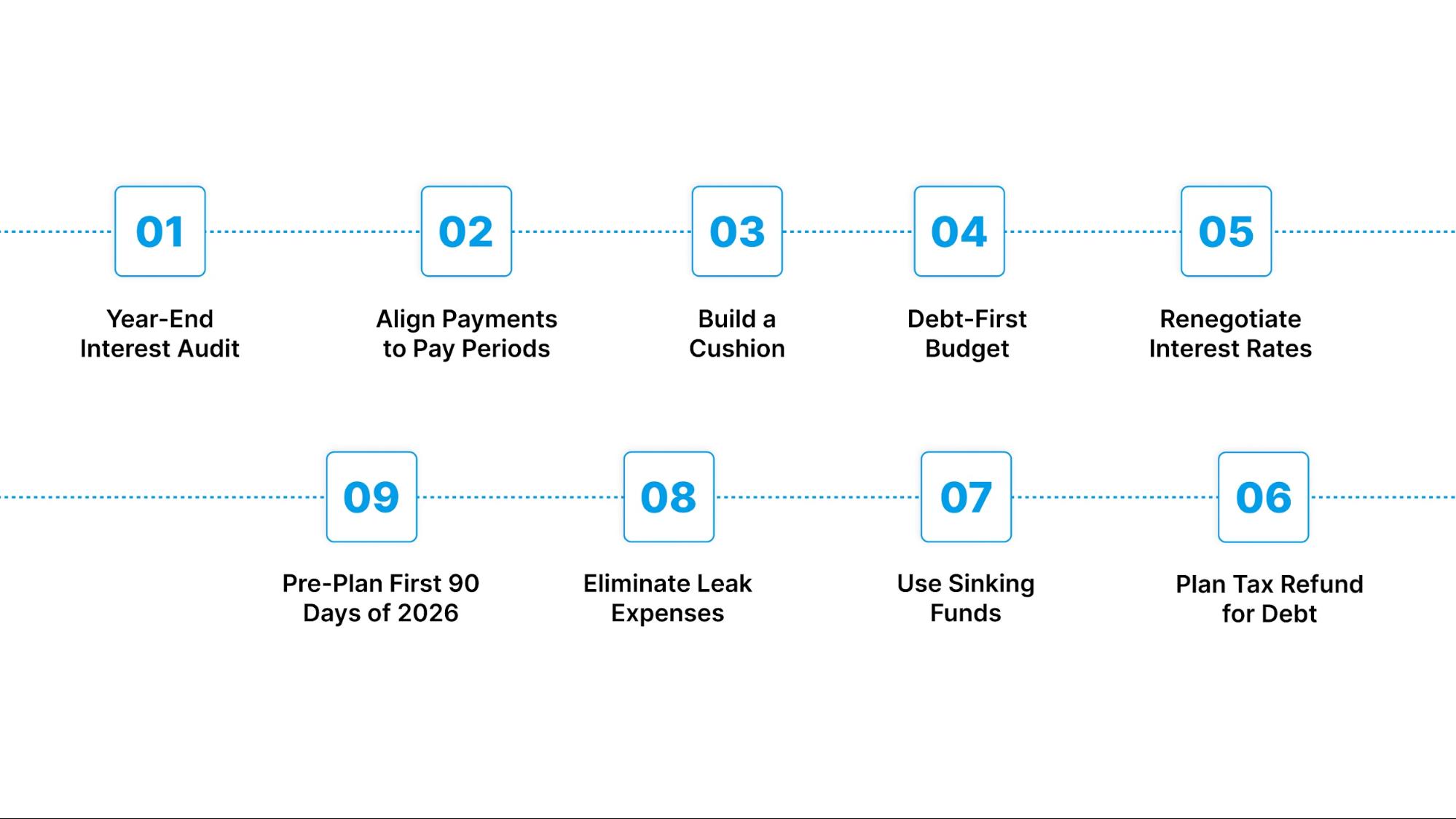
These tips were chosen because they create meaningful, measurable progress quickly, especially at the end of the year when income changes, seasonal expenses, and tax planning open unique opportunities to shrink debt.
Each strategy helps you improve cash flow, strengthen stability, and free up money that you can redirect toward paying off debt before 2026 begins.
Tip 1: Do a Year-End Interest Cost Audit
Interest (not the balance) is often what keeps people in long-term debt. A year-end interest audit shows the true daily cost of each account so you can prioritize the ones draining your budget the fastest. Seeing the numbers clearly turns overwhelming debt into a structured plan.
To complete your year-end interest audit:
- List each balance with its APR and compute the daily interest cost.
- Rank your debts from most expensive to least expensive.
- Note any cards scheduled for APR increases in January.
This closes the gap between where your money should be going and where it is quietly leaking. Once you see the real daily cost, your repayment priorities become clearer and more financially sound.
Tip 2: Match Payments to Your Pay Periods
A monthly budget is rarely effective when income arrives on a weekly or biweekly basis. Restructuring payments to match your pay schedule stabilizes your cash flow, prevents overdrafts, and eliminates mid-cycle stress. This works especially well during busy year-end months with irregular spending.
To structure your budget around your actual pay cycle:
- Assign each paycheck its own bills and debt contributions.
- Divide large bills across multiple pay periods.
- Automate payments to remove timing gaps.
This transforms your money pattern from unpredictable to steady. Over time, paychecks become tools you control instead of deadlines you chase.
Imagine you are paid every Friday, but rent, utilities, and credit cards all hit the first week. Every January, you fall behind; not because you overspend, but because timing works against you. By splitting bills across paychecks, you create real breathing room and escape the cycle entirely.
Tip 3: Build a Rapid-Response Cushion
End-of-year expenses often bring surprise costs. A small $200–$300 cushion prevents emergencies from pushing you into new debt and protects the progress you are working so hard to make. Think of it as a safety valve for your debt plan.
To build this protective buffer quickly:
- Use refunds, small bonuses, or subscription savings.
- Set aside a fixed amount from your next 2–3 paychecks.
- Keep the buffer in its own separate account.
Small buffers have an outsized impact because they prevent setbacks from derailing your plan. With a safety margin in place, your debt payments stay uninterrupted even when life becomes unpredictable.
Tip 4: Redesign Your Budget Using a “Debt-First” Structure
A debt-first budget prioritizes repayment, not an afterthought. By placing debt contributions at the top of your budget, you guarantee consistent progress rather than hoping leftover money appears. December is the ideal time to redesign your structure with intention.
To build a strong debt-first framework:
- Set a fixed monthly debt amount first.
- Adjust discretionary categories only after debt is accounted for.
- Track quarterly progress instead of monthly perfection.
This method transforms repayment from a wish into a routine. Even small commitments compound when they’re protected.
Say you commit $120 a month to debt before planning anything else. That becomes $1,440 of guaranteed annual progress. If you relied on “what’s left,” you might only put half of that toward debt. Prioritizing repayment first protects your momentum, even in expensive months.
Tip 5: Renegotiate Interest Before January
Year-end is a strategic time to request an APR reduction, as many creditors update their terms at the start of the year. Even a small rate drop can significantly accelerate your repayment timeline.
To renegotiate effectively:
- Ask whether your APR can be reviewed going into the new year.
- Request temporary hardship adjustments if needed.
- Ask to shift due dates to match your pay cycle.
Forest Hill Management prioritizes clear, timely communication, whether you are reviewing your budget, adjusting your repayment plan, or facing unexpected financial stress. Our team is always ready to answer questions, explain options, and help you stay on track. Speak with one of our financial advisors today to build a plan that fits your real-world needs.
Tip 6: Pre-Plan Your Tax Refund for Debt Reduction
Your tax refund can be one of the most powerful debt-reduction tools you receive all year. Planning its purpose early helps you avoid impulsive spending when the money arrives. This turns a once-a-year opportunity into a strategic advantage.
To lock in your tax refund strategy now:
- Estimate your refund using IRS calculators.
- Decide what percentage goes to debt.
- Apply the amount to your highest-cost debt first.
This strategy gives your debt plan a substantial early-year boost and helps you start with a clearer path.
Tip 7: Use Sinking Funds to Prevent Recurring Surprises
Sinking funds convert predictable annual or seasonal expenses into manageable monthly amounts. This stops those expenses from hitting your credit card and derailing your progress at the worst possible time.
To create strong sinking funds:
- Identify annual expenses (insurance, school fees, maintenance).
- Divide the total by 12.
- Set up automatic monthly transfers to a separate account.
These funds act like “shock absorbers” for your budget, reducing stress and keeping you away from new debt.
Tip 8: Remove Leak Expenses
Leak expenses are the small, forgotten costs that steal money you could use for debt. A year-end cleanout helps you reclaim cash with no lifestyle change at all.
To complete an effective cleanout:
- Review subscription renewals and unused memberships.
- Check accounts for app charges or bank fees.
- Cancel anything you haven’t used in 90+ days.
This is one of the simplest ways to give yourself a permanent raise. Every subscription you remove becomes steady debt repayment money.
If you cancel three subscriptions costing $12, $8, and $15, you instantly recover $35 per month — $420 per year — without changing any habit you care about. Redirecting that same $35 to high-interest debt shortens your payoff timeline while reducing interest loss.
Tip 9: Set Your First 90 Days of 2026 in Advance
The first quarter often determines whether your debt plan sticks or collapses under pressure. Planning it early removes uncertainty and gives you a clear roadmap.
To set up your first 90 days:
- Pick one debt to target.
- Set a monthly payment goal for Jan–Mar.
Pre-schedule your payments and buffers. This gives your plan structure before the new year begins. With the hardest part decided in advance, following through becomes much easier.
As you move into 2026, relying on outdated formulas can slow your progress or even increase your debt burden. The next section lists the strategies that may not work for you.
Suggested Read: How To Pay Debt in Credit Collection Services
Outdated Financial Strategies That Could Backfire in 2026
Some financial rules look good on paper but fall apart when real life gets messy. Many of these older strategies were created for a time when expenses were predictable, interest rates were lower, and households had fewer financial pressures.
Here are strategies that often sound wise but can create problems today:
- The 70/20/10 Rule
This guideline assumes 70 percent for living expenses, 20 percent for savings, and 10 percent for goals or giving. With higher living costs and rising interest rates, most households cannot meet these ratios without sacrificing essential stability or falling behind on debt.
- The “Save First, Pay Debt Later” Approach
Saving is essential, but prioritizing large savings contributions before addressing high-interest balances increases long-term costs. High APR debt grows faster than most savings accounts, so this approach can quietly worsen your repayment timeline.
- The One-Account-Fits-All Budgeting Method
Using a single account for bills, spending, savings, and debt creates confusion and makes it easy to overspend without noticing. This increases the risk of missed payments, bank fees, and a skewed sense of your cash availability.
- Bare-Bones Budgeting as a Default Strategy
Extreme restriction leads to burnout and inconsistency. When your budget is too strict, unexpected expenses become unavoidable setbacks that push you back into debt.
Outdated strategies fail because they assume life is predictable and controllable. Modern financial planning recognizes that income, expenses, and emergencies fluctuate constantly, and your strategy must adapt accordingly.
Now let’s move to the small, overlooked mistakes that cause debt to grow even when you are trying your best.
Suggested Read: Is Paying Debt Collection Agencies a Bad Idea?
Planning Decisions That Quietly Increase Personal Debt
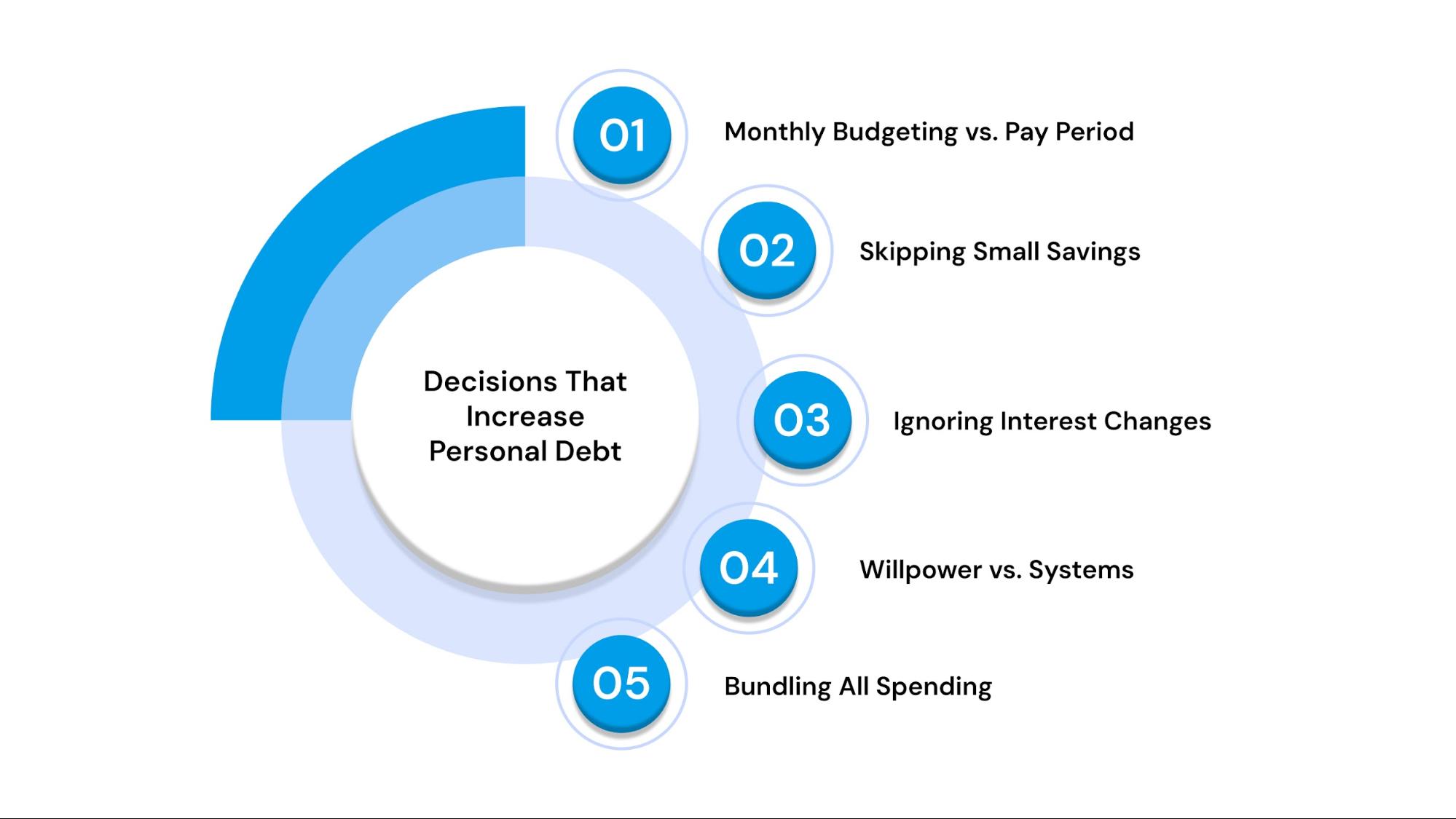
Some of the biggest shifts in your financial life come from small planning choices — both good and bad. Just as a few smart moves can shrink debt quickly, a handful of overlooked habits can quietly increase what you owe even when you are trying to do everything right.
These are the planning decisions that often increase debt without you realizing it:
- Planning Monthly Instead of by Pay Period: Monthly budgets ignore timing gaps, which can lead to overdrafts, late fees, and unexpected reliance on credit. Pay-period planning keeps your spending aligned with when money actually arrives.
- Skipping Small Savings During Repayment: Without a buffer, even minor surprise expenses push you back onto credit cards. Setting aside just $20–$40 per paycheck protects your plan from collapsing.
- Ignoring Interest Changes Throughout the Year: APRs shift, promo rates expire, and balances move around. If you do not update your strategy quarterly, interest quietly absorbs more of your progress.
- Relying on Willpower Instead of Systems: A plan built on self-control breaks down on stressful days. Automation and structured routines keep repayment predictable and reduce emotional pressure.
- Bundling All Spending Into One Checking Account: When bills, daily spending, and debt payments draw from the same pool, it becomes hard to see what is truly available. This often leads to unintentional overspending and missed or late payments.
These mistakes are not character flaws. They are planning issues, and they can be fixed with a better structure and clearer systems.
The team at Forest Hill Management understands your situation. Our goal is to help you move forward with a debt-repayment plan that reduces pressure rather than adding to it.
Suggested Read: Top 10 Money Management Tips to Help You Take Control
Achieve Financial Progress with Forest Hill Management
The Forest Hill Management is a receivables-management organisation that builds repayment plans around real people, real incomes, and real obligations. Instead of using standardized or rigid structures, we work with you to understand your financial reality and create a plan that feels manageable, respectful, and steady.
These are just a few ways we can support your financial progress:
- Personalized Repayment Plans: Your repayment schedule is designed around your income timing, household responsibilities, and budget, so you feel supported rather than overwhelmed.
- Flexible Payment Options: Payments can be adjusted or rescheduled when circumstances shift, allowing you to stay consistent even during unpredictable months.
- Clear, Supportive Communication: You receive guidance, reminders, and updates in simple, easy language so you always know what to expect and how you are progressing.
- Long-Term Structure Instead of Short-Term Pressure: We focus on steady, sustainable progress that fits your life, not quick fixes that collapse when something unexpected happens.
- Judgment-Free Guidance: Every conversation is respectful and focused on solutions. You are treated as a person, not a balance.
Paying off debt is one of the most powerful ways to make 2026 easier, calmer, and more financially secure. When you have a plan that fits your life, every payment becomes a step toward stability instead of a source of stress. With the right direction and support, your next year can feel clearer, lighter, and full of possibility.
Conclusion
Financial planning works best when it feels practical, humane, and rooted in the way real life unfolds. Momentum plays a larger role than motivation. Once you make even one small, repeatable financial change, it becomes easier for every other change to follow.
At Forest Hill Management, we focus on adaptability, not just repayment. If your income shifts, your plan shifts with you. If you face a difficult month, the support adjusts instead of resetting your progress. It is a partnership built around your real circumstances, not rigid expectations.
Choose an approach that adapts to your life instead of fitting you into a mold. Speak to us today.
Frequently Asked Questions
1. What is the 50/30/20 rule in your financial plan?
It is a budgeting guideline that allocates 50 percent of income to needs, 30 percent to wants, and 20 percent to savings or debt payments. It is a flexible framework, not a strict formula, and may need adjustment based on income, location, or debt levels.
2. What are the 5 pillars of financial planning?
The five pillars typically include budgeting, saving, investing, insurance protection, and retirement or future planning. Together, they create a balanced financial foundation that supports both short-term stability and long-term security.
3. What is the 70/20/10 rule money?
This rule suggests 70 percent of income goes to living expenses, 20 percent to savings or investments, and 10 percent to giving or financial goals. It is an older framework and may not work for modern households facing higher living costs or significant debt.
4. What is the 10-5-3 rule in finance?
It is a rule of thumb for expected long-term returns: stocks may average 10 percent per year, bonds around 5 percent, and cash or savings accounts about 3 percent. Actual returns vary, so this rule is a general guideline rather than a guarantee.
5. How often should you update your financial plan when managing debt?
Reviewing your plan at least quarterly is ideal, especially when interest rates, income, or expenses shift. Frequent check-ins help you make timely adjustments and ensure your debt strategy continues to match your actual financial situation.