-p-500%20(1).png)
How to Remove Collections from Your Credit Report

Need Help Reviewing Your Account?
Contact UsMost people don’t check their credit report expecting to find a collection account. It usually shows up unexpectedly, and when it does, the first reaction is often confused anxiety. Is it accurate? Can it be removed? What actually happens next?
Part of the confusion comes from how common these situations are. According to CNBC, credit card balances reached $1.28 trillion in the fourth quarter, rising by $44 billion and marking a 5.5% increase compared to 2024, often tied to debts people did not fully understand at the time they became overdue.
What makes this more complicated is the amount of conflicting advice out there. Some sources suggest every collection can be removed easily, while others imply nothing can be done. The truth sits in the middle. Removal depends on accuracy, verification, and how the account is reported.
In this blog, you’ll learn when collection accounts can actually be removed, the exact steps to approach it correctly, and how to handle the process without making assumptions that can set you back.
Key Takeaways
- Collection accounts can only be removed under specific conditions, primarily when there are errors, a lack of verification, or reporting issues, not simply because you want them gone.
- Reviewing your credit report carefully and identifying inconsistencies is the most effective starting point before taking any action.
- Methods like debt validation, disputes, and goodwill requests work differently depending on the status and accuracy of the account.
- Paying a collection does not automatically remove it from your credit report, and expectations should be aligned before making payments.
- Even if removal is not possible, resolving the account and rebuilding consistent financial behavior can still improve your overall credit position over time.
What Collection Accounts Mean on Your Credit Report?
A collection account signals that a debt has moved beyond the original repayment cycle and is now being handled separately, either by a third-party agency or a different division of the original creditor. This shift changes how the account is treated, both in terms of credit reporting and how lenders interpret it.
When a bill remains unpaid for a period of time, it is typically marked as delinquent. If the balance is still unresolved, it may then be assigned or transferred to collections, at which point a new entry can appear on your credit report. This entry is tied to the original debt but is reported as a separate event, which is why it often has a stronger impact.
What makes collection accounts particularly important is their timeline and persistence. Under standard credit reporting rules, most collection accounts can remain on your credit report for up to seven years from the date of first delinquency, not from when the account was sent to collections. This means even if the account changes hands or is reassigned, the original timeline still applies.
Another key aspect is how medical collections are treated differently from other types of debt. In recent years, credit reporting have introduced changes such as:
- A 365-day waiting period before medical collections appear on credit reports
- Removal of paid medical collections from reports
- Exclusion of smaller medical debts below a certain threshold
These changes are designed to give consumers more time to resolve accounts before they impact their credit profile, but they do not eliminate the importance of addressing the debt itself.
How Collections Affect Your Credit?
The impact of a collection account goes beyond a temporary score drop. It affects how your entire credit profile is viewed by lenders, especially when it comes to reliability and repayment behavior.
- It signals a breakdown in repayment history: Payment history is one of the most heavily weighted factors in credit scoring. A collection account indicates that a debt was not resolved within its original terms, which can lower confidence in future repayment behavior.
- It can lower your credit score, especially when recent: Newer collection accounts tend to have a stronger impact than older ones. Over time, their effect may reduce, but they still remain visible to lenders throughout the reporting period.
- It may affect your ability to access credit or favorable terms: Lenders often view collection accounts as higher risk indicators. This can result in higher interest rates, stricter approval conditions, or limited access to new credit.
- It can compound existing credit challenges: If there are already missed payments or high balances on your report, a collection account adds another layer of risk, making the overall profile more difficult to recover quickly.
- Its impact does not always end with payment: While paying a collection can change how it is viewed, it does not automatically remove it from your credit report unless specific conditions are met. This is why understanding the status of the account before taking action is important.
Also read: How to Pay Off Debt in Collections Safely
Collection accounts are often misunderstood because they appear late in the process, but they carry long-term implications. The key is not just knowing that they affect your credit, but understanding how and why, so you can take the right steps to address them properly.
How to Remove Collection Debt from Your Credit Report
Removing a collection account is about following the correct process based on how the account is reported, whether it is accurate, and whether it can be verified. Credit bureaus and collectors operate under strict guidelines, which means removal is possible only under specific conditions.
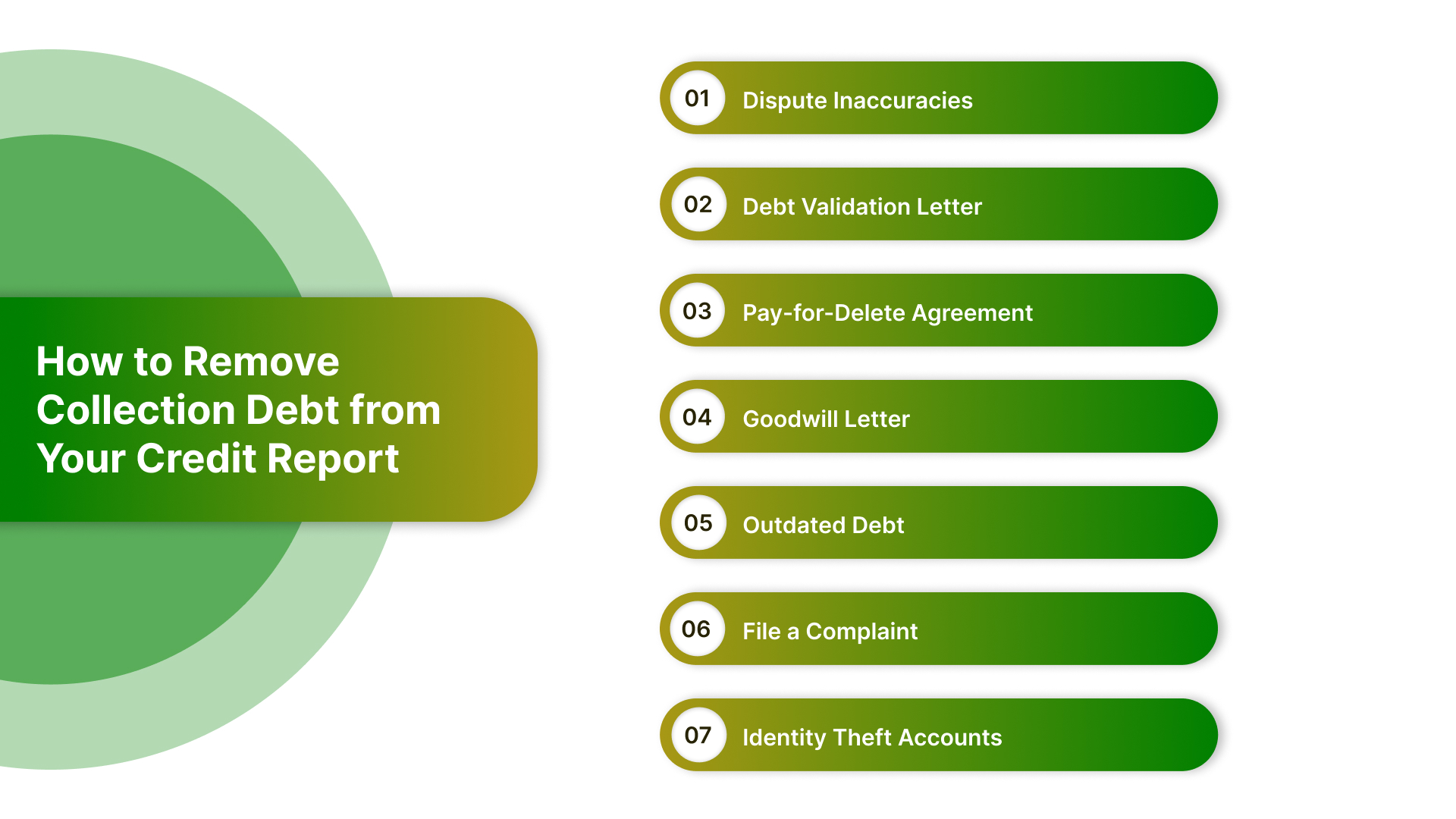
The methods below are the legitimate ways to approach this. Each one works differently depending on the status of your account, so the key is knowing which applies to your situation before taking action.
Dispute Inaccuracies
The most reliable way to remove a collection account is by identifying and disputing incorrect or incomplete information. Credit reporting agencies are required to ensure that all reported data is accurate and verifiable.
Start by reviewing your reports from all three major bureaus through AnnualCreditReport.com. Look closely at:
- Account balances that do not match your records
- Dates of delinquency that seem inconsistent
- Creditor or ownership details that are unclear or incorrect
Once identified, disputes can be submitted online, by mail, or through official channels. After a dispute is filed, the bureau typically has 30 days to investigate. If the collector or creditor cannot verify the information within that timeframe, the account must be corrected or removed.
Send a Debt Validation Letter
If a collection account is recent or unfamiliar, requesting validation is a critical step. This is different from disputing. It directly asks the collector to prove that the debt is legitimate and that they have the authority to collect it.
A proper validation should include:
- The original creditor’s details
- The total amount owed and how it was calculated
- Proof that the account belongs to you
If the collector cannot provide sufficient documentation, they are not allowed to continue reporting or collecting the debt. In such cases, the account may need to be removed from your credit report.
Negotiate a Pay-for-Delete Agreement
A pay-for-delete agreement involves negotiating with the collection agency to remove the account from your credit report in exchange for payment. While this approach is widely discussed, it is not standard practice and is not always accepted.
If you choose to pursue this:
- The agreement must be clearly documented in writing before any payment is made
- Terms should specify that the account will be removed, not just marked as paid
- You should confirm how and when the update will be reflected on your credit report
It is important to understand that many agencies follow reporting guidelines that limit this option, so results can vary.
Send a Goodwill Letter (For Paid Accounts)
If you have already paid the debt, a goodwill request may be an option, although it is not guaranteed. This approach is based on asking the creditor or collector to remove the account as a gesture of consideration.
A goodwill letter typically includes:
- A brief explanation of your situation
- Evidence that the account has been resolved
- A clear and respectful request for removal
This method tends to work in limited cases, often where there is a strong payment history or a reasonable explanation for the delinquency.
Check for Outdated or Expired Debt
Collection accounts are not meant to stay on your credit report indefinitely. In most cases, they must be removed after seven years from the original date of delinquency, regardless of whether the debt has been paid.
It is important to:
- Verify the original delinquency date, not the collection date
- Check for accounts that may have been incorrectly re-aged
- Dispute any listing that remains beyond the allowed reporting period
Outdated accounts are one of the more straightforward cases for removal when identified correctly.
File a Complaint if Necessary
If a dispute or validation request is not handled properly, you have the option to escalate the issue. This is where formal complaints come into play.
The Consumer Financial Protection Bureau (CFPB) allows consumers to file complaints against collectors or credit bureaus that fail to respond, verify, or correct information as required.
This step is typically used when:
- A dispute is ignored or improperly resolved
- A collector continues reporting unverified information
- There is a lack of clear communication or compliance
Escalation often leads to a more formal review of the issue.
Also read: How to Report Fake Debt Collectors and Scams
Handle Identity Theft or Fraud-Related Accounts
If a collection account is the result of identity theft, the process is different and more structured. These accounts are not just inaccurate. They are unauthorized.
To address this:
- File a report through IdentityTheft.gov
- Submit the report along with supporting documents to the credit bureaus
- Request a block or removal of the fraudulent account
Once verified, these accounts are typically removed, as they do not belong to you.
Removing collection debt from your credit report requires precision. The outcome depends on whether the account is accurate, how it is reported, and whether it can be verified.
If your account is being handled by The Forest Hill Management, you are not expected to navigate this process on your own. With clear account verification, transparent communication, and secure payment options, the focus is on helping you understand your situation first, and then move toward resolution in a way that is structured and manageable.
You can review your account, ask questions, and explore repayment options with clarity, so every step you take is informed and aligned with your financial stability.
When Can a Collection Debt Report not be Removed?

There are also situations where removal is not immediate or guaranteed. This is where expectations need to be aligned with how credit reporting actually works:
Accurate and Fully Verified Debt
If the account details are correct and the debt has been properly validated, it is generally allowed to remain on your credit report for the full reporting period. Disputing accurate information will not lead to removal.
Recently Reported Collection Accounts
Newer collections tend to remain visible because they are within the active reporting window. While their impact may reduce over time, they are not typically removed early unless an error is identified.
Paid Collections that Remain Reported
Paying a collection account does not automatically remove it from your credit report. It may change how it is viewed, but the record can still remain unless specific conditions are met.
Valid Accounts without Negotiation Agreements
In some cases, removal may be discussed as part of a negotiated arrangement, but this is not standard practice and cannot be assumed. Without a clear agreement in place, the account will usually remain.
Understanding when collection debt can and cannot be removed is what allows you to focus on the right actions. Instead of relying on assumptions, you can approach the process with clarity, knowing when to dispute, when to verify, and when to move toward resolution.
Rebuilding Credit After Removing Collections
Removing a collection account is a meaningful step, but it is not the final step. Credit recovery depends on what you do after the removal, not just the removal itself.
Once a negative entry is gone, your credit profile has space to improve, but it still needs consistent, positive activity to stabilize and grow.
The focus at this stage shifts from correction to rebuilding trust in your credit behavior.
- Re-establish consistent payment history across all active accounts: Payment history remains the most influential factor in your credit profile. Making on-time payments consistently, even on smaller obligations, helps rebuild credibility over time.
- Keep credit utilization low and controlled: If you use credit cards, maintaining lower balances relative to your limit shows that you are managing credit responsibly. This helps improve your overall profile gradually.
- Avoid taking on unnecessary new debt immediately: After a removal, it can be tempting to use newly available credit. However, adding too many new accounts or balances too quickly can offset the progress you have made.
- Monitor your credit reports regularly for accuracy: Even after removal, it is important to ensure that updates are reflected correctly across all bureaus. This helps you catch any discrepancies early.
- Build stability over speed: Credit recovery is not immediate. A steady pattern of responsible usage over time is what leads to meaningful improvement.
Rebuilding credit is less about quick gains and more about creating a pattern that lenders can rely on.
Conclusion
Removing a collection account is not always about finding a quick solution. It is about understanding what is possible in your specific situation and taking the right steps based on that clarity.
Some accounts can be removed through disputes or verification gaps. Others may remain for a period of time, but can still be resolved and managed in a way that improves your overall financial position. What matters most is approaching the process with the right information, rather than assumptions.
If your account is being handled by The Forest Hill Management, you have a clear and structured way to move forward. From verifying your account details to understanding your options and setting up repayment, the process is designed to help you resolve your balance without unnecessary confusion.
Take the first step toward financial clarity.
FAQs
1. Can a collection account be updated instead of removed?
Yes, in some cases, incorrect details can be corrected rather than the entire account being removed, especially if the debt itself is valid but reported inaccurately.
2. Does the type of debt affect how collections are handled on credit reports?
Yes, certain types like medical debt may follow different reporting timelines and rules compared to credit cards or personal loans.
3. Can multiple collection agencies report the same debt?
No, the same debt should not be reported multiple times simultaneously. If it appears more than once, it may be considered a duplicate and can be disputed.
4. Will removing a collection instantly fix my credit score?
Not necessarily. While removal can help, your overall credit profile depends on multiple factors, including payment history, credit usage, and other accounts.
5. Should I contact the credit bureau or the collection agency first?
It depends on the situation. If you are questioning accuracy, starting with the credit bureau can be effective, while verification-related concerns may require direct communication with the collection agency.