-p-500%20(1).png)
How to Handle Debt Collector Calls Effectively

Need Help Reviewing Your Account?
Contact UsFew things interrupt a day faster than a debt collector call. You are in the middle of work, trying to focus, or handling something at home, and suddenly you are expected to decide what to say, whether the call is real, and what happens next.
You are not the only person dealing with that pressure. The CFPB received approximately 29,618 complaints filed with the CFPB, representing a 11.7% increase from November 2025, which shows just how common this kind of contact is. The good news is that the call itself gives you room to slow things down, ask the right questions, and figure out whether the collector is legitimate and whether the debt is actually yours.
In this blog, we’ll break down how to handle debt collection phone calls effectively, what to say and what to avoid, the rights you can rely on, and how to respond in a way that keeps the conversation calm, clear, and under control.
Key Takeaways
- Debt collection calls follow a regulated process, which means you are not required to respond immediately or make decisions without proper verification.
- Verifying the caller and requesting written validation of the debt should always come before discussing payment or sharing any information.
- Avoiding common mistakes, such as admitting the debt too early or making small payments, helps protect your options and prevents unintended consequences.
- You have clear rights under federal law, including protection from harassment, control over communication, and the ability to dispute the debt.
- Handling the call in a calm and structured way allows you to move from uncertainty to clarity and take the next step with confidence.
Why Would a Debt Collector Call Me?
A debt collector typically reaches out when an account has not been paid according to its original terms. This does not always mean long-term non-payment. In many cases, it simply means that payments have been missed or delayed beyond a certain point.
Some reasons can be:
- The account has become past due: When payments are missed for a period of time, the creditor may assign the account for collection. This is often the most common reason for receiving a call.
- The original creditor has transferred or assigned the account: Instead of continuing to manage the account internally, the creditor may work with a collection agency to handle communication and repayment.
- There is a need to verify or clarify account details: Sometimes the purpose of the call is not immediate payment, but to confirm information, explain the balance, or provide next steps.
- The account requires resolution or repayment planning: The goal of the call is often to help move the account toward closure, whether through full payment or a structured arrangement.
Also read: Collection Debt Agency Contacted You? Here’s What to Know
Receiving a call from a debt collector can feel unexpected, but it is usually part of a standard process. Understanding why the call is happening makes it easier to respond with clarity rather than uncertainty.
What to Do When You Receive a Debt Collection Call?
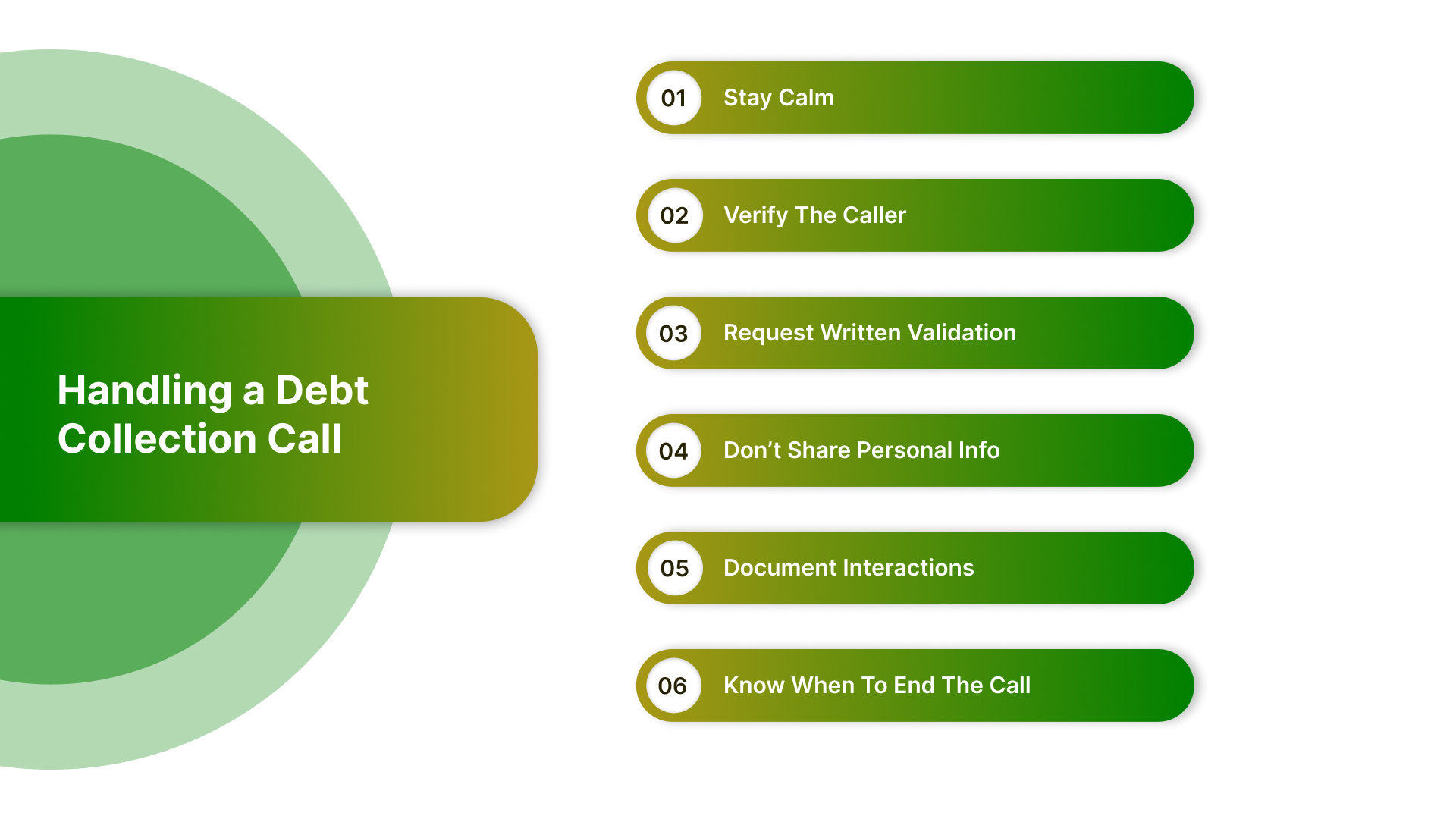
Receiving a debt collection call can feel unexpected, especially if you are unsure about the account or the process. However, these calls follow a regulated structure, which means you are not expected to respond immediately or make decisions on the spot.
The following steps will help you manage the call:
Stay Calm and Do Not React Immediately
The initial response to a debt collection call often determines how the conversation progresses. It is important to approach the call with a neutral and composed mindset rather than reacting based on urgency or stress.
- You are not required to make decisions during the call: Debt collectors may ask for payment or confirmation, but you are under no obligation to agree immediately. Taking time to understand the situation allows you to respond more accurately later.
- Avoid emotional or rushed responses: Reacting quickly can lead to agreeing to terms or sharing information without full clarity. Staying calm ensures that your decisions are based on verified details rather than pressure.
Verify the Caller Before Sharing Anything
Before discussing any details related to the account, you should confirm who you are speaking with. This step is essential to protect yourself from both errors and potential scams.
- Ask for the caller’s name, company, and official contact details: A legitimate debt collector should clearly provide their identity, company information, and a way to reach them through official channels. This helps you confirm that the communication is genuine.
- Treat unclear or incomplete responses with caution: If the caller avoids answering questions or provides vague information, it may indicate that the call is not legitimate. In such cases, it is safer to pause the conversation until verification is possible.
Request Written Debt Validation
Before discussing repayment or acknowledging the account, you have the right to request formal documentation of the debt. This ensures that you are working with accurate and complete information.
- Ask for a written validation notice to be sent to you: This notice should include the total amount owed, the name of the original creditor, and instructions on how to dispute the debt if needed. It provides a clear reference point for your next steps.
- Wait to review the details before taking action: Proceeding without written verification can lead to mistakes or misunderstandings. Reviewing the document allows you to confirm the accuracy of the account before making any commitments.
Do Not Share Personal or Financial Information
Protecting your personal information is a critical part of handling these calls correctly. You are not required to disclose sensitive details during the initial conversation.
- Avoid confirming personal details such as your address, bank information, or employment: Sharing this information prematurely can create unnecessary risks, especially if the caller has not yet been fully verified.
- Do not admit that the debt is yours at this stage: Acknowledging the debt before it is verified can affect how the situation progresses. It is better to wait until you have confirmed all details in writing.
Document Every Interaction
Keeping a record of each interaction helps you stay organized and ensures that you have a clear reference for future discussions.
- Record key details from every call: Note the date, time, caller’s name, company, and contact information so you can track who contacted you and when.
- Summarize what was discussed during the conversation: Writing down the main points helps you avoid confusion later and ensures that you can refer back to accurate information if needed.
Know When to End the Call
You have full control over whether to continue or end the conversation. If the call does not meet basic standards of clarity and professionalism, you are not required to stay on it.
- End the call if you feel pressured to act immediately: Legitimate processes allow time for review and do not require instant decisions. Pressure is a sign to step back and reassess.
- Disconnect if the caller behaves unprofessionally or refuses to provide information: Clear and respectful communication is a requirement, and you are not expected to engage in conversations that do not meet this standard.
Handling a debt collection call in this way allows you to stay informed, protect your information, and move forward with clarity instead of uncertainty.
If your call is from The Forest Hill Management, the process is designed to be transparent and structured. You can take your time to review your account details, request verification, and explore repayment options through secure and official channels, without being expected to decide everything during a single call.
What NOT to Do on a Debt Collection Call?
Knowing what to avoid during a debt collection call is just as important as knowing what to say. Small missteps, especially early in the conversation, can limit your options, create confusion, or lead to decisions that are difficult to reverse. The goal is to stay measured, informed, and in control of the process.
- Do not agree to payment immediately: Even if the request sounds straightforward, agreeing to pay on the spot can lock you into terms you have not fully reviewed. It is important to first verify the debt, understand the details, and assess what you can realistically afford before committing to anything.
- Do not admit that the debt is yours without verification: Acknowledging the debt too early can affect how the situation progresses and may limit your ability to dispute inaccuracies later. Always wait until you have received and reviewed proper documentation before confirming responsibility.
- Do not make small “good faith” payments without understanding the impact: Making even a small payment can sometimes restart the statute of limitations on a debt, which affects how long it can be legally pursued. Before making any payment, it is important to understand the legal and financial implications of doing so.
- Do not ignore repeated calls entirely: While you are not required to engage immediately, completely avoiding communication can lead to missed information and fewer opportunities to resolve the account on your terms. A better approach is to respond when you are prepared, with the right questions and understanding in place.
Also read: Understanding Debt Resolution and Collection Processes
Approaching the call with this level of awareness helps you avoid common mistakes and ensures that your next steps are informed, deliberate, and aligned with your situation.
Your Rights When Dealing With Debt Collectors

Debt collection is regulated, which means you are not expected to simply accept whatever a caller says. Federal rules and rights give you the right to know who is contacting you, what debt they are talking about, and how you can challenge it if something looks wrong:
Your Right To Know Who is Calling and Why
When a collector first contacts you, they are generally required to provide key information about the debt, including the name of the creditor, the amount owed, and how you can dispute it. If they do not provide this during the initial contact, they must send a written notice within five days. If that information is missing, vague, or inconsistent, the CFPB says that can be a warning sign of a scam.
That means you can pause the conversation and ask for details before going any further. A legitimate collector should be able to identify the company, provide contact information, and explain the debt clearly. If they refuse to do that, you do not need to keep engaging on the call.
Your Right to Dispute the Debt and Request Verification
Once you receive the validation information, you generally have 30 days to dispute the debt in writing. If you dispute it within that window, the collector must stop collection activity until they provide verification of the debt. That verification is meant to confirm that the account is accurate and that the collector has the right information.
This is one of your most important protections, because it gives you time to check whether the debt is actually yours, whether the amount is correct, and whether the account was handled properly before it reached collections. If you still do not agree after verification, you can continue to dispute the debt in writing.
Your Right to Limit or Stop Communication
You can tell a collector not to contact you again by writing to them, and you can also ask them to contact you only by mail or to stop calling at certain times or places. Once they receive that request, they are generally limited in how they can continue reaching out, although they may still be allowed to contact you for specific legal reasons.
You also have protections around how collectors contact you. They generally cannot call before 8 a.m. or after 9 p.m., and they cannot contact you at work if they know or have reason to know that your employer does not allow it. The CFPB also says you can ask them to call at a more convenient time or place if the current contact method is a problem.
Your Right to Fair Treatment
Collectors are not allowed to harass, oppress, or abuse you. They cannot use obscene language, make repeated calls simply to annoy you, threaten violence, lie about what you owe, pretend to be attorneys, or threaten arrest when that is not real. These limits are part of the FDCPA and the CFPB’s debt collection rules.
This matters because a collector’s tone can be intimidating even when the account itself is legitimate. The law is designed to keep the process professional, which means you do not have to tolerate pressure, deception, or bullying to move the situation forward.
Your Right to Understand the Statute of Limitations
One of the most important, and often overlooked, rights relates to how long a debt can be legally enforced. The statute of limitations limits how long a debt can be pursued through legal action. This time frame varies by state and type of debt, but once it expires, collectors generally cannot sue you to recover the balance.
Certain actions can restart this time period. Making a payment or acknowledging the debt in some cases may reset the statute of limitations, which is why it is important to verify the account fully before taking action.
Your Right to Keep Records and Complain If Needed
If you are contacted by a collector, it is smart to keep a record of the call, including the date, time, company name, the person you spoke with, and what was said. The CFPB specifically recommends documenting communications because those records can help if you later dispute the debt, speak with a lawyer, or file a complaint.
If a collector violates the rules, you can file a complaint with the CFPB and, depending on where you live, your state Attorney General’s office. That gives you a formal path to report harassment, misleading statements, or repeated contact that crosses the line.
Taken together, these rights give you a clear framework: verify first, respond in writing when needed, set communication boundaries, and document everything. That approach keeps the conversation grounded in facts instead of pressure, which is exactly where it should stay.
Conclusion
Debt collection calls can feel uncomfortable, but they do not have to feel uncertain. Once you know what to ask, what to avoid, and how to pace the conversation, the call becomes less about pressure and more about clarity.
You are not expected to resolve everything in one conversation. What matters is taking the right steps in the right order, verifying the details, protecting your information, and responding when you are ready.
If your account is being managed by The Forest Hill Management, you have a structured and transparent way to move forward. With clear communication, verified account details, and secure repayment options, the process is designed to help you resolve your balance without confusion or unnecessary pressure.
Take the first step toward financial clarity.
FAQs
1. Should I call a debt collector back if I miss their call?
Yes, but only after verifying the contact details independently. It is better to return the call on your terms rather than responding immediately without preparation.
2. Can I ask a debt collector to communicate only through email or mail?
Yes, you can request specific communication methods in writing, which helps you review information more carefully and maintain records.
3. What if multiple collectors contact me about the same debt?
You should verify each claim carefully, as debts can be reassigned. Always request validation from each party before taking any action.
4. Can a debt collector discuss my debt with family members?
Collectors are generally not allowed to share details about your debt with others, except in very limited circumstances, such as locating you.
5. What should I do if I feel overwhelmed during the call?
You can end the call politely and revisit it later. Taking time to gather information and respond calmly is always a better approach than reacting under pressure.