-p-500%20(1).png)
Why One-Size-Fits-All Debt Solutions Don't Work for Real Relief

Need Help Reviewing Your Account?
Contact UsYou have probably seen ads for “simple” solutions that claim to fix every type of debt. But real life is never that simple. According to Bankrate’s 2025 Credit Card Debt Survey, 46 percent of credit cardholders carry a balance, and 23 percent believe they may never pay it off.
Numbers like these indicate that people are struggling not because they lack discipline, but because most traditional one-size-fits-all debt solutions don't work. This guide explores why generic programs fall short and what meaningful, personalized debt relief actually looks like.
Brief breakdown:
- One-size-fits-all plans overlook real-life complexity. Standardized solutions often fail because they do not account for income timing, emergencies, or personal responsibilities.
- Personalized strategies create sustainable progress. Tailoring repayment to your cash flow, priorities, and stability level makes long-term consistency possible.
- Flexible approaches are more effective than rigid rules. Methods that adjust to life changes reduce stress and prevent setbacks from becoming new debt.
- Small buffers and quarterly reviews strengthen stability. Protective savings and regular check-ins keep your plan resilient and responsive over time.
- Understanding your own borrower profile is essential. Knowing your income pattern, debt mix, and household needs helps you choose the right tools and avoid ineffective generic plans.
The Problem With One-Size-Fits-All Debt Solutions
Debt is personal, and any solution that ignores your actual circumstances risks making things harder instead of easier. Real life is unpredictable, and a rigid program cannot adjust when you need to reshuffle priorities.
These are the common problems with standardized debt relief approaches:
- Fixed payment expectations that do not reflect irregular or unstable income.
- Uniform timelines that ignore differences in interest rates or debt types.
- Rigid budgets that leave no room for emergencies or rising costs.
- No accommodation for childcare, medical needs, or other personal responsibilities.
- Limited flexibility when life changes and the plan cannot adapt.
Debt Management Plans (DMPs) are a good example. They can be helpful for some people, but they are still based on standard payment structures that do not always align with every borrower’s situation.
A debt management plan is only as effective as its fit with the person’s financial reality. When plans are not tailored, people often feel pressured, fall behind, or drop out. This is not because they have failed, but because the plan did.
This is why personalization matters so much. In the next section, we will look at how borrower profiles shape the debt solutions that actually work.
Suggested Read: A Beginner’s Guide to Debt Management Strategies
Why Your Borrower Profile Shapes What Works
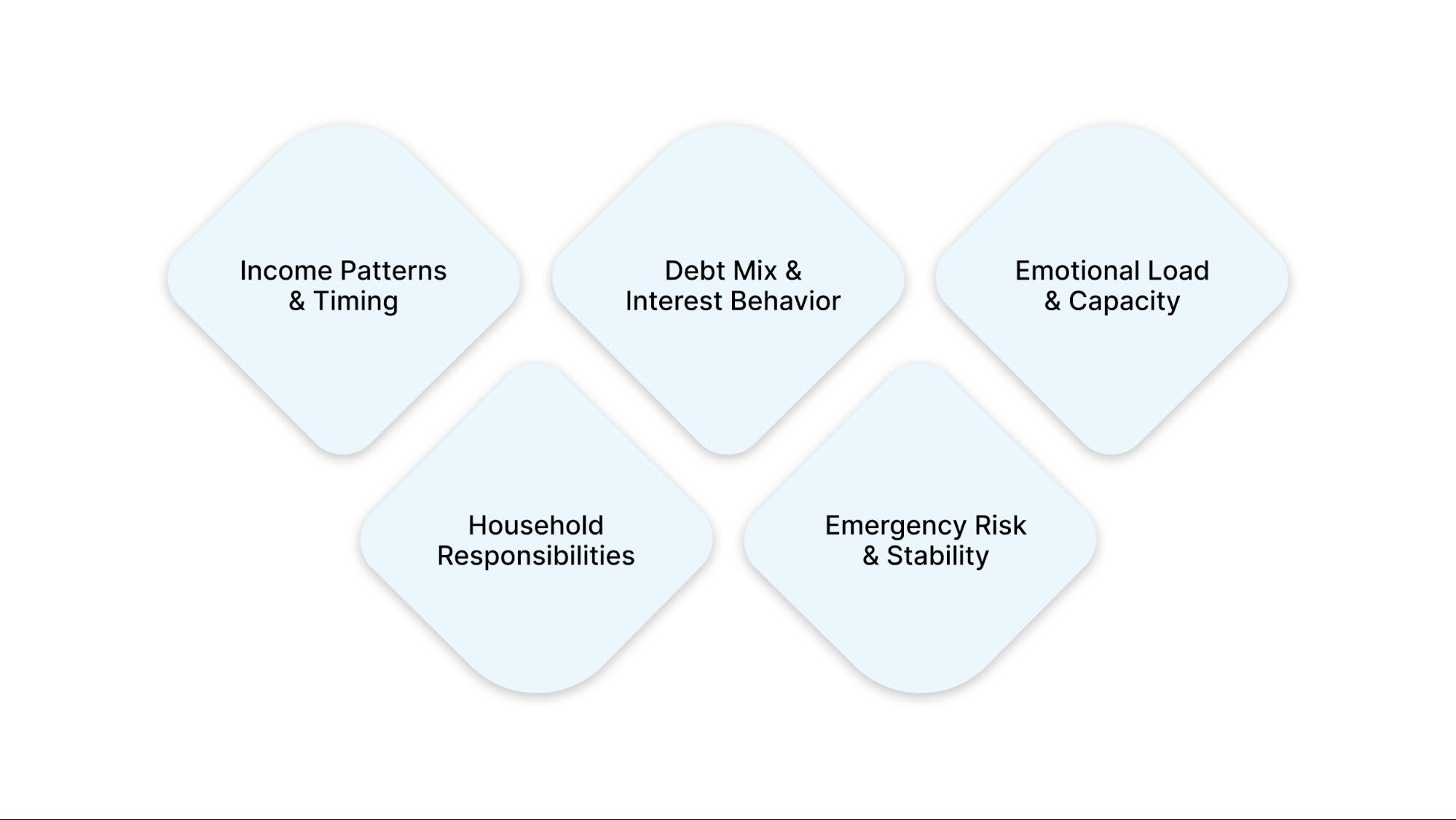
Your repayment success depends on factors that a uniform program simply cannot capture, such as how often you are paid, who depends on you, and what your financial pressure points look like.
As financial planner Carl Richards said, “Risk is what is left over when you think you’ve thought of everything.”
Your unique profile determines what risks you face and what solutions actually work.
These borrower differences shape every part of a debt plan:
- Income Patterns and Timing: The way your income arrives, weekly, biweekly, irregular, or seasonal, determines what payment schedules are sustainable.
- Household Responsibilities: Childcare, medical costs, caregiving, or shared bills change how much flexibility you realistically have in your budget.
- Debt Mix and Interest Behavior: High-interest credit cards, medical bills, auto loans, and personal loans each behave differently and require different strategies.
- Emergency Risk and Stability Level: Some households face higher unpredictability, and plans need buffers to prevent setbacks from turning into new debt.
- Emotional Load and Stress Capacity: Anxiety, burnout, and decision fatigue affect how consistently someone can follow a structured plan.
Forest Hill Management supports an individualized approach because we focus on your real-life circumstances rather than one-size-fits-all templates. Our advisors listen to your situation and help build a repayment plan tailored to your budget, timing and goals. We will help you plan in a way that fits your life, rather than forcing you into a one-size-fits-all template. Speak to us today.
Now that we have explored why borrower differences matter, let’s review the debt relief tools available and how they fit different financial situations.
Suggested Read: Top 10 Money Management Tips to Help You Take Control
Basic Debt Relief Options and How They Work
There are several debt relief tools available, but each one works best only under certain conditions. These options can be useful starting points, yet they are often built using standardized structures that do not adjust to your income pattern, financial responsibilities, or risk level.
Table with regular debt relief options:
Even though these tools exist, they are still standardized frameworks that assume the borrower fits a narrow profile. Real life rarely matches those assumptions.
For example, consider a borrower who earns a stable salary but also cares for an aging parent. A DMP might technically fit on paper, yet rising medical expenses or last-minute caregiving costs can disrupt the fixed monthly payment.
One study found that caregiving families spend an average of $7,200 per year out of pocket, which directly impacts their ability to adhere to rigid financial plans.
This is exactly why many people begin these programs but cannot continue. The plan is not built around the realities of their life.
To find real, lasting relief, you need tools that adjust to your financial reality, rather than locking you into a rigid formula. In the next section, we will explore different strategies and approaches.
Suggested Read: Is Paying Debt Collection Agencies a Bad Idea?
Debt Relief Approaches That Adapt to Your Financial Reality
Most people think debt relief is about choosing the “right program,” but the real power comes from choosing an approach that matches your actual life.
A good comparison is the 50/30/20 budgeting structure. It works because it adjusts to different incomes and responsibilities. Debt relief should function the same way: flexible, structured, and responsive to your personal circumstances.
Each of these approaches is designed to be practical right away.
1. Flexible Repayment Ladders
A flexible ladder adapts both to psychology and math. Start by creating a prioritized list of accounts, then split the difference between momentum and interest savings to achieve emotional wins while reducing total costs.
Actions to take to build a flexible ladder:
- Match your ladder to cash flow: choose weekly, biweekly, or monthly targets based on pay timing.
- Combine psychology and math: pay the two smallest balances first, then attack the highest APR.
- Rebalance quarterly when balances, rates, or income change.
When you follow this method, the momentum of small wins sustains behavior while the later avalanche phase saves interest. Track the exact dollars freed by each payoff and automatically commit those amounts to the next target, allowing the ladder to truly compound.
2. Income-Based Budget Structuring
Align payments to cash arrival, not arbitrary calendar dates. This reduces missed payments, avoids overdrafts, and makes budgeting realistic for people with irregular or gig income.
How to tailor your budget to real income:
- Create a pay-period ledger that maps each paycheck to specific bills and a fixed debt contribution.
- Convert large bills into pay-period micro-payments so they never shock a single period.
- Use a rolling buffer account sized to one pay period’s essential spending to smooth timing gaps.
When your schedule aligns with your finances, you avoid the cycle of borrowing to bridge gaps. A simple spreadsheet that shows each paycheck, assigned bills, and leftover for debt will reveal where even small reallocations produce immediate extra repayment capacity.
3. Cushion Building for Stability
Cushions are not long-term savings targets; they are tactical shock absorbers. The goal is to stop emergencies from turning into high-cost credit events, not to reach a six-month ideal overnight.
Tactical steps to build usable cushions quickly:
- Start a $500 rapid-response fund, then add targeted sinking funds for known large costs.
- Automate a small portion of every deposit to these accounts so they grow automatically.
- Keep cushion funds in a liquid, separate account and label them accordingly (e.g., car, medical, rent).
This approach prevents a single unexpected payment from erasing months of hard work and progress. By separating funds and automating deposits, you preserve your payoff momentum while reducing the need to take on new debt.
4. Quarterly Adjustments and Resets
Quarterly reviews are not bureaucratic; they are survival tools. They force you to update priorities, capture windfalls, and reassign resources before small deviations become big problems.
What to check each quarter and why it matters:
- Recompute effective interest cost per account (daily cost = balance × APR / 365) to rank targets.
- Recalculate the realistic surplus after accounting for essentials and sinking funds to set next-quarter payoff goals.
- Scan for one-time opportunities: renegotiated rates, promotions, and tax refunds to accelerate repayment.
Doing this allows you to pivot quickly to the highest-leverage moves rather than react when the pressure mounts. When you quantify which single action shortens your payoff most, rate negotiation, extra income, or cutting a recurring expense, you know exactly where to focus your effort that quarter.
5. Communication-First Planning
Proactive communication converts adversarial moments into manageable conversations. Reaching out early to explain temporary hardship often yields fee waivers, payment pauses, or modified terms that preserve options.
How to practice communication-first planning effectively:
- Prepare a short financial snapshot and a proposed plan before contacting creditors or servicers.
- Ask specifically for options: temporary reduced payment, interest repricing, or a formal forbearance.
- Get any agreement in writing and schedule a calendar reminder to follow up.
Forest Hill Management offers flexible repayment plans aligned with your income timing and obligations—not a generic formula. Our communication-first approach helps you adapt your plan when life changes. Our guidance makes it easier to sustain long-term debt management plans.
The next section will show you how to convert these approaches into a step-by-step roadmap tailored to your situation.
Steps to Personalize Your Own Debt Plan
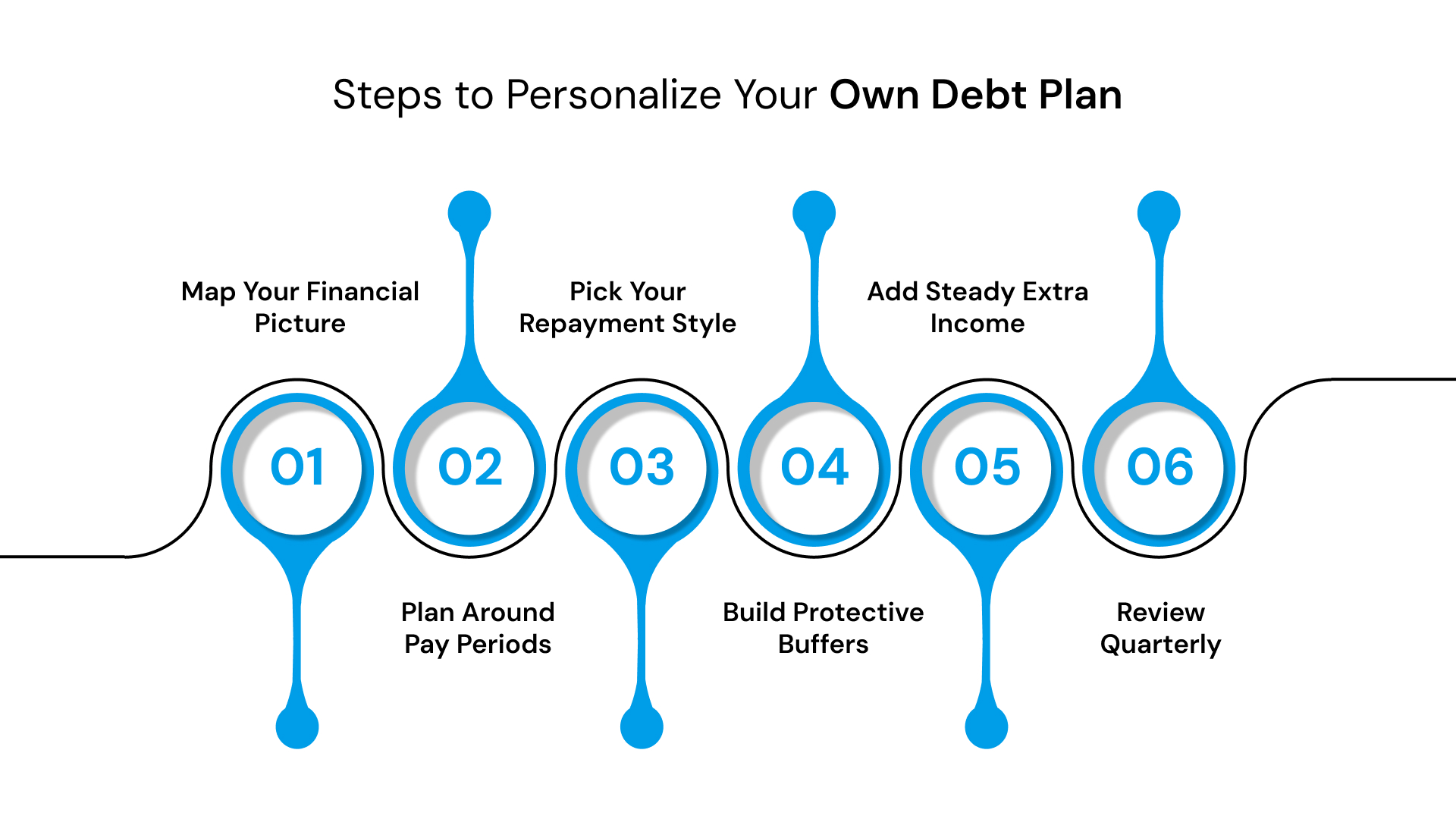
A personalized debt plan works because it is built around your numbers, your responsibilities, and your capacity. Think of it as designing a system rather than forcing yourself into one.
These steps will help you build a plan that fits your reality:
- Map Your Complete Financial Picture With Precision
- List every balance, APR, due date, minimum payment, and the daily interest cost for each account. This provides a clear baseline and reveals which debts incur the highest costs per day, not just per year. Knowing these numbers helps you target changes that save the most money with the least effort.
- Structure Your Cash Flow Around Pay Periods, Not Months
- Align every payment with the actual arrival of money to prevent timing gaps, overdrafts, and mid-cycle stress. Divide large bills into pay-period contributions so no single paycheck takes the hit. This reduces volatility and makes your plan easier to stick to.
- Choose the Repayment Method That Fits Your Psychology and Math
- If you need motivation, start with smaller balances; if you want maximum savings, target the highest interest rate. A hybrid approach often works best because it blends momentum and efficiency. The right method is one that you can follow consistently every month without experiencing burnout.
- Build Small, Functional Buffers to Protect Your Plan
- Start with a rapid-response fund and expand into sinking funds for known future expenses. This prevents emergencies from derailing your progress or forcing you to rely on credit. A protected plan stays intact even when life becomes unpredictable.
- Add One Dependable Income Layer to Create Breathing Room
- Look for something small and consistent: overtime, small services, gig work, or a shift that does not overwhelm you. Even an extra $ 50–$ 100 per pay period can meaningfully shift your payoff timeline. Extra income is a lever that amplifies every other step.
- Review Quarterly and Adjust With Intention
- Every three months, recalculate balances, update interest rankings, and check your budget against real results. Identify one high-impact change (renegotiating a rate, adding a small buffer, adjusting an expense). Quarterly adjustments keep your plan responsive so it never becomes outdated.
It is completely normal to make mistakes when managing debt. Most people are trying their best with tools that were never designed for their real lives. Forest Hill Management understands this and supports you with flexible repayment plans, clear communication, and personalized pacing so you can move forward confidently.
Suggested Read: How Does Debt Consolidation Affect Your Credit Score?
Forest Hill Management Supports Personalized Debt Solutions
Forest Hill Management is a receivables-management organisation that believes real relief comes from plans built around individuals and their unique budgets, not off-the-shelf templates. We understand that every person’s income, household, responsibilities, and challenges are different, which is why we focus on individualized support rather than standardized systems.
Our goal is to make your debt repayment manageable, predictable and respectful every step of the way. These are a few ways we make personalized debt payments possible:
- Custom Repayment Plans: Your payment schedule is built around your income timing, budget, and real-life obligations, so it feels sustainable, not stressful.
- Flexible Payment Options: We offer multiple ways to make payments and adjust schedules when life becomes unpredictable, which helps you stay consistent long term.
- Clear, Supportive Communication: You receive simple updates, reminders, and guidance so you always know where you stand and what to expect next.
- Respectful, Judgment-Free Support: Our team approaches every situation with understanding and empathy. You are treated as a person, not a balance sheet.
- Long-Term Stability Over Quick Fixes: We focus on strategies that support slow, steady progress rather than short-term pressure or unrealistic targets.
Paying off debt becomes manageable when you have a plan shaped around your life instead of a one-size-fits-all mold. With patience, structure, and steady guidance, you can move toward a future that feels lighter, clearer, and financially stable.
Conclusion
One-size-fits-all debt solutions often fall short because they ignore the realities of daily life. Personalized plans, on the other hand, create room for flexibility, stability, and progress. When a debt plan reflects who you are and how you live, it becomes something you can follow with confidence rather than pressure.
Forest Hill Management supports debt repayment by building individualized plans that adapt to your needs and circumstances. With flexible payment options, supportive communication, and long-term structure, you can work toward reducing your debt without feeling overwhelmed or alone.
Take a moment to review your current plan. See where personalization can make your next steps easier. Get in touch with us today.
Frequently Asked Questions
1. What’s the worst a debt collector can do?
Debt collectors can contact you, report your account to credit bureaus, and pursue legal action if the debt is valid and unpaid. They cannot harass you, threaten you, or take money without a legal judgment. Your rights are protected under the Fair Debt Collection Practices Act (FDCPA).
2. Do debt relief programs really work?
They work when the program matches your financial reality, income pattern, and goals. Personalized programs are more effective than standardized ones because they adjust to your capacity. The right plan depends on your debt mix, interest rates, and monthly stability.
3. Why do I keep getting denied for debt consolidation?
Lenders often deny consolidation loans if your credit score is low, your income is unstable, or your debt-to-income ratio is too high. Some lenders also have strict minimum credit requirements. A personalized repayment plan may be more realistic than a loan in this situation.
4. Can I reduce debt without hurting my credit score?
Yes, if you focus on consistent payments, negotiation, and structured budgeting. Late payments and high utilization hurt scores more than responsible debt reduction. Personalized payment schedules help protect your credit during repayment.
5. How long does it take to see real progress with a custom debt plan?
Most people see early progress within the first one to three months as balances start to shift and routines stabilize. Real transformation happens over several cycles of consistent action. Quarterly reviews help you measure improvement and stay motivated.